Circadian Disruption Drives Inflammatory Acne
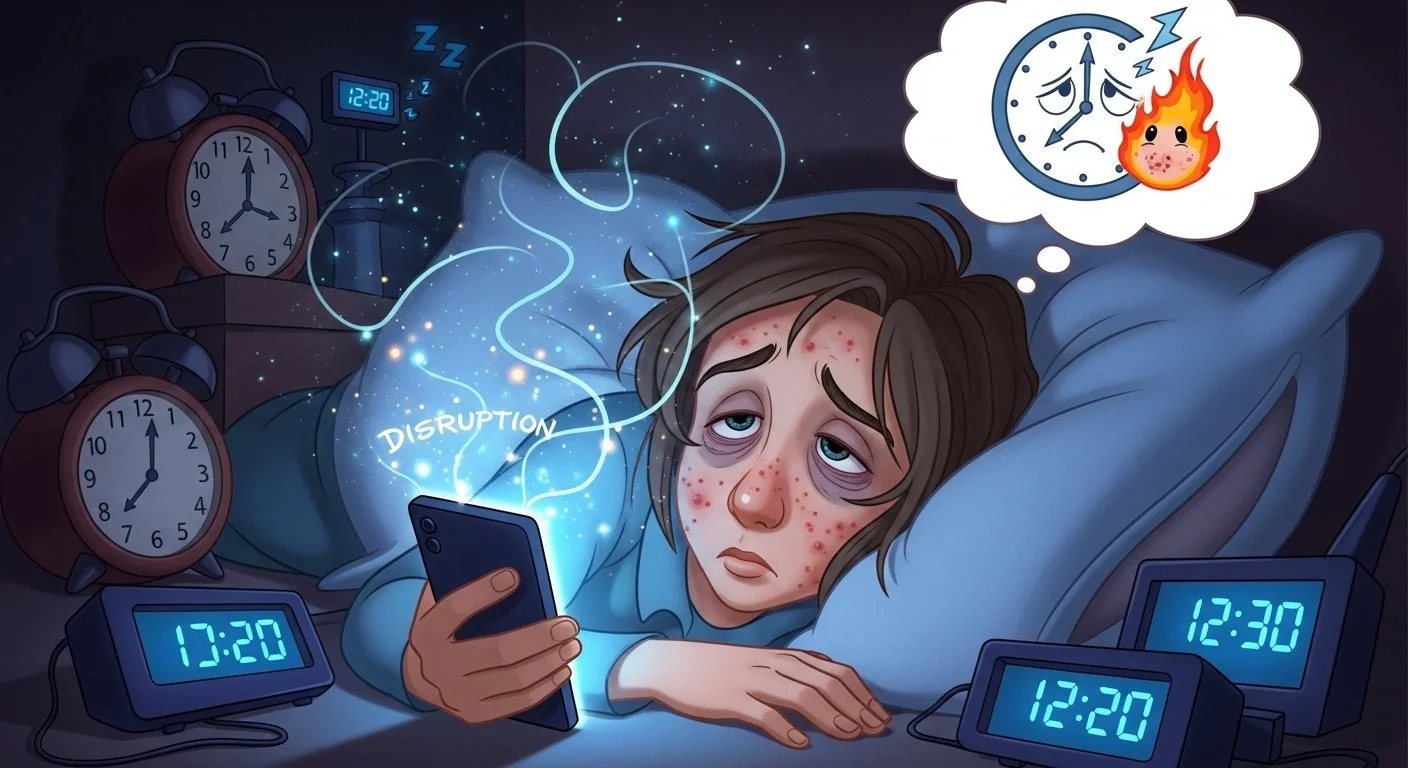
A landmark 2023 study published in Nature Communications demonstrate that human skin cells possess "autonomous peripheral clocks" that dictate everything from oil production to DNA repair—independent of the brain. This means that even if you feel rested, staying up under blue light or eating late-night meals creates a "molecular desynchrony" in your pores. It also may suggest to the dermatologists: acne severity isn't just about bacteria; it’s also a consequence of disrupted circadian clocks.
The Clock Regulation on Sebocytes (Oil Factories)
At the heart of acne severity is the sebocyte—the cell responsible for producing sebum (oil). Recent research has identified that these cells are governed by specific "clock genes," notably BMAL1 and CLOCK. Under a healthy circadian rhythm, sebum production follows a rhythmic peak, typically in the early afternoon, to provide a protective barrier against the day's environmental stressors.
When circadian disruption occurs—such as staying awake during biological night—the clock regulation on sebocyte is disrupted. Sebocyte begin to over-produce lipids (fats) at the wrong time. This "irregulated oil" is thicker and more prone to becoming trapped in the follicle, creating the initial plug that leads to severe, inflammatory acne.
Circadian Disruption Increases Risk in Dehydration and Clogs
Your skin barrier is not a static wall; it is a dynamic system that changes its permeability based on the time of day. This is measured as Transepidermal Water Loss (TEWL). In a healthy cycle, TEWL increases at night, allowing the skin to "breathe" and repair.
However, circadian disruption causes this permeability to stay high at the wrong times. When your rhythm is broken, the skin loses moisture too rapidly. To compensate for this rapid dryness, the skin triggers an emergency inflammatory signal that causes hyperkeratinization—the rapid shedding of skin cells that don't fall off, but instead "glue" together inside the pore. By losing the rhythm of the barrier, you create a cycle where the skin is simultaneously dehydrated and clogged, leading to the "angry," red acne characteristic of sleep-deprived individuals.
Late-Night Meal Increases Acne Severity
Your skin’s clock isn't just set by light; it’s also set by when you eat. When we consume high-glycemic food during our "biological night," it triggers a massive release of Insulin-like Growth Factor 1 (IGF-1).
In a synchronized body, IGF-1 levels stay stable at night. But a 2024 review in Nutrients highlighted that late-night insulin spikes talk directly to the mTORC1 pathway in our skin. This pathway is a master regulator of cell growth. When it is activated at night due to irregular eating, it forces the skin to produce more sebum and more skin cells simultaneously.
This "double-whammy" underlies irregular meal timing should be considered a clinical risk factor for increased acne severity.
The Cytokine Storm
Finally, we must address the immune system's timing. Our body's pro-inflammatory signals, known as cytokines (specifically IL-1α), follow a strict circadian rhythm. They are designed to be high during the day to fight off bacteria and low at night to allow for tissue healing.
Circadian disruption inteferes this "cool down" phase. When the internal clock is broken, the body stays in a state of "pro-inflammatory readiness."
For an acne sufferer, this means that even a minor clogged pore is treated by the immune system like a major infection. The result is severe inflammation: swelling, redness, and pain. Research from 2023 shows that patients with "irregular sleep-wake phases" have significantly higher levels of inflammatory markers in their skin tissue.
Conclusion
Achieving clear skin is no longer just about the products you apply to the surface; it is about the timing of the life you lead. The molecular evidence is clear: your skin is a rhythmic organ that thrives on predictability. When you align your light exposure, your eating windows, and your rest with your biological blueprint, you empower your skin's "peripheral clocks" to function correctly. By fixing the clock, you stop fighting a losing battle against inflammation and start supporting your skin’s natural, built-in system for clarity and health.
-
Lyons, A. B., Moy, L., Moy, R., & Tung, R. (2019). Circadian Rhythm and the Skin: A Review of the Literature. The Journal of Clinical and Aesthetic Dermatology, 12(9), 42–45. (Note: Baseline study for modern skin-clock theory).
Dong, K., Goyarts, E. C., Pelle, E., Trivero, J., & Yarosh, D. B. (2019). Blue light disrupts the circadian rhythm and create damage in skin cells. International Journal of Cosmetic Science, 41(6), 558–562.
Dufour, C. R., et al. (2023). Circadian rhythms in human skin: autonomous and systemic signaling. Nature Communications, 14(1), 1210. [Link: https://www.nature.com/articles/s41467-023-36881-2]
Patwardhan, A. R. (2024). The Skin-Metabolism Axis: Chrono-nutrition and its impact on acne vulgaris. Nutrients, 16(4), 582.
Matsui, M. S. (2020). Analysis of circadian genes and reactive oxygen species in skin. Journal of Investigative Dermatology Symposium Proceedings, 20(1), S20–S22.