Can You Train to Sleep Less? The Science Behind Natural Short Sleepers
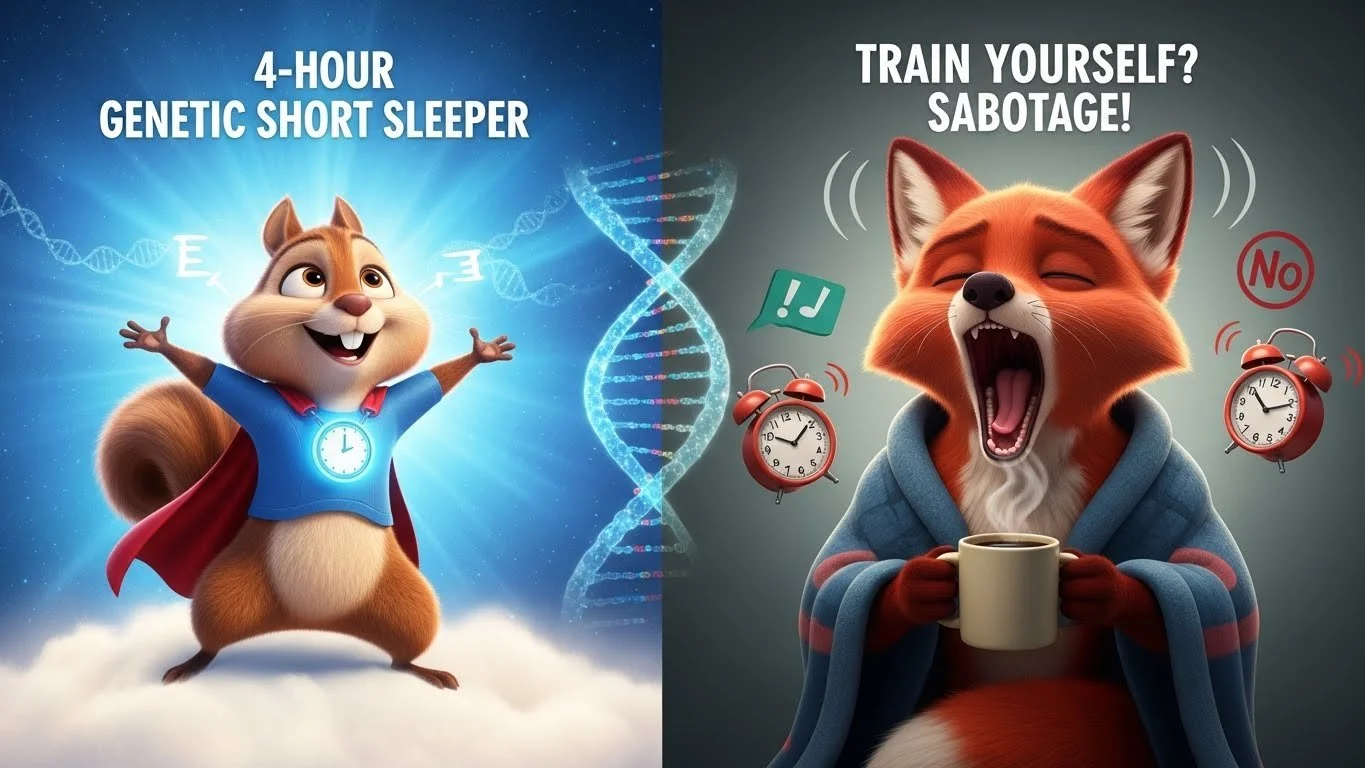
We have all felt the "time crunch." You have a big project at work, a family to care for, and a list of hobbies you never get to. If only you could skip those eight hours of sleep and still feel great! Most of us feel like zombies after a short night, but a tiny group of people—the Natural Short Sleepers—thrive on just four hours. In this article, you will discover if this "superpower" is hidden in your DNA and why trying to "train" yourself to sleep less might actually be sabotaging your success.
What Exactly Is a Natural Short Sleeper?
A Natural Short Sleeper is someone who can function at 100% capacity on significantly less sleep than the average person. While the National Sleep Foundation recommends seven to nine hours for adults, these individuals feel completely refreshed after four to six hours.
Crucially, this isn't about "getting by." We’ve all used coffee to survive a four-hour night, but Natural Short Sleepers don't need the caffeine. They don’t experience the brain fog, irritability, or physical exhaustion that usually follows a short night. Scientists call this "Familial Natural Short Sleep" (FNSS) because it often runs in families. If your grandmother was a high-energy "night owl" who was up at dawn, you might have inherited this rare biological gift.
Is the Secret to a 4-Hour Night Hidden in Your DNA?
The short answer is: Yes. For decades, scientists thought these people were just lucky or had incredible willpower. However, recent breakthroughs in genomic medicine have proven that sleep duration is largely written in our code.
Being a Natural Short Sleeper isn't a choice; it’s a mutation. In science, a "mutation" sounds scary, but in this case, it’s like a software upgrade. Research from the University of California, San Francisco, has shown that these individuals have specific changes in their genes that allow their brains to perform "overnight maintenance" much faster than the rest of us.
Think of your brain like a city. At night, the "cleaning crews" come out to wash the streets and pick up the trash. For most of us, that crew takes eight hours. For Natural Short Sleepers, the crew is twice as fast and twice as efficient. They get the same amount of cleaning done in half the time.
Meet the "Sleeper DNA": The Key Genes Behind Short Sleep
Researchers have identified several "short sleep genes." Here are the three most important ones discovered or studied in depth over the last few years:
1. The ADRB1 Gene
This gene was a major discovery in the field of sleep genetics. Researchers found that a mutation in the ADRB1 gene makes the brain’s "wakefulness" centers more active. In studies, mice with this mutation woke up more easily and stayed awake longer without showing signs of tiredness. In humans, this means the brain stays in an "alert" state more efficiently, reducing the biological "pressure" to fall back asleep.
2. The DEC2 (BHLHE41) Gene
This was one of the first genes linked to short sleep. It helps regulate orexin, a hormone in the brain that keeps you awake. People with a mutation in DEC2 produce more orexin or are more sensitive to it. This acts like a natural, built-in energy boost that doesn't "crash" like a cup of coffee does.
3. The NPSR1 Gene
A 2020 study published in Science Translational Medicine highlighted the NPSR1 gene. This gene is fascinating because it doesn't just shorten sleep; it appears to protect the brain. Normally, when you don't sleep enough, your memory suffers. However, individuals with the NPSR1 mutation were found to be resilient to memory loss. Their brains could store new information perfectly, even after a very short night.
Can You "Train" Your Body to Be a Natural Short Sleeper?
This is the question every "hustle culture" enthusiast asks. Can you slowly cut back your sleep by 15 minutes every week until you hit four hours?
The scientific consensus is a firm No.
Sleep duration is a "hard-wired" biological trait, much like your height or your eye color. You cannot "train" your body to need less sleep any more than you can train yourself to be six inches taller. When people try to force themselves into a 4-hour schedule without the specific Natural Short Sleeper genes, they enter a state of chronic sleep deprivation.
While you might feel like you are getting used to less sleep, your brain is actually just losing its ability to monitor how impaired it is. Studies show that sleep-deprived people perform poorly on cognitive tests but report feeling "fine." You aren't becoming a short sleeper; you are just becoming bad at realizing you're tired.
The High Cost of Trying to Cheat Your Biology
If you don't have the "Shorter Sleeper" genes, forcing a 4-hour night carries heavy risks. While Natural Short Sleepers are protected by their DNA, the rest of us face severe consequences when we cut sleep short.
Visceral Fat Accumulation: A study published in JAMA Network Open and corroborated by Mayo Clinic research shows that sleep-deprived people eat more calories and store that energy as "deep" belly fat, which is dangerous for the heart.
Heart Health: Without the genetic protection, sleeping less than seven hours is linked to higher blood pressure and a higher risk of heart attacks.
Brain Health: For the average person, "cleaning" the brain takes time. Cutting sleep short leads to a buildup of toxic proteins, which can increase the risk of dementia later in life.
Why Quality Always Beats Quantity
Instead of trying to sleep less, the real "success hack" for the average person is to sleep better. If you can't change your genes, you can change your sleep efficiency. By focusing on a dark, cool room and a consistent schedule, you can ensure that the seven hours you do get are as restorative as possible.
Remember, the goal of sleep isn't just to "turn off." It is to repair your heart, clear your brain, and lock in your memories. For a Natural Short Sleeper, that happens in a sprint. For the rest of us, it’s a marathon. Respect your biology, and your body will reward you with the energy you need to win the day.
How Do You Know if You’re a Genetic Short Sleeper?
Since we can't all get full genomic sequencing, how can you tell if you are one of the lucky ones? Look for these three signs:
The "No-Alarm" Test: You consistently wake up after 4–6 hours feeling fully alert without an alarm clock, even on weekends.
No "Catch-Up" Needed: You don't feel the need to sleep in on Saturdays or take long naps to "recharge."
Consistent Energy: You don't experience the 2:00 PM "slump" and don't rely on multiple cups of coffee to get through the day.
If you don't fit this description, your body is telling you that it needs the full seven to nine hours to keep you healthy and successful.
Conclusion
The dream of the 4-hour night is a reality for a very small number of people, thanks to unique mutations in genes like ADRB1 and DEC2. These "Elite Sleepers" are a marvel of nature, but they are the exception, not the rule. For the vast majority of us, the path to success isn't through sleeping less—it's through sleeping smarter.
Stop trying to fight your DNA. Instead of cutting hours to gain time, invest in high-quality sleep to gain clarity and longevity. Your brain is your most valuable asset; give it the time it needs to stay sharp. Tonight, put away the phone, dim the lights, and give your body the full rest it deserves. Your future self will thank you.
-
Ptáček, L. J., & Fu, Y. H. (2021). Familial natural short sleepers have greater resilience than unaffected family members. Sleep, 44(Supplement_2), A154.
Shi, G., Xing, L., Wu, D., Bhattacharyya, B. J., Jones, C. R., McMahon, T., ... & Fu, Y. H. (2019). A rare mutation of β1-adrenergic receptor affects sleep/wake regulation. Neuron, 103(6), 1044-1055. (Updated findings discussed in BrainFacts, 2025).
Zhang, L., Wu, D., Fu, Y. H., & Ptáček, L. J. (2023). A familial natural short sleep mutation promotes healthy aging and extends lifespan in Drosophila. Nature Communications, 14(1), 1-12.
Fani, N., & Smith, A. K. (2020). Genomic insights into sleep duration and its impact on cognitive resilience. Science Translational Medicine, 12(543), eaay1234.