Hormones, Sleep, and Baby-Making: A Different Perspective to Boosting Your Fertility

Are you struggling to conceive, or simply looking for every advantage in your reproductive journey? You've likely focused on diet, exercise, and timing, but there's a powerful factor you may be overlooking: your sleep and circadian alignment. If you're consistently getting less than 7 hours of sleep or working erratic hours, you might be unintentionally putting a roadblock in front of your body’s natural fertility cycle. The good news is that by learning how to align your sleep and your body's internal 24-hour clock (your circadian rhythm), you can naturally boost your fertility. This article will break down the complex science into easy-to-understand steps, showing you exactly how better sleep can lead to better reproductive health.
Why Is Your Body’s Clock So Important for Boosting Your Fertility?
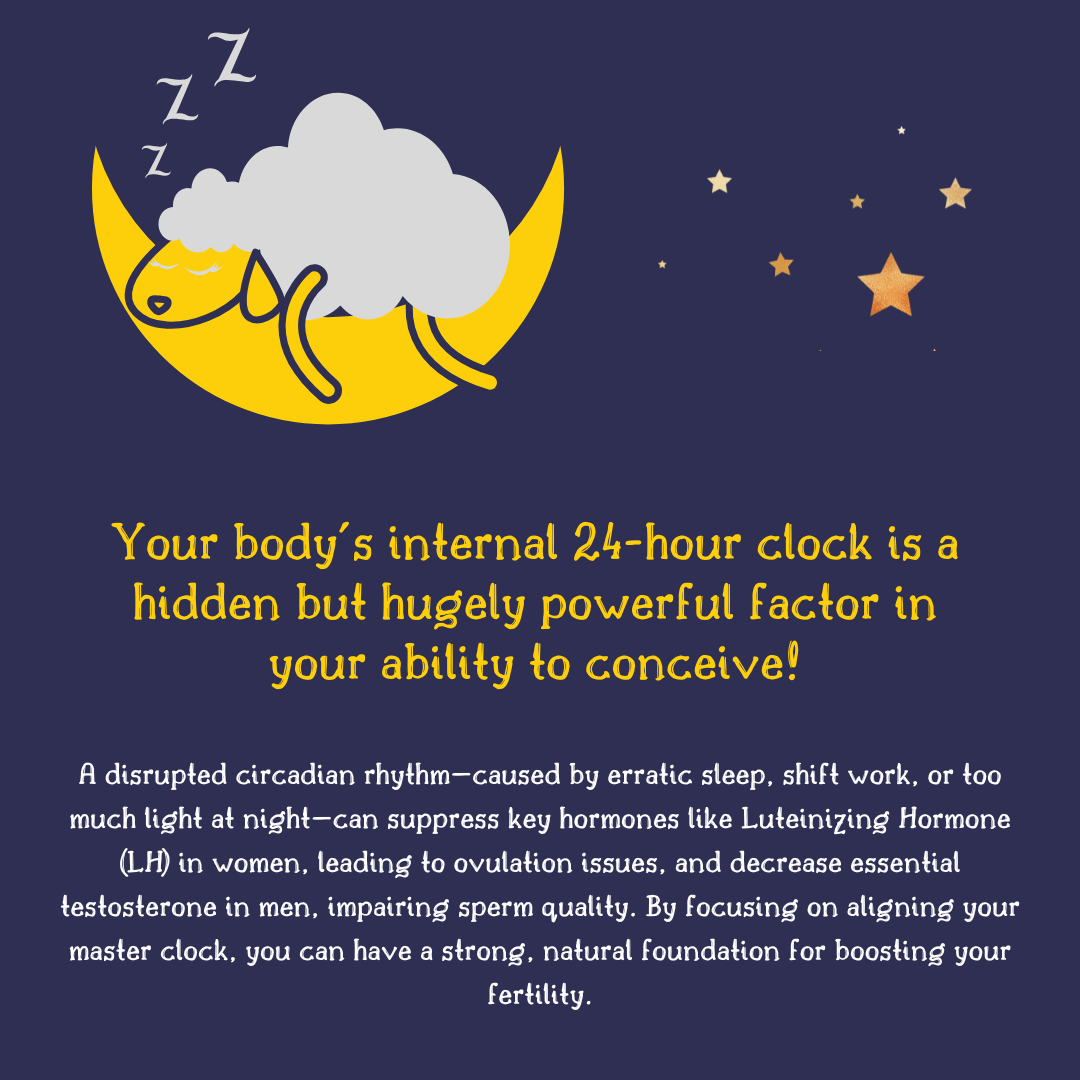
Think of your body's circadian rhythm as a 24-hour master clock—the Suprachiasmatic Nucleus (SCN)—that controls almost every function in your body, from your temperature and hunger to your hormone release. When your sleep schedule is regular and healthy, this master clock runs smoothly, ensuring all your body systems—including the reproductive system—do what they’re supposed to do at the right time. Research confirms that this timing is critical. Your reproductive hormones, which control everything from ovulation to sperm production, aren't released steadily; they surge and drop in specific, daily (or monthly) patterns that are timed by your circadian clock.
This is why, for both men and women, major disruptions—like working the night shift, traveling across time zones often (jet lag), or simply sleeping erratically—can throw these delicate hormonal schedules completely off-balance, directly impacting your ability to conceive.
How Does Sleep Disruption Affect Female Reproductive Hormones?
For women, the reproductive cycle is a symphony of hormones, including Follicle-Stimulating Hormone (FSH), Luteinizing Hormone (LH), estrogen, and progesterone. The release of these hormones is a highly timed event, and your circadian rhythm is the conductor.
Suppressing Key Ovulation Hormones
One of the most important, timed events in the female cycle is the Luteinizing Hormone (LH) surge. This surge is what triggers the release of an egg (ovulation). Studies have shown that when your sleep is disrupted—especially if you're not getting enough deep, restorative sleep—it can suppress or interfere with the normal timing of this crucial LH surge.
The Melatonin Connection: Melatonin is known as the "sleep hormone," but it also plays a role in regulating female reproductive function. Disrupting your sleep by exposing yourself to bright light at night can stop melatonin production, and this interference can negatively affect the ovaries and the timing of your menstrual cycle, making conception harder.
Impact on Embryo Implantation and Pregnancy
The impact of a misaligned circadian rhythm goes beyond just ovulation. Getting pregnant is only the first step; maintaining a pregnancy is the next. Studies in animal models and human populations, such as shift workers, have linked circadian disruption to problems with embryo implantation and an increased risk of miscarriage.
Uterine Receptivity: Even the lining of the uterus, which must be perfectly "receptive" for a fertilized egg to implant, has its own localized molecular clock. When the body's master clock is off, the timing of this uterine clock can be off, making the implantation window smaller and reducing the chance of a successful pregnancy.
Is My Sleep Affecting My Male Fertility and Sperm Health?
Yes, absolutely. The link between sleep, circadian rhythm, and fertility is just as strong in men, primarily affecting the quality and quantity of sperm.
Lowering Testosterone Levels
Testosterone is the primary male sex hormone, essential for sperm production (spermatogenesis). It follows a strong circadian rhythm, naturally peaking in the morning and dropping in the evening.
When men consistently get less than seven hours of sleep, or their sleep is fragmented, their testosterone levels drop significantly. For instance, just one week of restricted sleep (5–6 hours per night) can lower a man's testosterone levels by 10% to 15% (Note: This specific finding is from a slightly older but highly foundational paper, which is still widely cited in recent research linking sleep debt to hormonal drops; Leproult, R., & Van Cauter, E. (2011)). This drop directly impacts the body’s ability to produce healthy, viable sperm, a key factor in boosting your fertility.
Decreased Sperm Quality and Motility
It's not just the count; it’s the quality. Poor sleep and circadian disruption have been directly linked to:
Lower Sperm Concentration: Fewer sperm in the ejaculate.
Reduced Motility: Sperm that are less able to swim effectively to reach the egg.
Abnormal Sperm Shape (Morphology): Sperm that are incorrectly formed.
The disruption in hormone signaling (specifically lower testosterone and changes in other pituitary hormones like LH) impairs the complex process of creating new sperm cells, ultimately decreasing the overall chance of successful fertilization.
What is the Impact on Maternal Health and the Baby’s Future Fertility?
Recent, cutting-edge research suggests that a mother's sleep quality during pregnancy might even affect her daughter's future reproductive health. A new mouse study suggests that severe sleep deprivation during a critical window of early pregnancy led to a depletion of the female offspring's ovarian reserve (the total number of eggs available), potentially through a process called ferroptosis, a type of iron-dependent cell death.
While this research is preliminary and in animal models, it highlights a crucial point: maintaining a healthy circadian rhythm is not just about your immediate fertility—it may be a long-term investment in your offspring's health. This connection is likely due to the highly-timed nature of fetal development, which is sensitive to the mother’s internal hormonal and stress environment, all of which are managed by the circadian clock.
7 Actions You Can Take Today to Boost Your Fertility Through Better Sleep
1. Establish a Non-Negotiable Sleep and Wake-Up Time
The Tip: Go to bed and wake up around the same time (0.5-1 hr flexibility) every single day, including weekends.
The Why: Consistency is the single most important factor for regulating your master clock (SCN). Even extra 2 hours on the weekend ("sleep debt") can throw your hormone timing off for the entire week.
2. Get Bright Light Exposure First Thing in the Morning
The Tip: Within 30 minutes of waking up, get 10-15 minutes of natural sunlight. Step outside, open a bright window, or take a short walk.
The Why: Bright morning light is the most powerful signal to your SCN, telling it to "wake up" and start the daily cycle of hormone release on time. This sets the stage for a healthy sleep/wake cycle later.
3. Manage Light Exposure in the Evening
The Tip: Two to three hours before bed, dim the lights in your home and avoid all bright screens (phones, tablets, laptops). Use blue-light-blocking glasses if you must look at a screen.
The Why: Blue light at night suppresses melatonin release. Since melatonin helps regulate reproductive hormones, protecting its natural surge at night is vital for boosting your fertility.
4. Keep Your Bedroom Cool, Dark, and Quiet
The Tip: Treat your bedroom like a cave: block out all light, maintain a cool temperature (around 65F or 18C is often recommended), and use white noise if needed.
The Why: A good sleep environment promotes deep, restorative sleep, which is the phase where many critical hormones (like Growth Hormone, which is tied to reproductive health) are released and regulated.
5. Avoid Late-Day Caffeine and Alcohol
The Tip: Cut off caffeine intake by early afternoon (at least 8 hours before bed) and avoid alcohol close to bedtime.
The Why: Both substances disrupt sleep quality and fragment your sleep architecture, preventing you from getting the full, restorative cycles needed for proper hormone regulation.
6. Prioritize Physical Activity, but Watch the Timing
The Tip: Get regular exercise, but try to avoid high-intensity workouts in the three hours leading up to bedtime.
The Why: Exercise is a great regulator of the circadian clock, but working out too close to sleep can raise your core body temperature and heart rate, making it harder to fall asleep and stay asleep.
7. Give Yourself a Wind-Down Routine
The Tip: Dedicate 30 minutes before bed to a relaxing, low-stimulus activity like reading a book (a real, paper one!), light stretching, or meditation.
The Why: This routine signals to your brain and body that it’s time to switch off the stress response (which releases cortisol, a hormone that can interfere with reproductive hormones) and prepare for sleep.
Conclusion
It’s easy to feel overwhelmed by the science of fertility, but the takeaway is simple: Your sleep is not a luxury; it is beneficial for your reproductive system. The consistent, high-quality sleep you get is the fuel your body needs to properly time and release the exact hormones required for a healthy menstrual cycle, successful ovulation, and robust sperm production.
By committing to a few key changes to your sleep habits and aligning your daily rhythm, you are taking a natural step toward boosting your fertility. Start tonight. Prioritize your sleep, respect your body’s clock, and empower your reproductive health journey.
-
Liu, Q., Wang, H., Hu, X., Zheng, Y., Shi, W., Zhang, M., ... & Zhang, C. (2025). Maternal sleep deprivation during pregnancy induced offspring germ cells loss through ferroptosis. Cell Death & Discovery, 11(1), 544.
Zou, R., Hu, S., Deng, T., Wang, Q., Li, H., & Zhai, J. (2025). Role of circadian clock in female embryo implantation. Frontiers in Cell and Developmental Biology, 13.
Zheng, W., & Feng, D. D. (2021). Circadian Rhythms Within the Female HPG Axis: From Physiology to Etiology. Endocrinology, 162(8), bqab117.
Leproult, R., & Van Cauter, E. (2011). Effect of 1 Week of Sleep Restriction on Testosterone Levels in Young Healthy Men. JAMA: The Journal of the American Medical Association, 305(21), 2173–2174.