REM Sleep and Mental Health are More Connected Than You Think
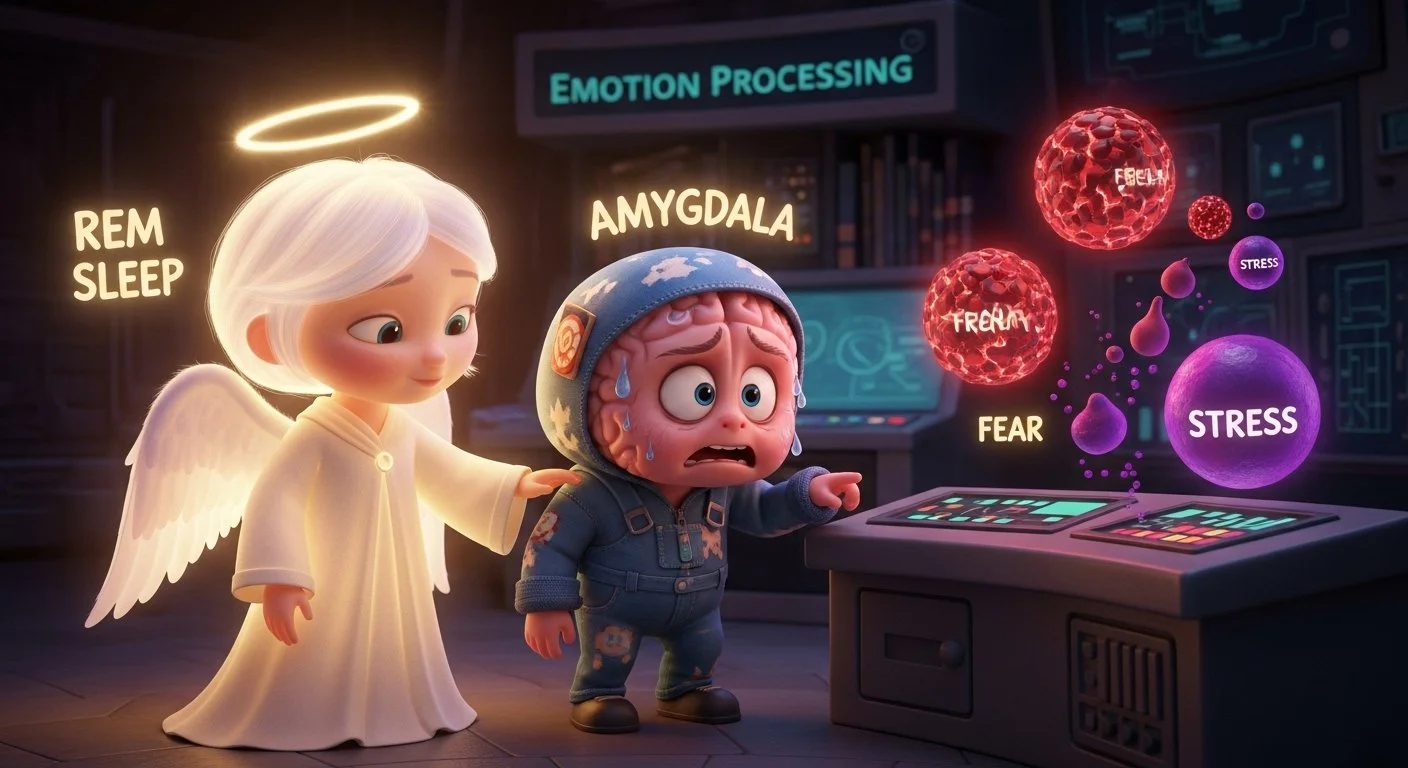
Most of us think of sleep as a single, long block of downtime. In reality, your brain is doing two very different types of work. While deep sleep (NREM) handles the physical "housekeeping," REM sleep handles the emotional heavy lifting. Think of REM as your brain’s internal therapist.
When you don't get enough REM, you never strip the emotional charge away from your memories. The result? You wake up with yesterday’s baggage still feeling fresh, raw, and overwhelming. This is why a lack of REM sleep and mental health issues like PTSD and generalized anxiety are so closely linked; the brain has lost its ability to "file away" stress.
When the Amygdala Won't Stop Screaming: The Real Cost of Missing REM
Have you ever noticed that after a bad night’s sleep, you’re much more likely to snap at a partner or feel a sudden wave of panic over a small mistake? That’s because, without REM sleep, the connection between your prefrontal cortex (the logical adult in the room) and your amygdala (the emotional alarm system) weakens.
Under normal conditions, the amygdala is like a smoke detector. It’s supposed to go off when there’s a fire, but it should stay quiet when you’re just making toast (the prefrontal cortex keeps the amygdala in check). However, when we are deprived of REM sleep, this smoke detector becomes hypersensitive. Research shows a 60% increase in amygdala reactivity in sleep-deprived adults. Essentially, your brain loses its "brakes." You aren't just "grumpy"; your brain is physically less incapable of regulating its emotions.
Impaired Fear Extinction
In addition to hyperactive amygdala, reduced REM sleep impairs amygdala’s normal process for forgetting traumatic events.
One of the most fascinating roles of the amygdala is its ability to learn what to be afraid of. This is a survival mechanism. If a dog bites you, your amygdala records that event so you’ll be cautious around dogs in the future. But for a healthy life, we also need "fear extinction"—the ability for the brain to learn that not all dogs are dangerous.
This "unlearning" happens almost exclusively during REM sleep. During this stage, the amygdala communicates with the medial prefrontal cortex. Together, they review the day’s events and decide which fears are valid and which can be let go. Without enough REM sleep, this communication breaks down. The amygdala stays stuck in "fear mode," and the logical brain can't talk it down. This is why sleep deprivation is so closely linked to Post-Traumatic Stress Disorder (PTSD) and generalized anxiety.
The Modern REM Crisis: How High-Stakes Living Short-Circuits the Amygdala
In our current culture, we often treat the last two hours of sleep as optional. We set alarms to wake up early for the gym or to start work, but those last two hours are the most REM-dense hours of the entire night. By "hacking" our sleep to be shorter, we are disproportionately robbing ourselves of emotional stability.
When we live in a state of chronic REM deprivation, we create a feedback loop. The amygdala becomes more reactive, which makes us more stressed during the day. That stress leads to higher levels of cortisol and noradrenaline, which—you guessed it—makes it harder to enter REM sleep the following night. Breaking this cycle requires more than just "dark curtains." it requires a fundamental shift in how we value the early morning hours. We have to stop seeing sleep as a luxury and start seeing it as the biological necessity that keeps our amygdala from taking over our lives.
The Future of Mental Health: REM as a Diagnostic Tool
We are entering an era where sleep tracking isn't just for athletes. Psychiatrists are beginning to use REM latency (how long it takes you to start dreaming) and REM density (how active your eyes are during dreams) as biomarkers for depression.
Depression
In a healthy brain, it takes about 90 minutes to reach REM. However, researchers have found that people with high "depressive severity" often fall into REM much faster—sometimes in under 60 minutes. This is called "REM disinhibition." It’s as if the brain is so starved for emotional processing that it "panics" and dives into the dream state too early. New AI models, such as the SleepFM foundation model developed at Stanford in 2026, can now analyze a single night of sleep data to predict over 100 health conditions with a staggering 80-90% accuracy.
Conversely, those with anxiety often have "fragmented" REM, where they pop in and out of the state, never completing the emotional processing. By monitoring these patterns, we can treat the root of the mental health struggle rather than just the symptoms.
Neurodegeneration
REM sleep isn't just telling us about our mood; it’s telling us about the structural integrity of our brain. We are seeing a massive surge in the diagnostic power of REM Sleep Behavior Disorder (RBD)—the condition where people physically act out their dreams because their muscles don't "paralyze" as they should.
In the past, this was seen as a quirky sleep issue. Today, it is recognized as one of the strongest early warning signs for Parkinson’s disease and certain types of dementia. By using AI-powered video analysis, clinicians can now diagnose RBD with 92% accuracy. More importantly, these REM changes can show up 10 to 15 years before the first physical tremor appears. This gives us a massive head start on neuroprotective treatments that were never possible before.
Conclusion
Understanding the link between REM sleep and mental health changes the way we look at a "good night’s rest." It is no longer about just "recharging your batteries"; it’s about giving your brain the dedicated time it needs to perform "overnight therapy." By prioritizing the neurochemical environment that allows for deep dreaming, you aren't just avoiding a morning headache—you are actively fortifying your mind against the stressors of modern life. Your dreams aren't just random stories; they are the key to your emotional survival.
-
Goldstein, A. N., & Walker, M. P. (2014). The Role of Sleep in Emotional Brain Function. Annual Review of Clinical Psychology, 10(1), 679–708.
Wassing, R., Lakbila-Kamal, O., Ramautar, J. R., Stoffers, D., Schalkwijk, F., & Van Someren, E. J. W. (2019). Restless REM Sleep Impedes Over-Night Amygdala Adaptation. Current Biology, 29(14), 2351–2358.
Vandekerckhove, M., & Wang, Y. L. (2018). Emotion, emotion regulation and sleep: An intimate relationship. AJP: Regulatory, Integrative and Comparative Physiology, 314(3), R434–R441.
Walker, M. P. (2017). Why We Sleep: Unlocking the Power of Sleep and Dreams. Simon & Schuster. (Refencing primary research cited within).
Palagini, L., Rosenlicht, N., & Drake, C. L. (2022). The role of REM sleep in the regulation of emotional processing and its implications for the treatment of insomnia and depression. Sleep Medicine Reviews, 65, 101672.
Tempesta, D., Socci, V., De Gennaro, L., & Ferrara, M. (2018). Sleep and emotional processing. Sleep Medicine Reviews, 40, 183–195.
Zou, J., & Mignot, E. (2026). SleepFM: A multi-modal foundation model for health risk prediction using polysomnography. Stanford Medicine/Nature Digital Medicine.
Wassing, R., et al. (2025). Assessing REM Sleep as a Biomarker for Depression Using Consumer Wearables. Journal of Clinical Sleep Medicine, 21(3), 442-456.
During, E. (2025). AI-Powered Video Analysis for the Early Detection of REM Sleep Behavior Disorder. Annals of Neurology, 97(2), 210-224.
Kim, H., & Dimsdale, J. E. (2026). Association between psychological stress and REM/NREM sleep among urban workers: A multilevel analysis. Chronobiology International, 43(1), 12-28.