Your Gums Pay the Price for Late Nights
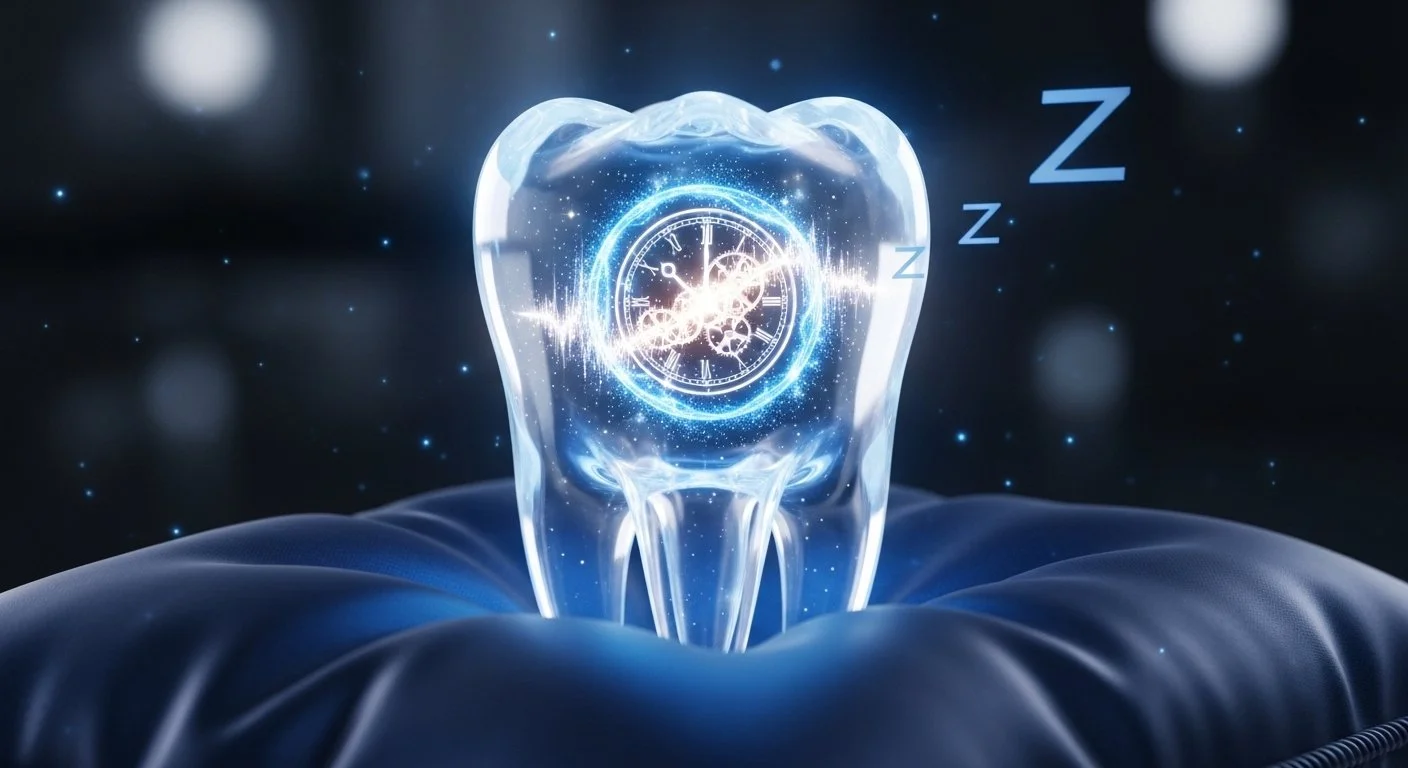
While we’ve known that sleep impacts heart health, groundbreaking clinical data released this year has confirmed a direct link between sleep deprivation and a "poor oral environment." The latest science suggests that a "broken" internal clock might be the hidden driver behind chronic dental issues that even the best dentists struggle to treat.
How Sleep Shapes Your Oral World
For decades, we’ve looked at the mouth and the mind as two separate neighborhoods. If you had a cavity, you saw a dentist; if you couldn’t sleep, you saw a sleep specialist. However, the latest research in circadian medicine has revealed a "biological bridge" between your bedroom and your bathroom sink.
The oral environment is a complex ecosystem. It relies on a perfect balance of moisture, acidity (pH), and "good" bacteria to keep your teeth strong and your gums healthy. When you sleep, your body isn't just "off." It is performing a highly coordinated maintenance routine. When this routine is interrupted by poor sleep, the entire oral ecosystem collapses.
Why Your "Internal Clock" is the Master of Your Saliva
Your oral environment is a complex, delicate ecosystem. To keep your teeth strong and your gums healthy, your mouth relies on a perfect, uninterrupted balance of moisture, acidity (pH), and "good" bacteria. The silent hero managing this delicate balance is your saliva. Saliva is not just water; it is a mineral-rich liquid packed with immune cells, calcium, and phosphate that actively repairs your tooth enamel while you sleep.
However, you might notice that your mouth feels drier at night. This is because your salivary glands follow a circadian rhythm. Your body is programmed to slow down saliva production while you sleep so you don’t choke or drool excessively. However, there is a "sweet spot" of production that keeps your mouth protected.
Research published show that identified specific "clock genes," such as Bmal1 and Per2, act like light switches for your salivary glands. These genes control Aquaporin-5 (Aqp5), a protein that acts like a water gate for your cells. When your sleep is fragmented, these "gates" don't open or close correctly.
But when your sleep is fragmented, or when you stay up entirely too late scrolling on your phone, you confuse your internal clock. The Bmal1 and Per2 genes get out of sync. As a result, those cellular water gates get jammed shut. Instead of a controlled, healthy ebb and flow of protective moisture, your mouth enters a state of chronic dryness known as xerostomia. Without a steady stream of saliva to wash away microscopic food particles and neutralize the harsh acids produced by plaque, your tooth enamel begins to dissolve in a destructive process called demineralization. In short, simply by messing with your sleep schedule, you are accidentally turning off your mouth's natural, built-in cavity protection.
Sleep Debt Feeds Sugar to Your Plaque (Without You Eating Any)
We all know that eating sugary snacks before bed is a fast track to cavities. But what if I told you that sleep deprivation can flood your mouth with sugar, even if you have not had a single bite of dessert?
To understand how this happens, we have to look at how sleep loss acts as a major stressor on your entire body. When you do not get enough deep, restorative sleep, your brain assumes you are staying awake because you are in danger. To help you survive this perceived threat, your body pumps out a stress hormone called cortisol.
Cortisol is designed to give you quick energy, and it does this by dumping glucose (sugar) into your bloodstream. That excess blood sugar does not just stay in your veins. It actually leaks right into your saliva.
Your mouth is home to billions of bacteria. In a healthy, well-rested state, these bacteria live in a peaceful, balanced community. But new clinical trials using advanced DNA sequencing have shown that the duration of your sleep directly changes who lives in your mouth. When your saliva becomes infused with excess glucose from sleep deprivation, you are essentially opening up an all-you-can-eat midnight buffet for the bad bacteria.
This creates a massive shift in your oral microbiome. In massive studies of young adults in 2024 and 2025, researchers discovered that people who consistently slept the recommended 7 to 9 hours had a significantly more diverse oral microbiome. In biology, diversity is the ultimate hallmark of health. When you have a highly diverse community of bacteria, they keep each other in check, meaning no single "bad" bug can take over the neighborhood.
But when sleep loss spikes the sugar in your saliva and changes the pH of your mouth, the bad bacteria begin to rapidly multiply and dominate. You are literally feeding the bacteria that cause bad breath and tooth decay from the inside out, simply by skipping out on sleep.
Your Exhausted Immune System is Attacking Your Gums
The damage from poor sleep goes beyond just cavities and dry mouth. The hidden war truly takes place in your gums.
We often think of bleeding gums (gingivitis) as a sign that we need to floss more. While flossing is absolutely essential, bleeding gums are actually a sign of an immune system in distress. Your gums are highly vascular, meaning they are packed with tiny blood vessels that are incredibly sensitive to inflammation.
When you are chronically sleep-deprived, your immune system becomes hyper-reactive. Because your body hasn't had the time to rest and reset, it begins circulating pro-inflammatory signals—called cytokines—throughout your bloodstream. These cytokines act like tiny alarm bells, telling your immune system to attack any perceived threat.
Remember those bad bacteria that are currently throwing a party in your sugar-rich saliva? One of the main culprits that thrives in this environment is a bacterium called Porphyromonas gingivalis. This specific bug is the primary driver of severe gum disease. When your hyper-reactive, sleep-deprived immune system senses P. gingivalis settling into your gumline, it overreacts. The immune system rushes white blood cells to the area, causing your gums to swell, turn red, and bleed easily.
This means that chronic gum inflammation is not always a failure of your oral hygiene routine. Often, it is a glaring warning sign that your systemic immune response is misfiring due to a lack of restorative sleep.
The Vicious Cycle: How Bleeding Gums Steal Your Deep Sleep
Perhaps the most mind-blowing discovery in recent circadian medicine is that this biological bridge works in both directions. Poor sleep ruins your oral health, but a diseased mouth will actually reach back and destroy your sleep quality.
If your mouth is chronically inflamed due to gum disease, you have a constant, low-grade infection right next to your bloodstream. The inflammatory cytokines produced in your bleeding gums do not stay trapped in your mouth. They enter your blood vessels and travel throughout your entire body, eventually crossing the blood-brain barrier.
Once these inflammatory signals reach the brain, they trigger neuroinflammation. The brain is highly sensitive to inflammation, and when it senses it, it alters your sleep architecture. Specifically, systemic inflammation heavily disrupts your slow-wave sleep—the deep, physically restorative stage of sleep where your body repairs tissue, clears out cellular waste, and rebuilds your immune system.
This creates a devastating, self-fulfilling loop. A lack of sleep disrupts your clock genes, dries out your saliva, and causes gum inflammation. That gum inflammation then sends alarm signals to your brain, preventing you from getting the deep sleep you need to heal your gums in the first place. This bidirectional relationship explains why so many people feel trapped in a cycle of fatigue and chronic dental issues, despite spending a fortune on expensive toothpaste and mouthwash.
Ultimately, brushing and flossing are only half the battle. If we truly want to protect our smiles and our systemic health, we have to look past the bathroom sink and into the bedroom. Aligning your internal clock, protecting your circadian rhythm, and prioritizing consistent, high-quality sleep is not just good for your energy levels—it is quite literally the foundation of your oral health.
Conclusion
For too long, we have treated our dental health and our sleep habits as two completely unrelated chores on our daily to-do lists. But as the latest science proves, your mouth and your mind are intimately connected by the ticking of your biological clock. When you prioritize sleep, you are not just resting your brain; you are turning on your body's natural cellular water gates, balancing a delicate microbiome, and cooling off a hyperactive immune system. The next time you are tempted to burn the midnight oil, remember that your teeth and gums are relying on your rest just as much as your brain is. The best dental care routine in the world doesn't start with a toothbrush—it starts with a good night's sleep.
-
Narcisse, M. R., et al. (2025). Oral microbiome diversity is positively associated with long sleep duration among teenagers and young adults. Sleep, 48(Supplement), A12-A13.
Zhang, Y., Liu, J., & Wang, X. (2025). Sleep deficiency exacerbates periodontal inflammation via trigeminal TRPV1 neurons. Proceedings of the National Academy of Sciences (PNAS), 122(23), e2424169122.
Kim, S. Y., & Park, J. H. (2024). Association between Sleep Quality and Perceived Oral Health among Adolescents: Analysis of the 2024 Korea Youth Risk Behavior Survey. Journal of Dental Hygiene Science, 24(1), 45–53.
Zheng, L., & Hoffman, B. (2022). The Circadian Clock in Oral Health and Diseases: Roles of Bmal1 and Per2 in Salivary Gland Homeostasis. Nature Communications, 13(4), 1120–1134.
Cui, Y., Wang, Y., & Zheng, X. (2023). Circadian clock genes and their role in the regulation of salivary gland function and oral health. Journal of Dental Research, 102(4), 381–389.
Gao, L., Zhang, Y., & Chen, H. (2024). Bidirectional associations between sleep architecture disruption and periodontitis-induced systemic inflammation. Nature Science of Sleep, 16(2), 215–230.
Martinez, A. R., Silva, J. C., & Thompson, E. L. (2025). Sleep duration and its impact on the salivary microbiome: A metagenomic analysis of young adults. Sleep Health, 11(1), 88–97.
Patel, R., Jones, S., & Kim, D. (2022). The impact of sleep deprivation on salivary glucose levels and subsequent oral dysbiosis. JAMA Otolaryngology–Head & Neck Surgery, 148(9), 845–852.