The Hidden Clock Controlling Your Entire Health.
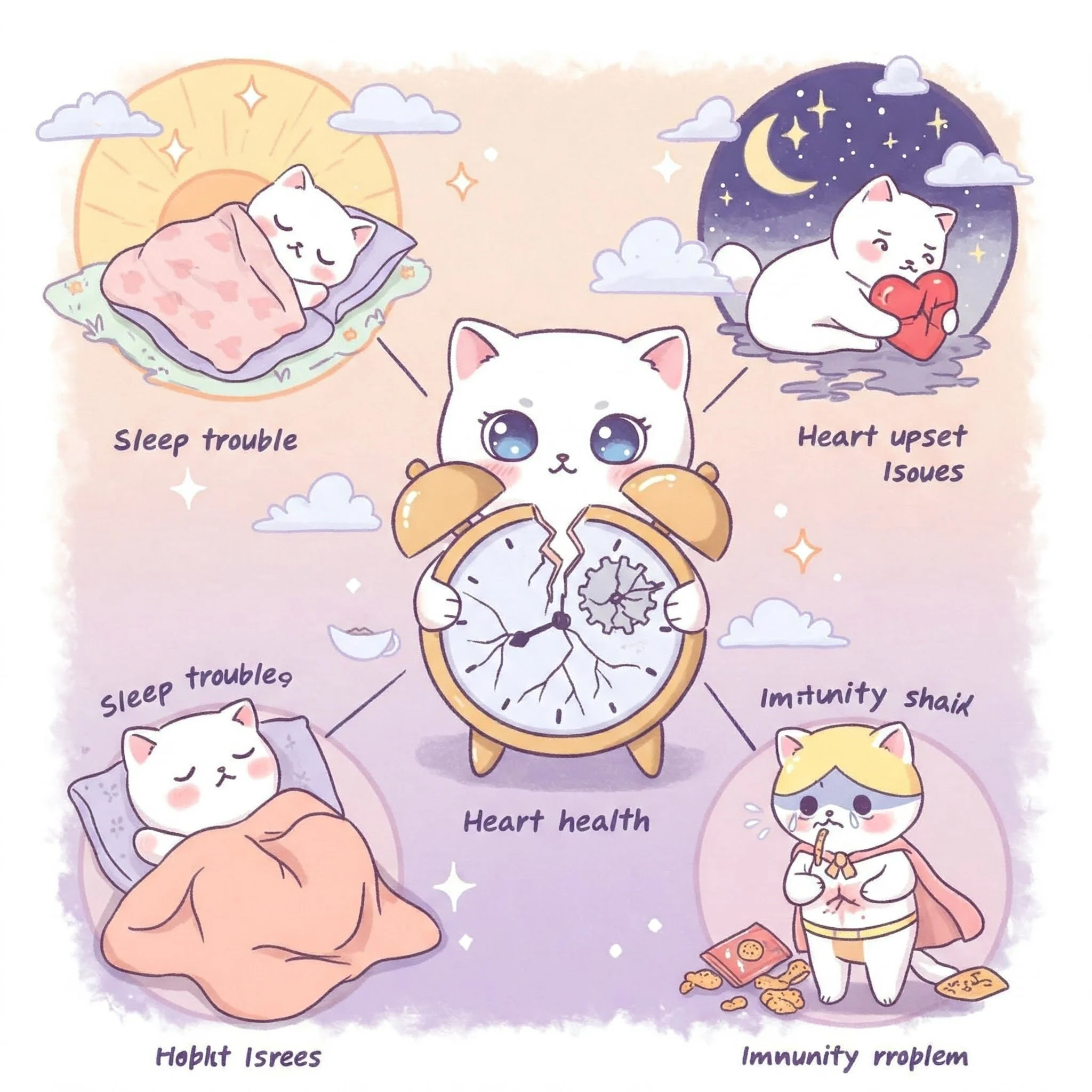
Have you ever pulled an all-nighter or hopped a few time zones on a trip, only to have your whole body feel utterly wrong? That dizzy, foggy, and uncomfortable feeling—where your stomach is grumbling when it should be quiet and your eyes are wide open at 3 AM—is governed by a tiny, powerful regulator deep inside your brain. It's your physiological clock, and it matters far more than the watch on your wrist.
While we might call it the physiological clock, scientists use the more precise term: Circadian Rhythm. This beautiful word comes from Latin roots: circa (approximately) and diem (one day). It describes the fundamental fixed changes that cycle through your body roughly every 24 hours. Your sleep-wake pattern—where you naturally seek about eight hours of sleep followed by 14 to 16 hours of wakefulness—is the most familiar example of this 24-hour cycle in action.
The Inner Commander: What is Your Circadian Rhythm?
The incredible influence of this clock is no accident; it’s rooted in the natural world. Since Earth's rotation cycles approximately every 24 hours, life—from simple bacteria to complex humans—evolved to build this daily rhythm into its very blueprint: your DNA.
This sophisticated, time-regulating system exists in every cell that has a nucleus. But in humans, the entire process is commanded by a central coordinator in the brain called the Suprachiasmatic Nucleus (SCN).
Think of the SCN as the orchestra conductor. It primarily receives light signals from the environment and, in turn, regulates the individual clocks in all your other organs. This central control affects critical systems like your metabolism, cardiovascular function, and immune system. When the system runs smoothly, your body functions like a harmonious symphony.
When the Clock Breaks: The Hidden Costs of Misalignment
Unfortunately, modern life is a relentless temptation to throw this delicate system into disarray. Late-night streaming binges, shift work, cross-time-zone travel, or simply staring at the bright blue light of your smartphone screen late at night all trick your brain. They make your body's internal clock fall drastically out of sync with the natural light outside.
Disrupting your circadian rhythm leads to consequences far beyond just a bad night’s sleep. Scientific research has confirmed that long-term misalignment actively erodes your health in three critical ways:
Metabolic Chaos: A disrupted clock makes it easier for your body to accumulate fat. It significantly reduces your ability to control blood sugar and diminishes insulin sensitivity, drastically raising the risk of obesity and diabetes.
Cardiovascular Danger: A disordered clock interferes with the function of the cells that regulate the elasticity of your blood vessels. When these cells are damaged, arteries are more likely to harden, increasing the risk of atherosclerosis (hardening of the arteries). Even more dangerously, misalignment can lead to elevated blood pressure that stops dropping at night—a signal strongly associated with heart attacks and strokes.
Weakened Immunity: Even your immune cells are controlled by clock genes! When the rhythm is disturbed, your immune system’s reaction weakens, potentially compromising your defense against viruses and even increasing the risk of certain cancers. The physiological clock ensures your immune army knows exactly when to deploy effectively.
Simple Steps to Synchronize Your Life
The great news is that you have the power to help your physiological clock find its natural, healthy rhythm again. Implementing a few simple lifestyle changes can make a massive difference:
Embrace Morning Light: Light is the most powerful signal for resetting your clock. Start your day by getting outside or sitting by a window for at least 10–15 minutes of sunlight exposure. This signals to your brain that the day has started, improving metabolic health and alertness.
Ditch the Screens at Night: The blue light emitted by phones, tablets, and computers fools your SCN into thinking it's still daytime, delaying the onset of sleep. Try to wind down without your devices for at least an hour before bed.
Time Your Meals Wisely: Research suggests concentrating your eating window during the daytime and avoiding large late-night meals. Eating too late interferes with the clock functions in your gut and liver, throwing off your overall metabolic schedule.
Consistency is Key: Perhaps the most crucial step is maintaining a fixed sleep schedule. Go to bed and wake up at roughly the same time every day, even on weekends.
By following these steps, you stop fighting your internal rhythm and start leveraging it. You’ll be tapping into a powerful, natural mechanism to improve everything from your waistline to your heart health. Are you ready to reset your clock?
-
Guan, D., et al. (2021). “Interconnections between circadian clocks and metabolism.” Journal of Clinical Investigation, 131(19), e148278.
Chellappa, S. L., et al. (2023). “Circadian misalignment and cardiovascular risk: Implications for shift workers.” Hypertension, 80(5), 987-996.
Sinturel, F., et al. (2020). “Circadian clocks make metabolism run.” Journal of Molecular Biology, 432(12), 3680-3699.
Petrenko, V., et al. (2023). “Lipid metabolism around the body clocks.” Progress in Lipid Research, 91, 101235.
Gebicke-Haerter PJ, Pildain LV, Matthaus F, Schmitt A, Falkai P: Circadian rhythms investigated on the cellular and molecular levels. Pharmacopsychiatry 2013, 46 Suppl 1:S22-29.