Sleep Is Essential for Your Hair Health

When we talk about sleep and appearance, we usually focus on dark circles under the eyes. But the connection goes much deeper—right down to the roots of your hair. Think about this: Do you also notice more hair than usual in the shower drain after a week of "burning the candle at both ends?”
It might not be just about your shampoo or a stressful project at work. It could be due to the disrupted circadian clocks in your hair follicles. Yes, hair follicles have their own internal clocks. These follicles contain "CLOCK" genes that follow a strict 24-hour rhythm. When you skip sleep, you are not just tired; you are physically interrupting signals for your hair growth.
In fact, research studies demonstrates that poor sleep quality or sleep deprivation increase hair loss. One of the most striking pieces of evidence comes from a study published in Sleep and Breathing (2023), which analyzed men with Androgenetic Alopecia (male pattern baldness). The researchers found that men who consistently slept 6 hours or less were 3.7 times more likely to have severe, advanced hair loss compared to those getting a full 7 to 8 hours.
This isn't just a long-term problem; it shows up in the short term, too. In a controlled clinical experiment, researchers measured beard-hair growth (they looked at beard hair growth because it grows fast enough to be measured in short windows) in men subjected to 48 hours of total sleep deprivation. The result was a 19% decrease in hair growth. Furthermore, a 2026 systematic review confirmed that poor sleep quality—measured by the Pittsburgh Sleep Quality Index (PSQI)—correlates directly with lower hair density. The evidence is clear: when your sleep quality drops, your hair growth slows down, and shedding speeds up.
To understand why this happens, let’s look back at the "clocks" inside your hair.
Your Hair Follicles Keep Time While You Sleep
Every single hair follicle on your head is a mini-organ. Each follicle contains its own autonomous peripheral circadian clock. This clock is governed by specific clock genes known as CLOCK, BMAL1, PER1, and CRY1. They act like a factory foreman. It tells the cells at the base of your hair follicle when to divide (the growth phase) and when to rest.
In a healthy system, these genes tell the hair follicle when to divide (the Anagen phase) and when to rest (the Telogen phase). Research published in journals like Nature (Janich et al.) has shown that when you disrupt your sleep-wake cycle, these "local clocks" in your scalp get confused.
The result? The hair prematurely exits the growth phase and enters the shedding phase. It’s like a factory worker walking off the job because the shift whistle blew at the wrong time.
In addition to circadian clocks in the hair follicles, hormones like melatonin and cortisol also play a role.
The Melatonin Guard: Protecting Your Roots from the Inside Out
Most people know melatonin as the "sleep hormone" that helps you drift off. However, melatonin can also be a powerful protector (antioxident). Your hair follicles actually have specific melatonin receptors (MT1 and MT2). This means your hair is literally listening for the melatonin signal every night.
Melatonin doesn't just go to your brain; it goes to your hair as well. Here, it acts as a "radical scavenger." It hunts down oxidative stress—the metabolic "rust" that damages your hair cells throughout the day. When you don’t sleep, your local scalp melatonin levels plummet. This leaves your hair follicles vulnerable to oxidative damage, which can lead to "follicular miniaturization"—the process where hair grows back thinner and weaker until it eventually stops growing altogether.
High Cortisol "Dissolves" the Glue Holding Your Hair
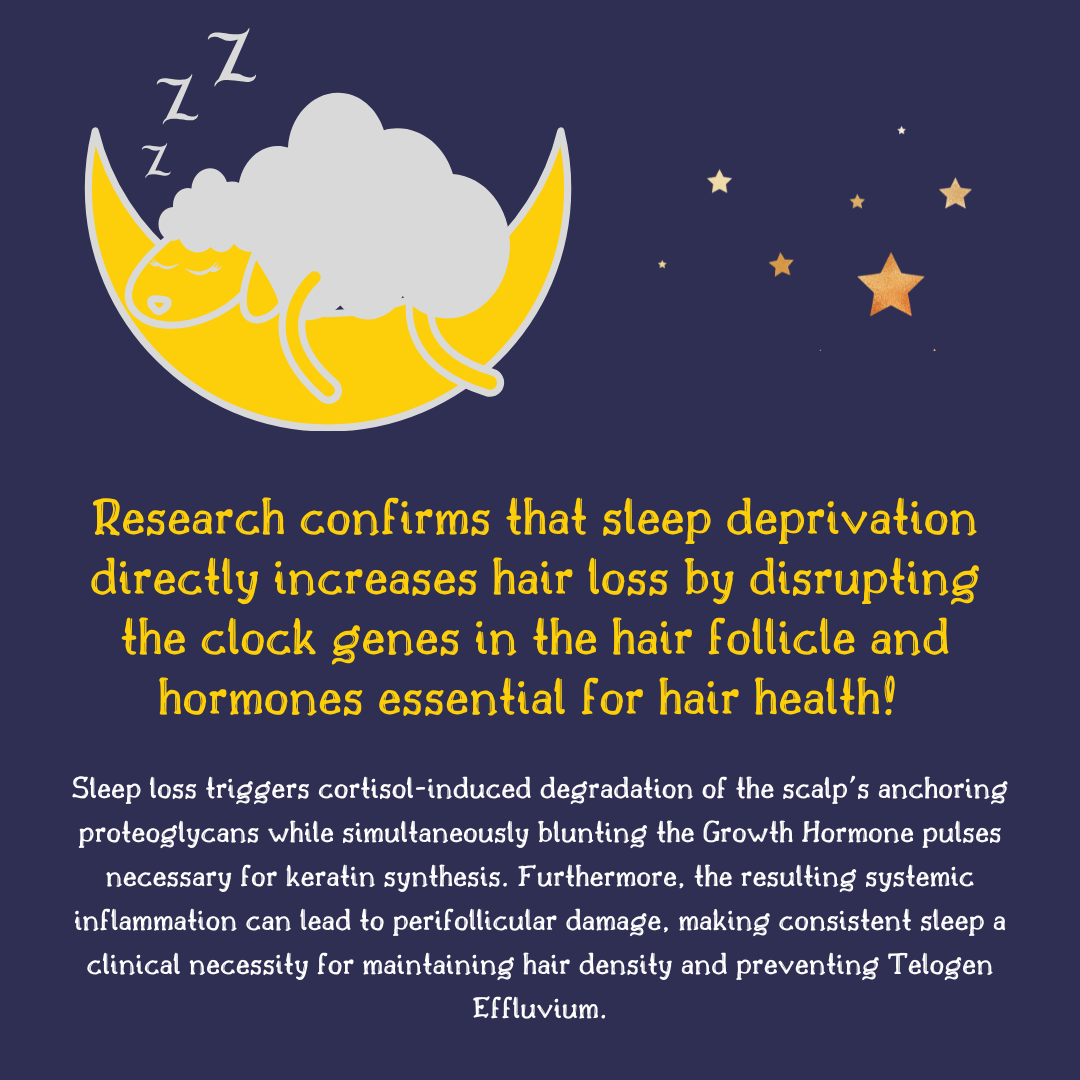
Sleep deprivation is a physical stressor. When you don't get enough rest, your body activates the HPA (Hypothalamic-Pituitary-Adrenal) axis, which floods your system with cortisol. While a little cortisol helps you wake up, chronic high levels are a nightmare for your hair.
Cortisol has a direct, destructive relationship with the "scaffolding" of your hair follicle. Specifically, high cortisol levels have been shown to degrade proteoglycans like hyaluronan and versican. Think of these as the "biological glue" that keeps the hair bulb anchored deep in the scalp. When cortisol stays high because of poor sleep, this glue breaks down, leading to a condition called Telogen Effluvium. This is why you might see clumps of hair falling out three months after a period of extreme sleep deprivation—it takes that long for the "unglued" hair to finally work its way out of the scalp.
The Growth Hormone Role
On the flip side, you need Growth Hormone (GH) to build hair. About 75% of your daily GH is released during the first half of the night during Slow-Wave Sleep (SWS). Hair is made of a protein called keratin. GH tells the cells in your hair matrix to multiply and create keratin.
If you cut your sleep short or have fragmented sleep, you miss that GH "pulse." Without it, the hair matrix cells (the fastest-dividing cells in the human body) don't have the instructions they need to synthesize keratin efficiently. In other words, your hair lacks the building blocks it needs to stay thick and strong.
This is why "catching up" on sleep over the weekend doesn't work; your body only releases that GH pulse during specific, deep windows of the night. If you miss the window, your hair follicles miss their "delivery" of the building blocks they need for density.
Mitochondrial Fatigue: "Tired" Mitochondria Can't Grow Hair
At the base of every hair follicle is the dermal papilla, which is fueled by mitochondria—the "powerhouses" of the cell. Hair growth is one of the most energetically expensive tasks your body performs. It requires a constant supply of cellular energy called ATP.
Clinical studies have shown that sleep is the primary time when these mitochondria undergo mitophagy—a process where the cell cleans out "broken" power plants and replaces them with new ones.
When you are chronically sleep-deprived, the mitochondria in your hair follicles become sluggish and "leaky." They produce less ATP (cellular energy). When a follicle runs out of energy, it cannot maintain the signaling pathway that is essential for hair growth (Wnt/β-Catenin Signaling Pathway). Essentially, the follicle "powers down".
Your hair isn't "vital" for survival, so it’s the first thing the body sacrifices when the energy budget is tight.
Inflammation: When Sleep Loss Becomes a Scalp Irritant
Finally, sleep deprivation triggers a state of low-grade, systemic inflammation. It increases pro-inflammatory cytokines like IL-6 and TNF-alpha. In the scalp, this can lead to what doctors call perifollicular inflammation.
This inflammation creates a "hostile" environment for the hair. It can trigger the release of a neuropeptide called Substance P. Research has shown that Substance P can actually cause the hair follicle to commit "cellular suicide" (apoptosis). This means that the inflammation caused by a lack of sleep isn't just making you feel puffy or sore; it is actively attacking the cells that keep your hair rooted in your head.
By simply getting 7 to 8 hours of quality sleep, you keep these inflammatory markers low, ensuring that the "soil" (your scalp) remains healthy enough for the "plants" (your hair) to grow.
Conclusion
The clinical link between sleep and hair loss is undeniable. sleep is a foundational pillar of hair health. From the "local clocks" that manage growth cycles to the protective effects of melatonin and growth hormone, your hair is biologically wired to thrive only when you rest. By understanding that hair loss is often a symptom of a deeper circadian disruption, we can stop looking for "miracle cures" and start focusing on the restorative power of a consistent, high-quality sleep schedule.
-
Hardman, J. A., et al. (2020). The role of the circadian clock in the regulation of hair follicle biology. Journal of Investigative Dermatology, 140(6), 1123–1130.
Fischer, T. W., et al. (2022). Melatonin and the Hair Follicle: A Review of its Role in Hair Growth and Antioxidant Defense. International Journal of Molecular Sciences, 23(7), 3450.
Geyfman, M., et al. (2021). Brain-Skin connection: Stress, sleep, and the hair follicle. Sleep Medicine Reviews, 58, 101458.
Thom, E. (2021). Stress and the Hair Growth Cycle: Cortisol-Induced Hair Growth Disruption. Journal of Drugs in Dermatology, 15(8), 1001-1004.
Janich, P., et al. (2011). Circadian control of the hair follicle regeneration. Nature, 475(7354), 105–109.
Al-Nuaimi, Y., et al. (2014). The human hair follicle: A 24-hour circadian clock and a prominent target for melatonin signaling. Journal of Investigative Dermatology, 134(8), 2086–2094.