Teen Sleep Health: Price of Social Jetlag
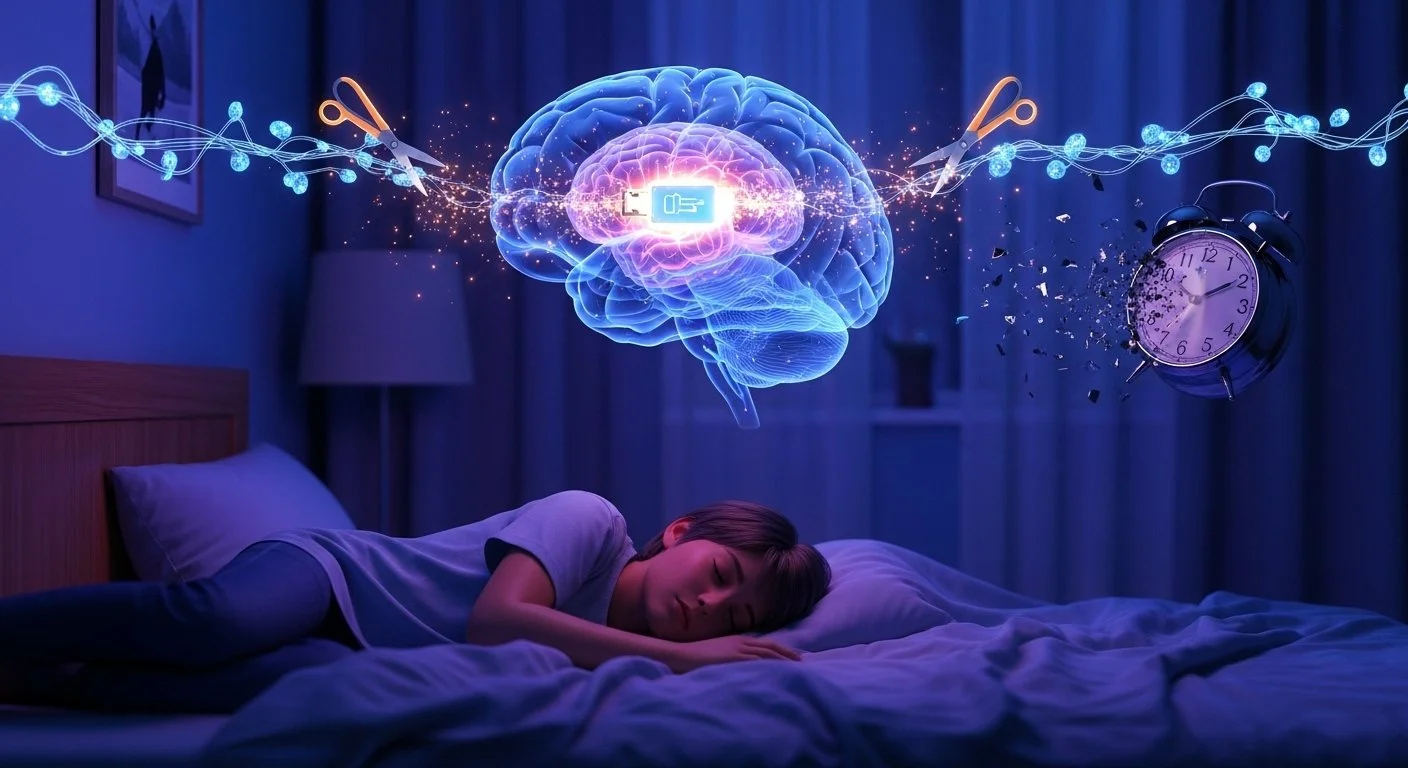
For a teenager, sleep isn't just a recovery period; it’s a biological necessity for building the emotional and intellectual "hardware" they will use for the rest of their lives. If you’ve noticed a teen in your life struggling with mood swings or "brain fog," it isn't just about how long they stay in bed; it’s about when that sleep happens and what the brain is doing during those invisible hours.
"Catch-Up Sleep" Is Actually Making Your Teen’s Social Jetlag Worse
Does the weekend cycle look familiar to you: a teenager who survives on six hours of sleep during the week, only to "crash and burn" on Saturday, sleeping until 2:00 PM. While this feels like a logical "repayment" of a sleep debt, research in circadian medicine suggests this habit is actually creating a state known as Social Jetlag.
This isn't just a catchy term; it’s a measurable physiological mismatch between the body’s internal clock and the external demands of society. When a teen shifts their sleep schedule by more than two hours between weekdays and weekends, they are essentially forcing their body to fly across three time zones every Friday night and fly back every Sunday.
This constant "resetting" of the brain master clock—the suprachiasmatic nucleus in the brain—wreaks havoc on more than just energy levels. It disrupts the peripheral clocks in the liver, gut, and muscles. Research now shows that this misalignment is a primary driver of insulin resistance in adolescents. Their bodies literally forget how to process sugar efficiently because the "digestive clock" thinks it's the middle of the night while the "social clock" is demanding a pancake breakfast. This is why a sleep-deprived teen doesn't just feel tired; they are metabolically compromised.
The Melatonin Delay: Your Teen Isn't a "Night Owl" by Choice
One of the most misunderstood aspects of the adolescent brain is the circadian phase delay. During puberty, the timing of melatonin secretion—the hormone that signals the body it’s nighttime—shifts naturally by about two to three hours later than in adults or younger children. This isn't a behavioral rebellion; it’s a biological shift.
Imagine trying to go to sleep at 8:00 PM as an adult; your body simply isn't ready. For a teenager, asking them to sleep at 10:00 PM is biologically equivalent to asking an adult to nap in the late afternoon. Teenagers are often still in a state of high physiological arousal when parents are asking them to wind down. When we force these "night owls" to wake up at 6:00 AM for school, we aren't just cutting their sleep short—we are cutting off the most vital stage of their sleep cycle: Rapid Eye Movement (REM). Since REM sleep predominates in the second half of the night, early school start times act as a "REM-ectomy," stripping the brain of the time it needs to process emotions and solidify learning.
The Emotional Cost
When a teen undergoes a daily REM-ectomy, they lose this emotional processing time. Without REM, the "affective" (emotional) tone of a memory isn't stripped away. This means that a minor social slight in the hallway or a bad grade doesn't just feel like a "memory"—it feels like a fresh, raw trauma every time they think about it. We are seeing a direct correlation between this lack of morning REM sleep and the inability of teenagers to regulate their reactions to everyday stress.
In addition, when the REM-ectomy occurs, the physical connection between the amygdala (the brain's emotional center) and the prefrontal cortex (the logical center) weakens. In a brain starved of REM sleep, the amygdala becomes hyper-active (up to 60% more responsive to negative stimuli).
Think of the amygdala as a car’s gas pedal and the prefrontal cortex as the brakes. REM sleep is the "mechanic" that ensures the brakes are working. Without those final two hours of sleep, a teenager is driving through their day with a stuck gas pedal and no brakes. This is why "morning-after" irritability isn't just a bad mood—it’s a neurological state where the brain is physically unable to dampen emotional responses.
The Cognitive Cost
We often tell students to "get a good night's sleep before a test," but we rarely explain why. Sleep is when the brain moves information from "temporary storage" (the hippocampus) to "long-term storage" (the cortex). This process is called Consolidation.
In addition, for a teenager, intellectual development isn't just about learning facts; it’s about Cognitive Flexibility—the ability to take what you’ve learned and apply it to a new problem.
Many teens stay up late to study, thinking they are "getting ahead." However, they are inadvertently sabotaging the very learning they are trying to achieve. While deep sleep (the first half of the night) helps store "fact-based" information, REM sleep (the second half) is responsible for integration and creativity.
REM is the phase where the brain looks for distant associations. It’s where the brain takes a new math formula and figures out how it relates to a physics problem, or how a vocabulary word fits into a complex essay. By performing a REM-ectomy on themselves to squeeze in more study hours, students are essentially filling a bucket with water that has a giant hole in the bottom. They might remember the fact for the test at 8 AM, but by the following Tuesday, that information—and the ability to use it creatively—is gone.
The Role of NREM Sleep: How Deep Sleep Prunes the Teen Mind
To understand why teen sleep is so unique, we have to look at synaptic pruning. Think of the teenage brain as a wild, overgrown garden. During the day, as they learn new skills and navigate social hierarchies, the brain creates thousands of new neural connections (synapses). If we kept every single one of these connections, the brain would become inefficient, cluttered, and incredibly "expensive" to run in terms of energy.
Deep, non-REM (NREM) sleep is the "master gardener" that comes in at night to prune away the weak or unnecessary connections, leaving only the strongest and most efficient pathways. This process is essential for the transition from the "plastic" brain of a child to the "specialized" brain of an adult. When a teen is chronically sleep-deprived, the synaptic pruning is dramatically reduced. The result is a brain that is physically "noisier," making it harder for the teenager to focus, solve complex problems, or filter out distractions.
The Metabolic Price For a Sleep-Deprived Teen
Finally, we must address the link between sleep and the "hunger hormones," leptin and ghrelin. Leptin tells the brain when we are full, while ghrelin signals that it’s time to eat. In the adolescent body, sleep deprivation causes a double-whammy: leptin levels plummet and ghrelin levels spike.
This is why a tired teen doesn't just crave food; they crave high-calorie, high-sugar "junk" food. Their brain is screaming for a quick hit of energy to compensate for the lack of rest. When combined with the insulin resistance caused by social jetlag, this creates a dangerous metabolic environment. We are seeing that improving a teen’s sleep architecture can be as effective—if not more so—than dietary changes in managing weight and preventing adolescent-onset Type 2 diabetes. Sleep is no longer just "rest"; it is a primary pillar of metabolic medicine.
Conclusion
Protecting a teenager’s sleep requires us to shift our perspective from seeing it as a luxury to seeing it as a medical necessity. When we allow for later start times and consistent circadian rhythms, we aren't "coddling" them; we are ensuring that the gardener can prune the brain, the mechanic can fix the emotional brakes, and the data can be moved from the temporary USB drive to the permanent hard drive. By respecting the "invisible hours," we give our teenagers the best possible chance to grow into emotionally resilient, intellectually flexible adults.
-
Hagenauer, M. H., Kuletz, E. K., & Lee, T. M. (2009). Adolescent changes in the homeostatic and circadian regulation of sleep. Developmental Neuroscience, 31(4), 276–284.
Dahl, R. E., & Lewin, D. S. (2002). Pathways to adolescent health sleep regulation and behavior. Journal of Adolescent Health, 31(6), 175–181.
Telzer, E. H., Goldenberg, D., Fuligni, A. J., Lieberman, M. D., & Galván, A. (2015). Sleep deprivation exacerbates adolescent-specific alterations in cognitive-control-related brain function. NeuroImage, 119, 282–289.
de Vivo, L., Bellesi, M., Marshall, W., Bushong, E. A., Ellisman, M. H., Tononi, G., & Cirelli, C. (2017). Ultrastructural evidence for synaptic scaling across the wake/sleep cycle. Science, 355(6324), 507–510.
Tarokh, L., Saletin, J. M., & Carskadon, M. A. (2016). Sleep in adolescence: Physiology, cognition and mental health. Sleep Medicine, 25, 71–77.
Walker, M. P., & van der Helm, E. (2009). Overnight therapy? The role of sleep in emotional brain processing. Psychological Bulletin, 135(5), 731–748.
Xie, L., Kang, H., Xu, Q., Chen, M. J., Liao, Y., Thiyagarajan, M., ... & Nedergaard, M. (2013). Sleep drives metabolite clearance from the adult brain. Science, 342(6156), 373–377.
Carskadon, M. A. (2011). Sleep in adolescents: The perfect storm. Pediatric Clinics of North America, 58(3), 637–647.
Goldstein, A. N., & Walker, M. P. (2014). The role of sleep in emotional brain function. Annual Review of Clinical Psychology, 10, 679–708.
Krause, A. J., Simon, E. B., Mander, B. A., Greer, S. M., Saletin, J. M., Goldstein-Piekarski, A. N., & Walker, M. P. (2017). The sleep-deprived human brain. Nature Reviews Neuroscience, 18(7), 404–418.
Van Der Helm, E., Yao, J., Dutt, S., Rao, V., Saletin, J. M., & Walker, M. P. (2011). REM sleep depotentiates amygdala activity to previous emotional experiences. Current Biology, 21(23), 2029–2032.
Stickgold, R. (2005). Sleep-dependent memory consolidation. Nature, 437(7063), 1272–1278.
Adrienne, W., & Walker, M. P. (2024). REM sleep and the emotional brain: A review of the norepinephrine-depletion hypothesis. Nature Reviews Neuroscience, 25(2), 89–104.