Wake Up to Pee? Our Body's Clock Governs Our Bladder
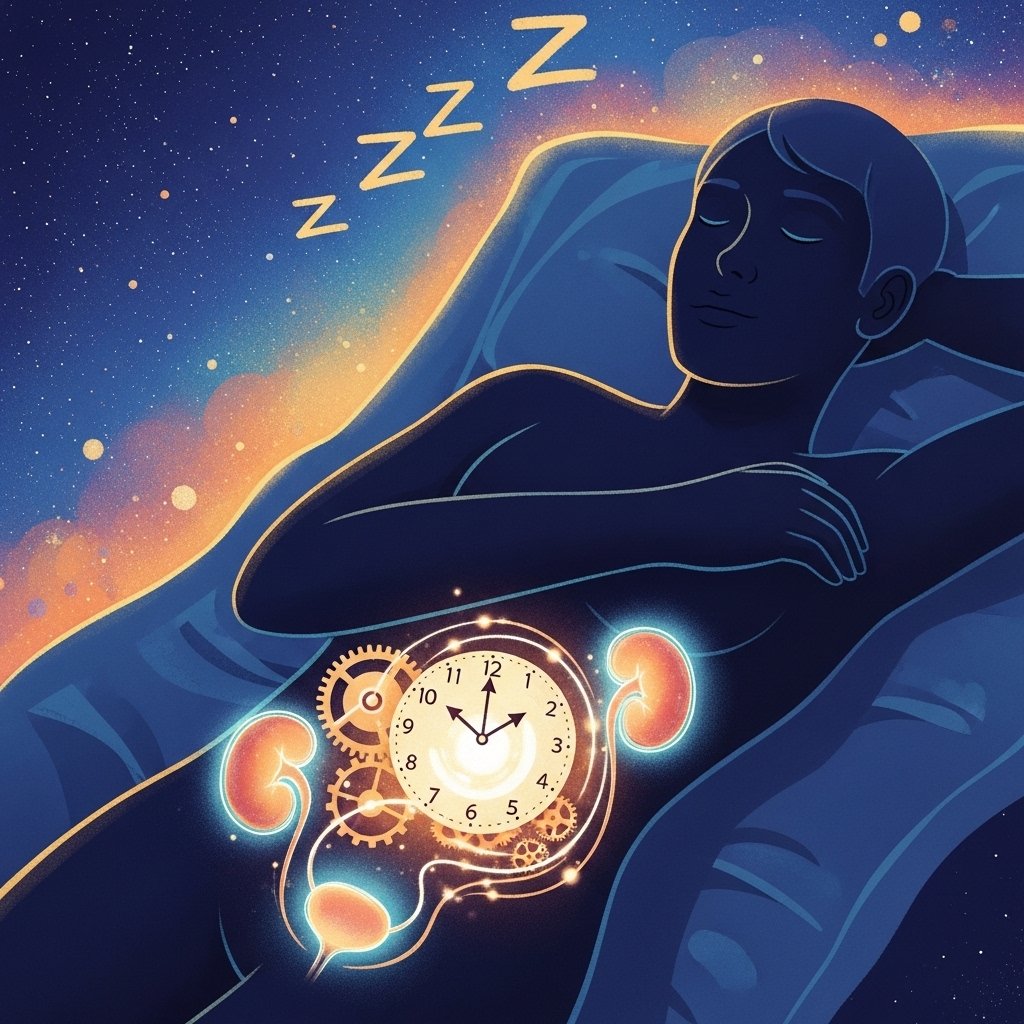
You settle into bed, your eyes finally close, and just as you drift into deep sleep—nature calls. Waking up for a late-night bathroom trip, or nocturia, feels like a minor annoyance. But the sophisticated system that's failing to keep you asleep involves much more than just a full bladder; it's a breakdown in your body's master internal clock.
The same powerful force that regulates your sleep-wake cycle—the circadian rhythm—is supposed to lock down your bladder for the night. When this internal timing mechanism fails to hold the line, it impacts more than just your sleep.
The Kidney’s Night Shift
For you to enjoy a continuous, uninterrupted rest, your body executes a flawless "night shift" for fluid control. The star of this show is a neurohormone called vasopressin (or antidiuretic hormone, ADH).
Hormonal Lock: While vasopressin is released all day, its critical impact happens after dark. Your circadian rhythm dictates a physiological peak of vasopressin during nighttime hours. This hormone drastically decreases urine production by reabsorbing most of the water back into your body.
Genetic Fine-Tuning: This process isn't just about hormones floating around; it's hardwired into your DNA. Core clock genes directly control how sensitive your kidneys are to vasopressin. This molecular mechanism ensures the kidney is maximally receptive to the hormone exactly when you need it to be—when you are sleeping.
Bladder Coordination: Furthermore, your bladder has its own peripheral clock, coordinating with the kidney to naturally increase its capacity at night, minimizing any urge to void.
This whole system is a perfectly orchestrated symphony designed to keep the floodgates closed until morning.
When the Clock Fails: The Cost of Nocturia
When this careful orchestration breaks down, you experience Nocturnal Polyuria (NP)—the production of excessive urine during sleep, which leads to waking up (nocturia).
This failure often stems from two sources:
Central Hormonal Failure: The brain either isn't releasing enough vasopressin, or it's releasing it at the wrong time.
Peripheral Resistance: The kidney's internal clock is disrupted, making it resistant to vasopressin, even if the hormone levels are adequate.
However, sometimes the system is simply overwhelmed by a fluid influx. If you retain fluid in your lower extremities (edema) from a high-sodium diet or conditions like heart failure, that fluid mobilizes centrally when you lie down. This rapid fluid influx quickly overwhelms the body’s nighttime lock-down mechanism, leading to rapid urine production shortly after you fall asleep.
The consequences of this disruption are far more severe than just an annoying trip to the toilet:
Injury Risk: Nocturia is strongly associated with an increased risk of nighttime falls and fractures, especially in older adults.
Systemic Health: Fragmented, poor-quality sleep impairs cognitive function and is linked to higher risks of hypertension, cardiovascular disease, and mood disorders.
Chronic Strain: Nocturia is independently associated with an increased mortality risk, suggesting that persistent sleep fragmentation acts as a chronic stressor on your body.
Practical Solutions
Given the serious health implications, managing nocturia should be viewed as a critical preventative health measure. We can often help "re-train" the kidney and bladder through behavioral and lifestyle adjustments, sometimes called Behavioral Chronotherapy.
Fluid and Diet Timing
Front-load Hydration: Rationally distribute your daily fluid intake, and most importantly, strictly control fluid consumption within three to four hours of bedtime.
Watch the Stimulants: Avoid caffeine and alcohol in the late afternoon and evening, as both are powerful diuretics and can cause bladder overactivity.
Restrict Sodium and Protein: High dietary salt intake contributes significantly to fluid retention. Also, limit large, high-protein meals in the late evening, as protein creates an osmotic load that draws water into the urine.
Managing Edema and Medications
If fluid retention in your legs is the problem:
Pre-Mobilize Fluid: Elevate your lower extremities sometime before bed.
Wear Compression: Daytime use of compression stockings helps minimize fluid sequestration in the legs, ensuring the fluid is processed by the kidneys during the day when your body is physiologically prepared for it.
Finally, if you take diuretics, discuss timing with your doctor. Diuretics are often most effective when scheduled six to eight hours before bedtime (typically mid-afternoon) to ensure their peak effect is completed before you try to sleep.
By making these temporal adjustments—and maintaining a consistent sleep schedule while avoiding artificial light before bed—you are supporting the natural rhythms that keep your kidney and bladder clocks perfectly synchronized for a full, restful night.
-
Crislip, G. R., Douma, L. G., Masten, S. H., Cheng, K. Y., Lynch, I. J., Johnston, J. G., Barral, D., Glasford, K. B., Holzworth, M. R., Verlander, J. W., & Gumz, M. L. (2022). Circadian clocks of the kidney: function, mechanism, and regulation. Physiological Reviews, 102(3), 1289–1321.
Negoro, H., Togo, Y., Murata, S., Ueda, T., Fukamizu, A., & Harada, O. (2023). Glucocorticoids coordinate the bladder peripheral clock and diurnal micturition pattern in mice. Communications Biology, 6(1), 82.
Juffre, S., & Gumz, M. L. (2024). Recent advances in understanding the kidney circadian clock mechanism in health and disease. American Journal of Physiology-Renal Physiology, 326(5), F711–F722.