Beyond the 8-Hour Myth: Why You’re Still Exhausted and How to Fix It
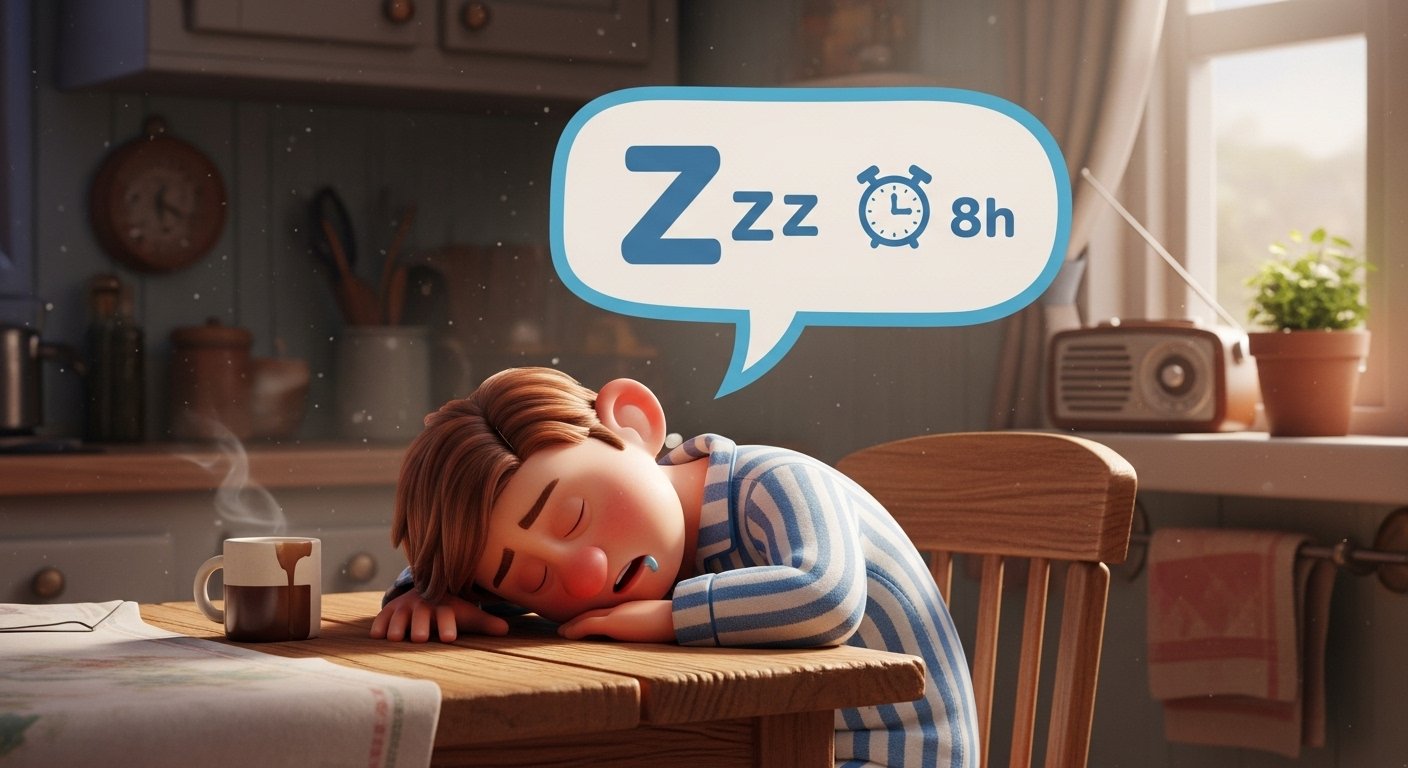
You stayed in bed for a full eight hours. Yet, when the alarm goes off, you feel like you’ve been hit by a truck. It is incredibly frustrating to "do everything right" and still feel like a zombie by noon. If you are waking up tired after 8 hours, the problem usually isn't the amount of sleep you’re getting—it’s the sleep quality. Here, we will look past the basic advice and uncover the hidden biological reasons why your body isn't recharging, and exactly how you can reclaim your energy.
Can it actually be Sleep Inertia?
Have you ever woken up feeling heavy, confused, and grumpy? This isn't just a bad mood; it’s a biological state called sleep inertia. While everyone feels a little groggy for about 15 minutes after waking, some people remain in this fog for hours.
So you may not actually be tired after the 8-hr sleep; it is sleep inertia that makes you not feel energetic!
This often happens because of when you wake up, not how much you slept. Your sleep happens in cycles of roughly 90 minutes. If your alarm goes off while you are in the middle of "Slow Wave Sleep" (SWS)—the deepest, most restorative stage—your brain is forced to jump from a very "off" state to an "on" state instantly.
Research in the journal Frontiers in Physiology by Hilditch and McHill (2019) explains that during SWS, your brain is flooded with adenosine, the chemical that builds up all day to make you feel sleepy. When you are ripped out of deep sleep, that adenosine is still stuck in your brain’s receptors. Think of it as a mechanical "glitch." Your brain is physically awake, but chemically, it’s still trying to stay under. Even if you got 8-9 hours of rest, waking up at the wrong moment in the cycle can leave you feeling drained for half the day.
A "Flat" Cortisol Response Steals Your Morning Energy.
If sleep inertia is the "mechanical" fog, the Cortisol Awakening Response (CAR) is your "hormonal" ignition. In a healthy body, cortisol—the hormone that helps you feel alert—should spike by 50% to 75% within 30 minutes of you opening your eyes. This surge acts like a natural shot of espresso, clearing away the lingering adenosine and telling your brain it’s time to be alert.
Even if you wake up at a "good" time in your sleep cycle, without this cortisol jump, you lack the power to flush out the morning grogginess.
Research published in Psychoneuroendocrinology by Elder et al. (2023) shows that a weak CAR is a primary predictor of low morning alertness. When this ignition misfires, you don't get that "lift-off" feeling. Instead of your energy rising as the sun comes up, it stays flat, leaving you in a hybrid state—halfway between sleep and wakefulness—for the entire morning.
Is "Social Jetlag" Ruining Your Internal Clock?
Even if you get enough hours, your body has a very strict internal schedule called the circadian rhythms (the internal biological clock). This rhythm tells every cell in your body when it is time to be active and when it is time to repair. One major reason for waking up tired after 8 hours in the modern society is a phenomenon known as "Social Jetlag."
Social jetlag happens when your biological clock (when your body wants to sleep) doesn't match your social clock (when you actually sleep for work or school). For example, if you stay up late on Friday and Saturday and sleep in, but wake up early on Monday, you have effectively "flown" across three time zones and back in one weekend.
A 2023 study published in The American Journal of Clinical Nutrition by Bermingham et al. found that even a 90-minute difference in your mid-sleep point between work days and free days is linked to poorer health markers and increased fatigue. When your sleep schedule shifts constantly, your brain never reaches the deep, restorative stages effectively because it is constantly trying to "reset" itself. To fix this, your body needs consistency more than it needs extra hours.
The Invisible Thief: How Micro-Arousals Destroy Sleep Quality
You might think you slept through the night, but your brain might have "woken up" dozens of times without you knowing it. These are called micro-arousals. These tiny interruptions last only 3 to 15 seconds, so you don't remember them, but they "reset" your sleep cycle.
If you are waking up tired after 8 hours, micro-arousals are often the culprit. They are frequently caused by things you might ignore, such as:
Minor Breathing Issues: Not just full sleep apnea, but "Upper Airway Resistance," where your body works harder to breathe, keeping your brain on high alert.
Blood Sugar Dips: If you eat a high-carb snack before bed, your blood sugar may crash at 3:00 AM, causing a spike in stress hormones like cortisol that pulls you into a lighter sleep.
Pet Movement: A dog shifting on the bed can create enough noise or movement to pull you out of deep sleep, even if you don't fully open your eyes.
A study in Scientific Reports (2020) highlighted that fragmented sleep—sleep broken up by these small arousals—is just as damaging to your mood and energy as getting only 4 hours of total sleep. Your body needs "sleep continuity" to perform the deep cleaning your brain requires.
How Late-Night Eating Disrupts Your Deep Repair
Sleep should be a state of rest, but for many, it is a state of physiological stress. One major "invisible thief" of sleep quality is late-night digestion. For your brain to enter the deepest stages of sleep, your core body temperature must drop by about 2 to 3 degrees.
If you eat a large, heavy meal close to bedtime, your body stays "hot" because it is working hard to digest food. This metabolic activity keeps your heart rate elevated and prevents you from reaching the most restorative stages of sleep. You might be "unconscious" for 8 hours, but your body was essentially working a night shift. This results in waking up feeling physically unrecovered and heavy.
Why Mouth Breathing Prevents High-Quality Sleep
If you wake up with a dry mouth or a slight headache, you likely breathed through your mouth all night. This is a significant reason for waking up tired after 8 hours. Mouth breathing is less efficient than nasal breathing and can lead to lower oxygen levels in the blood.
As mentioned above, mouth breathing often triggers "micro-arousals"—tiny interruptions where your brain wakes up for a few seconds to adjust your breathing. You won't remember these, but they "reset" your sleep cycle constantly. A study in the journal Sleep (Vargas & Lopez-Duran, 2020) demonstrated that this kind of fragmented sleep ruins your morning cortisol spike. If your sleep is broken by breathing issues, your "hormonal ignition" will never fire correctly the next morning.
Are You Sleeping Outside Your "Biological Window"?
There is a period in the early evening known as the "Wake Maintenance Zone," or the "Forbidden Zone." This is a window of time where your body sends out its strongest signal to stay awake. If you push through this and stay up too late, you might get a "second wind."
When you finally go to sleep after this second wind, your body is often over-tired and flooded with stress hormones like cortisol. This results in "wired but tired" sleep. Even if you stay in bed until 10:00 AM to make up for it, the quality of that sleep is significantly lower. Research by Roenneberg et al. in Nature Communications shows that when we sleep outside our natural "window," the brain's ability to clear out toxins is compromised. This is why you wake up with "brain fog" even after a long sleep.
Conclusion
Waking up tired after 8 hours is a signal from your body that the structure of your sleep is broken. It’s not just about the clock; it’s about the rhythm, the timing, and the environment. Don't settle for "good enough" rest. Start by picking one change today—like keeping your wake-up time the same all week—and watch how your energy transforms.
-
Bermingham, K. M., Hall, W. L., & Berry, S. E. (2023). Social jetlag is associated with a less healthy diet, higher BMI, and unfavorable metabolic health markers in a large UK cohort. The American Journal of Clinical Nutrition, 118(2), 432–441.
Elder, G. J., Ellis, J. G., Barclay, N. L., & Wetherell, M. A. (2023). The cortisol awakening response is associated with subjective sleep quality and morning alertness in healthy young adults. Psychoneuroendocrinology, 151, 106063.
Hilditch, C. J., & McHill, A. W. (2019). Sleep inertia: Determinants, counter-measures, and implications for personalized medicine. Frontiers in Physiology, 10, 1002.
Vargas, I., & Lopez-Duran, N. (2020). The cortisol awakening response: An index of sleep quality and sleep fragmentation. Sleep, 43(1), zsz191.
Roenneberg, T., Pilz, L. K., Zerbini, G., & Winnebeck, E. C. (2019). Chronobiological aspects of sleep. Current Biology, 29(17), R819–R827.
Bäumler, D., Kliegel, M., Kirschbaum, C., & Miller, R. (2014). The cortisol awakening response is not influenced by the sleep stage of awakening. Psychoneuroendocrinology, 48, 128–134.