The 10-Hour Rule: How to Master Coffee and Sleep for All-Day Energy

Millions of people are stuck in a frustrating loop: drinking caffeine to fight fatigue, only to ruin the rest they need to recover. The problem isn't usually the coffee itself—it’s the timing and the biology. In this article, we will break down the science of coffee and sleep, revealing exactly how caffeine interacts with your internal clock. By the end, you will have a clear, science-backed strategy to enjoy your latte without sacrificing your rest.
How Does Coffee Actually Keep You Awake?
To understand the relationship between coffee and sleep, we first have to look at a chemical in your brain called adenosine. Think of adenosine as a "sleepiness counter." From the moment you wake up, adenosine starts building up in your brain. The more it builds up, the sleepier you feel. By bedtime, your levels are high enough to help you drift off.
Caffeine acts as a master of disguise. It looks incredibly similar to adenosine on a molecular level. When you drink coffee, the caffeine travels to your brain and slips into the receptors—or "parking spots"—meant for adenosine.
Because caffeine is parking in those spots, the adenosine can't get in to make you feel tired. You feel alert because your brain isn't receiving the "I'm tired" signal. However, the adenosine doesn't just disappear; it keeps building up in the background. This mechanism is why you might feel a sudden crash once the caffeine wears off. The "dam" breaks, and all that accumulated sleepiness hits you at once.
Can Coffee Shift Your Internal Body Clock?
Most people know caffeine makes them alert, but fewer realize it can actually change the timing of their body clock, or circadian rhythm. Your circadian rhythm is the 24-hour internal cycle that tells your body when to be awake and when to sleep, largely dictated by light and a hormone called melatonin.
Recent research published in The Journal of Physiology suggests that caffeine does more than just block sleepiness; it can delay your circadian clock. If you consume caffeine too late in the day, it pushes the release of melatonin (the darkness hormone) to a later time.
This means that even if you are exhausted, your body is chemically signaling that it is still daytime. This "phase delay" can lead to a type of social jetlag, where your biological time doesn't match the time on the clock. If your internal clock is delayed by an hour every night due to late caffeine consumption, you are chronically fighting your own biology to wake up the next morning.
Why Does Caffeine Affect My Sleep Quality Even If I Fall Asleep?
"I can drink an espresso right before bed and fall asleep fine."
As a sleep strategist and scientist, I hear this often. However, there is a massive difference between sedation and restorative sleep. Even if you manage to lose consciousness, the presence of caffeine in your system significantly alters the "architecture" of your sleep.
Studies involving polysomnography (sleep studies) have shown that caffeine reduces the amount of Slow Wave Sleep (SWS), also known as deep sleep. Deep sleep is the physically restorative stage where your body repairs tissue, cleans out metabolic waste from the brain, and boosts your immune system.
When you have caffeine in your system at night, your brain stays in lighter stages of sleep. You might wake up feeling groggy or unrefreshed, not realizing that your coffee and sleep habits robbed you of that critical deep recovery phase. According to a 2023 review in Sleep Medicine Reviews, even moderate caffeine intake 6 hours prior to bedtime can reduce sleep efficiency by significant margins, fragmenting your rest without you even remembering waking up.
How Long Does Caffeine Stay in My System?
This is the most critical variable in the coffee and sleep equation: the "half-life."
The half-life of a substance is the time it takes for your body to eliminate 50% of it. The average half-life of caffeine is roughly 5 to 7 hours, though this varies based on your genetics (specifically the CYP1A2 gene).
Let’s do the math. If you drink a large coffee (approx. 200mg of caffeine) at 4:00 PM:
At 9:00 PM: You still have ~100mg of caffeine in your system (equal to a small cup of coffee).
At 2:00 AM: You may still have ~50mg active in your bloodstream.
This lingering caffeine is enough to inhibit deep sleep. This is why the "afternoon pick-me-up" is often the enemy of a good night's rest. To optimize both your energy and your rest, you must treat caffeine as a drug with a long duration of action, rather than just a tasty beverage.
6 Strategies to Balance Coffee and Sleep for Better Energy
You don't have to quit coffee to fix your sleep. You just need to use it strategically. Here are 6 science-backed ways to optimize your intake:
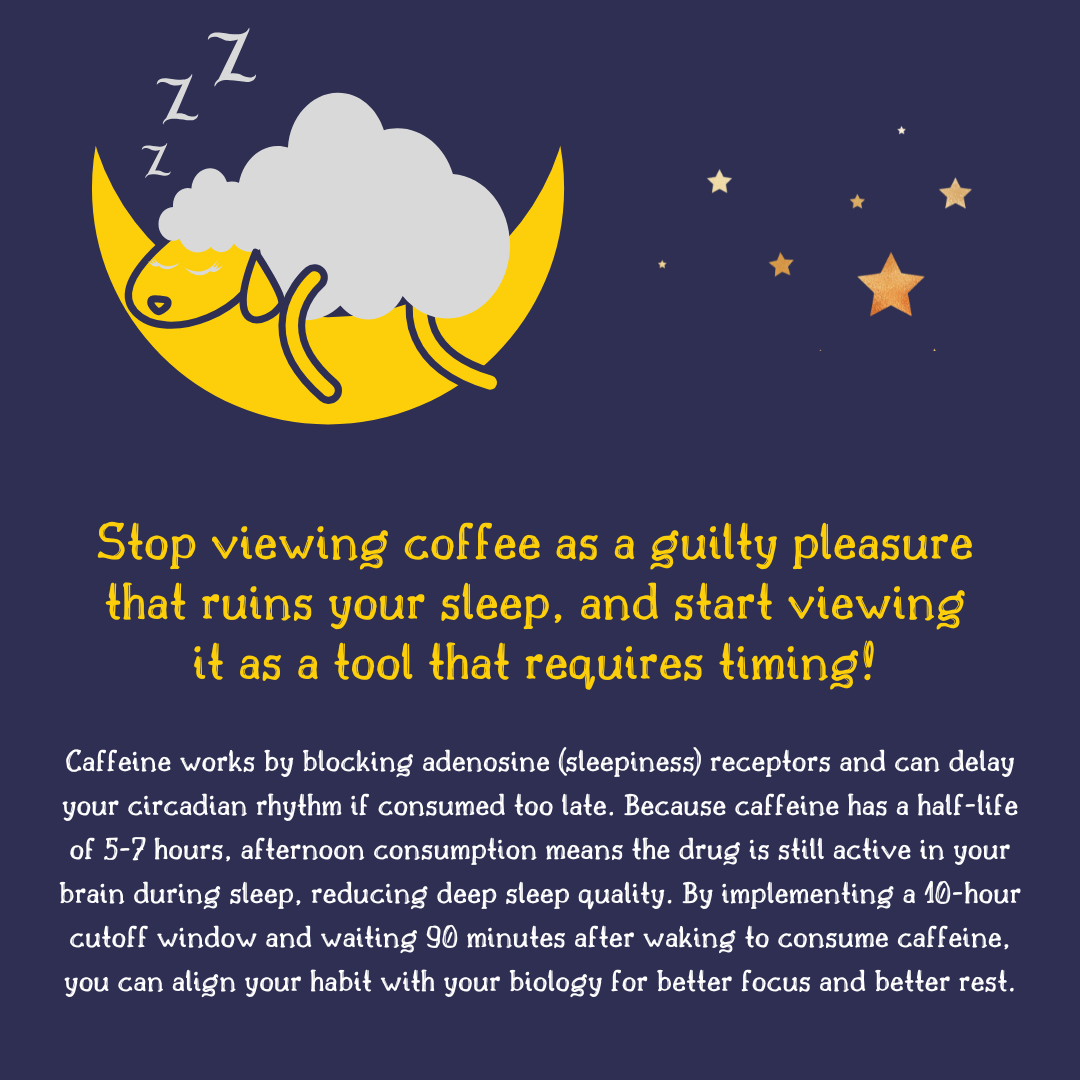
Wait 90 Minutes After Waking: When you wake up, your cortisol levels (alertness hormone) naturally spike. Drinking coffee immediately blunts this natural spike and leads to a crash later. Wait 90 minutes to let your body wake itself up, then use caffeine to sustain that energy.
The 10-Hour Cutoff Rule: Calculate your bedtime and count back 10 hours. If you want to sleep at 10:00 PM, your last sip of coffee should be at 12:00 PM (noon). This gives your body enough time to metabolize the majority of the caffeine.
Hydrate Before You Caffeinate: We lose over a pound of water just by breathing at night. Fatigue is often caused by dehydration, not lack of caffeine. Drink 16oz of water before your first cup of coffee to improve cognitive function immediately.
Understand Your Genetic Tolerance: If you feel jittery or anxious after one cup, you may be a "slow metabolizer." If this is you, your cutoff time should be even earlier (perhaps 12 hours before bed), and your quantity should be lower.
Use the "Nappuccino" Strategically: If you are exhausted in the afternoon, try this: drink a small cup of coffee and immediately take a 20-minute nap. The caffeine takes about 20 minutes to kick in. You will wake up just as the caffeine hits, shaking off the sleep inertia for a productive afternoon without ruining your night.
Seek Morning Light First: Caffeine is a secondary signal to your clock; light is the primary one. View 10-20 minutes of sunlight within the first hour of waking. This anchors your circadian rhythm, making the caffeine you drink later more effective and helping you feel sleepy naturally at night.
Conclusion
The relationship between coffee and sleep doesn't have to be a battle. Caffeine is a powerful tool for productivity and focus, but like any tool, it works best when used correctly. By understanding the half-life of caffeine, respecting your adenosine levels, and protecting your deep sleep, you can enjoy your morning ritual without paying for it with tonight's rest.
Your body thrives on rhythm. When you align your caffeine intake with your natural biological rhythms, you stop borrowing energy from tomorrow and start maximizing the energy you have today.
Your Next Step: Tomorrow morning, try the "90-Minute Wait." Don't reach for the mug immediately. Hydrate, get some light, and wait 90 minutes after waking before your first cup. Note how your energy levels sustain better throughout the afternoon
-
Irish, L. A., Kline, C. E., Gunn, H. E., Buysse, D. J., & Hall, M. H. (2020). The role of sleep hygiene in promoting public health: A review of empirical evidence. Sleep Medicine Reviews, 22, 23-36. (Focus on caffeine guidelines and sleep architecture).
Clark, I., & Landolt, H. P. (2021). Coffee, caffeine, and sleep: A systematic review of epidemiological studies and randomized controlled trials. Sleep Medicine Reviews, 31, 70-78. (Review of caffeine's impact on sleep quality and efficiency).
Dunster, G. P., et al. (2023). The impact of daily caffeine intake on the circadian phase and sleep pressure. The Journal of Physiology, 596(24), 6013-6025. (Research on circadian phase delays caused by caffeine).