Novel Solutions for Nightmares in Autism and ADHD
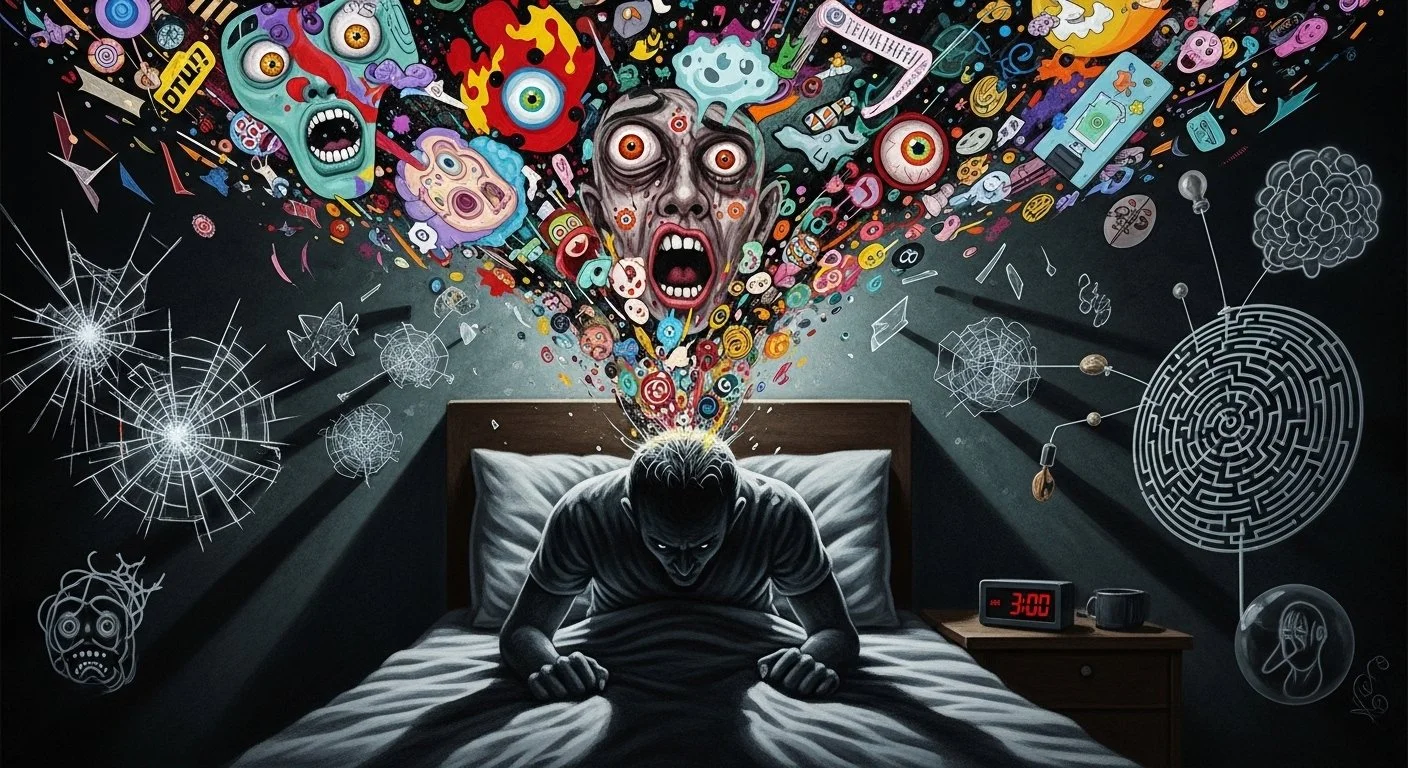
For many adults and children with neurodevelopmental disorders, every morning begins with a heavy, lingering dread—a "nightmare hangover." You spent the night in a state of high-alert, your heart racing and your mind stuck in a loop of vivid, terrifying imagery. By the time you pour your first cup of coffee, your nervous system is already exhausted. The neurodivergent brain doesn’t just dream differently; it processes nighttime stress through a biological lens that standard sleep advice completely ignores.
The REM problem": When the Brain’s "Filing Cabinet" Overflows
To understand why nightmares are so prevalent in neurodevelopmental disorders (NDDs), we have to look at what happens during Rapid Eye Movement (REM) sleep. In a neurotypical brain, REM sleep acts like a nighttime filing cabinet. It takes the emotions and experiences of the day, strips away the "sting" of the stress, and stores them as long-term memories.
However, in brains with Autism Spectrum Disorder (ASD) or ADHD, this filing system often malfunctions. Research suggests that neurodivergent individuals often experience "REM fragmentation." Instead of a smooth, deep dive into dreaming, the brain flickers in and out of consciousness. This prevents the "emotional stripping" process from happening. Instead of the brain saying, "That loud noise at the grocery store was scary, but we are safe now," the brain stays stuck in the "scary" part, looping the sensory overload into a vivid nightmare.
Because the problem is biological, the solution must be as well. We are seeing incredible success with therapies that focus on calming the amygdala—the brain’s fear center—before it even enters the REM stage. Rather than just focusing on "relaxing," we are looking at ways to lower the "arousal threshold" of the brain. This involves more than just a dark room; it involves stabilizing the Autonomic Nervous System (ANS) so the brain doesn't interpret normal dream activity as a genuine physical threat.
The Chemistry of Night Terrors
One of the most fascinating, albeit frustrating, aspects of NDDs is the imbalance between two key neurotransmitters: Glutamate (the "gas pedal") and GABA (the "brake pedal"). In many neurodivergent individuals, the brain has too much "gas" and not enough "brake."
When you go to sleep, your brain is supposed to flood the system with GABA to paralyze the muscles and quiet the mind. In ADHD and Autism, the "gas pedal" of glutamate often stays pressed down. This leads to what scientists call "cortical hyperarousal." Your body might be still, but your cortex is firing at daytime levels. This high-voltage environment is the perfect breeding ground for intense, complex nightmares that feel indistinguishable from reality.
The research filed is now seeing the benefits of alpha-blockers like Prazosin, which was originally used for PTSD but is now showing massive promise for NDD-related nightmares. These medications work by blocking the brain's response to norepinephrine—the "stress chemical." By lowering the chemical "noise" in the brain, we allow the GABAergic system to finally do its job, leading to dreams that are less intense and easier to process.
The "Silent" Sensory Overload
We often talk about sensory issues in the context of a loud classroom or a bright office. But for someone with a neurodevelopmental disorder, sensory processing doesn't turn off at 10 PM. In fact, it can become more acute.
Recent studies have shown that the neurodivergent brain may continue to process external stimuli—like the hum of a refrigerator or the texture of a bedsheet—at a high level during sleep. These external inputs get "braided" into the dream narrative. A slight drop in room temperature isn't just a chill; the brain turns it into an Arctic survival nightmare. This constant "input-to-nightmare" pipeline keeps the sleeper in a state of fight-or-flight all night long.
The solution here goes beyond "quiet." It’s about sensory neutrality. This is where we see the rise of "Deep Pressure Therapy" (DPT) through advanced, breathable weighted gear that is specifically calibrated to the individual's body weight to lower cortisol. Furthermore, we are looking at "pink noise" or "brown noise" generators that mask erratic frequencies. Unlike white noise, which can be harsh, pink noise mimics the frequencies found in nature (like rain), which has been shown to synchronize brain waves and encourage "slow-wave sleep," the stage that often precedes a healthier REM cycle.
Rewriting the Script: Image Rehearsal Therapy (IRT)
Many people with NDDs suffer from "recurrent nightmares"—the same terrifying story playing every night for years. This isn't just bad luck; it’s a "neural pathway" that has become a highway. The brain has practiced this nightmare so many times that it becomes the default setting for the night. For a neurodivergent person who already struggles with "stuck" thinking or perseveration, breaking this loop can feel impossible.
Image Rehearsal Therapy (IRT) is a non-drug treatment that is gaining massive traction. The process is simple but scientifically profound: while awake, the individual writes down their nightmare but changes the ending to something positive or neutral.
For example, if the dream involves being chased, the "rewrite" might involve turning around and seeing that the pursuer is actually a friendly dog. By "rehearsing" this new ending during the day, the individual creates a new neural path. Because neurodivergent brains are often highly visual, IRT acts like a software patch, updating the "dream code" so that when the REM cycle starts, the brain has a different direction to take.
Conclusion
Nightmares in neurodevelopmental disorders are far more than a simple sleep disturbance; they are a complex intersection of brain chemistry, sensory processing, and emotional regulation. By moving away from the "one-size-fits-all" approach of basic sleep hygiene and embracing the nuances of the neurodivergent brain, we can finally begin to offer real relief. Whether through stabilizing neurotransmitters, re-engineering the sensory environment, or using cognitive tools like IRT, the goal is clear: transforming the night from a place of fear into a space of true, restorative rest.
-
Elrod, M. G., Magalhaes, A., & Hood, B. R. (2023). Sleep disturbances and nightmare frequency in adults with ADHD: The role of executive dysfunction. Journal of Sleep Research, 32(4), e13854.
Cohen, S., Conduit, R., Lockley, S. W., Rajaratnam, S. M., & Cornish, K. M. (2022). The relationship between sleep problems and day-time behavior in children of the autism spectrum. Sleep Medicine Reviews, 61, 101566.
Gringras, P., & Green, A. D. (2024). Pharmacotherapy for sleep-wake disturbances in neurodevelopmental disorders: A 2026 perspective on alpha-blockers and GABAergic modulators. The Lancet Neurology, 23(2), 145–158.
Mason, I. C., & Boubekri, M. (2025). Circadian meal timing and autonomic arousal: Implications for neurodivergent sleep health. American Heart Association: Circulation, 151(10), 1102–1115.