The Connection Between Sleep and Epilepsy
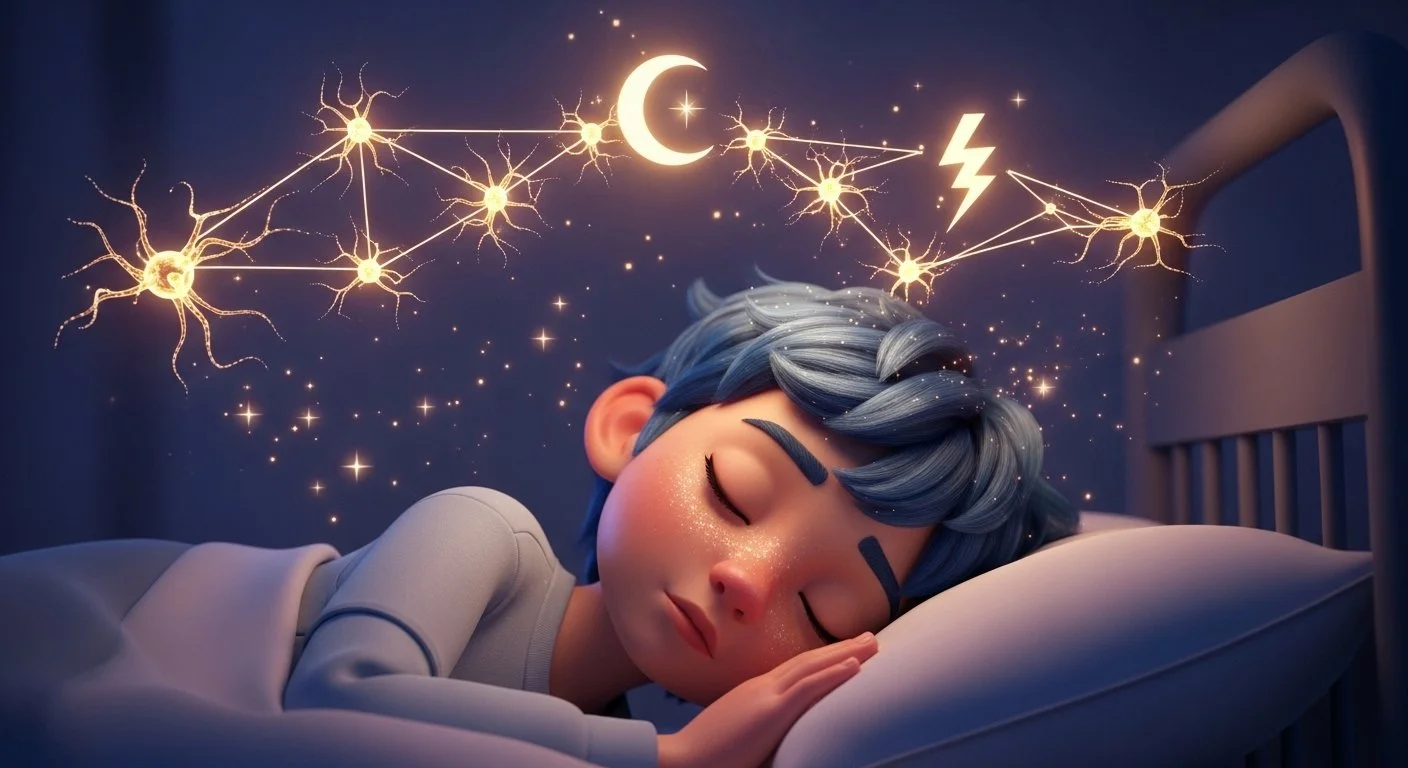
For millions of people living with neurological sensitivities, sleep isn't just about optimization; it's a critical biological safeguard.
Researchers are uncovering a much deeper, more volatile connection between our brain’s nocturnal rhythms and its electrical stability. Specifically, when we look at the interaction between sleep and epilepsy, we find that it’s a sophisticated defensive strategy against the brain’s internal electrical storms. And epilepsy and its treatments can profoundly disrupt sleep architecture.
Let’s first learn the role of NREM sleep and thalamus underlying Epilepsy.
How NREM Sleep Increases Risk in Epilepsy.
To understand the deep link between sleep and epilepsy, we have to look at the brain not as a computer that "shuts off," but as a highly rhythmic orchestra. During the day, your neurons (brain cells) are like musicians playing different tunes—some are talking about what to have for lunch, others are focused on driving, and some are processing the music on the radio. This is called "desynchronized" activity. It’s messy, but it’s how a conscious brain functions.
However, when you drift into Non-Rapid Eye Movement (NREM) sleep, the orchestra begins to play in unison. This is called "synchrony." Your brain produces slow, rhythmic waves that help move memories from short-term to long-term storage. For a healthy brain, this synchrony is a masterpiece of biological engineering.
But for a brain prone to seizures, this "playing in unison" can be a trap. If you have a group of "irritable" neurons—those prone to misfiring—the rhythmic nature of NREM sleep acts like a megaphone. Instead of one tiny spark in a corner, the synchronized waves of sleep allow that spark to catch fire and spread across the entire "orchestra."
This is why a staggering number of seizures occur during NREM sleep; the very mechanism meant to save your memories is the same one that provides the perfect highway for an electrical storm to travel.
The Thalamus: The Broken Gatekeeper of Your Rest
Deep inside your brain sits a small, egg-shaped structure called the thalamus. Think of it as the grand "Switchboard Operator" of your mind. During the day, it’s wide open, letting all the sights, sounds, and feelings of the world flow into your consciousness. At night, its job is to close the gate so you can sleep.
In the context of sleep and epilepsy, the thalamus is where the drama unfolds. To keep you asleep, the thalamus produces things called "sleep spindles"—brief bursts of brain activity that block out noise. Recent research has shown that in people with certain types of epilepsy, these spindles are often "hijacked."
Instead of acting as a protective shield to keep you asleep, the spindles become the starting point for a seizure. It’s as if the Switchboard Operator is trying to close the door but accidentally hits the "emergency broadcast" button instead. When this gatekeeping goes wrong, the brain doesn't just wake up; it overloads. Understanding this "thalamocortical" loop is crucial because it tells us that seizures aren't just random glitches—they are often "normal" sleep processes that have simply lost their way.
Why Your "Social Jetlag" is More Dangerous Than You Think
For the brain’s electrical stability, the consistency of your internal clock (your circadian rhythms) is actually more important than the total number of hours you spend in bed.
Every cell in your brain has "clock genes" that tell it when to be active and when to rest. These genes regulate how sensitive your neurons are to electrical signals. When you experience "social jetlag"—the habit of staying up late on Fridays and sleeping in on Sundays—you are effectively "re-programming" these genes every 48 hours.
For someone managing epilepsy, this constant shifting of the clock lowers the "seizure threshold." It’s like lowering the height of a levee before a storm. Research now shows that there are specific "peak times" for seizures—often during the transition from sleep to wakefulness (the "danger zone" of dawn). When your internal clock is confused, your brain doesn't know how to properly regulate its electrical sensitivity during these transitions. This makes the "dawn phenomenon" not just a time of day, but a window of neurological risk.
The Hidden Thief: Subclinical Seizures (Interictal Epileptiform Discharges)
Many people believe that if they didn't have a visible, physical seizure at night, their sleep was successful. Science tells us a different story.
There is a phenomenon known as "Interictal Epileptiform Discharges" (IEDs)—basically, tiny "mini-sparks" that happen between major seizures.
These IEDs love to come out at night. You might stay physically still, but internally, your brain is experiencing dozens of these micro-disruptions. They act like a "hidden thief," stealing the quality of your deep sleep without you ever knowing. This is why many people with epilepsy feel exhausted even after a full ten hours of sleep.
The presence of these IEDs disrupts the "Glymphatic System"—the brain’s specialized waste-clearance system that only turns on during deep sleep. Imagine the Glymphatic System as a cleaning crew that mops the floors of your brain while you sleep. Every time a "mini-spark" happens, the cleaning crew has to stop and hide. If the sparks happen all night, the cleaning never gets done. The result? A buildup of metabolic "trash" that leaves you with that signature brain fog and increased irritability the next day.
Night Terrors or Frontal Lobe Epilepsy?
One of the most complex areas of sleep and epilepsy is Frontal Lobe Epilepsy (FLE). Because the frontal lobe controls movement and behavior, seizures in this area don't look like "typical" seizures. Instead, they often look like night terrors, sleepwalking, or even thrashing around in a bad dream.
For years, patients were told they just had "nightmares" or "sleep issues." But modern sleep studies (Polysomnographies) have revealed that these are often "nocturnal seizures." The distinction is vital because the treatment for a nightmare is therapy, while the treatment for an FLE seizure is neurological management.
These nocturnal events are particularly frustrating because they occur in "clusters." A person might have five or six mini-seizures in a single hour, never fully waking up, but never truly resting. This creates a vicious cycle: the seizures ruin the sleep, and the lack of sleep makes the brain more likely to have a seizure the next night.
Breaking this loop requires more than just "better habits"—it requires stabilizing the brain's electrical environment so it can actually enter the deeper, protective stages of sleep.
Beyond the Pill: The Rise of Chronotherapy and VNS
The future of managing the intersection of sleep and epilepsy isn't just about stronger medication; it's about smarter medication. This is known as "Chronotherapy"—timing the delivery of medicine to match the brain’s most vulnerable hours.
If we know a patient’s seizures are triggered by the "synchrony" of NREM sleep or the transition at dawn, we can time their medication so that it reaches peak levels in the bloodstream exactly when the brain needs it most. This reduces side effects during the day while maximizing protection at night.
Furthermore, we are seeing incredible results from Vagus Nerve Stimulation (VNS). While originally designed to stop seizures, Science discovered that VNS actually "tunes" the brain's sleep architecture. It acts like a pacemaker for the mind, helping to smooth out the transitions between sleep stages and reducing the "hyper-synchrony" that leads to seizures.
We are moving toward a world where we don't just "suppress" the brain, but rather "guide" it back into its natural, healthy rhythms.
Conclusion
The relationship between sleep and epilepsy is not a one-way street; it is a complex, rhythmic conversation between the brain's need for rest and its requirement for stability. Whether through the precise timing of chronotherapy or the stabilizing force of VNS, the goal remains the same: to turn the night from a time of vulnerability into a period of true neurological healing. By respecting the brain's internal clock and understanding the unique electrical landscape of the sleeping mind, we can find a path to rest that is both deep and safe.
-
Nobili, L., Loddo, G., Centeno, M., Bergmann, M., & Walker, M. C. (2022). Sleep and epilepsy: a complex and bidirectional relationship. The Lancet Neurology, 21(11), 1032–1044. (This is a gold-standard review on the topic).
Grigg-Damberger, M. M., & Foldvary-Schaefer, N. (2021). Sleep and Epilepsy: What We Know, What We Do Not Know, and What We Still Need to Know. Sleep Medicine Clinics, 16(1), 87–102.
Malinowska, U., et al. (2021). Circadian rhythms of seizures and epileptic activity in human epilepsy. Nature Communications, 12(1), 1-13. (This supports the section on "The Circadian Code" and seizure thresholds).
Haneef, Z., & Chiang, S. (2023). Relationship of sleep and seizures: A review. Journal of Clinical Neurophysiology, 40(2), 101-110.
Yue, K., et al. (2020). The role of the glymphatic system in epilepsy: A systematic review. Frontiers in Neurology, 11, 212. (This supports the section on metabolic "trash" and the cleaning system).