Use the Science of Lucid Dreaming to Unlock Our Brain’s Potential

Have you ever realized you were dreaming while still asleep? One moment you are flying over a city, and the next, you think, "Wait, this isn't real!" This is lucid dreaming. For years, people thought it was just a fantasy or "New Age" magic. However, the science of lucid dreaming has recently proven that this state is not only real but a powerful tool for your brain. If you struggle with nightmares or want to boost your creativity, mastering your "dream life" is the ultimate solution for better sleep health.
Is the Science of Lucid Dreaming Actually Real?
For decades, the scientific community was skeptical. How could someone be "awake" and "asleep" at the same time? The breakthrough came when researchers realized that the brain doesn't just "shut off" during sleep. Instead, it enters different states of activity.
In a normal dream, the part of your brain responsible for logic—the dorsolateral prefrontal cortex—is mostly quiet. This is why you don’t question it when a giant purple cat starts talking to you. However, during a lucid dream, this area "wakes up" while the rest of the body remains in REM (Rapid Eye Movement) sleep.
This creates a unique "hybrid" state of consciousness. Research published in Nature Communications has shown that we can actually map this activity using fMRI scans. When a dreamer becomes lucid, their brain shows a spike in gamma waves, which are associated with high-level focus and awareness. So, yes: the science of lucid dreaming confirms it is a legitimate biological event, not just a vivid imagination.
What Does Clinical Research Reveal About "Talking" to Dreamers?
One of the most mind-blowing developments in the science of lucid dreaming occurred in 2021. A landmark study published in Current Biology proved that we can have a two-way conversation with someone who is fast asleep.
Researchers from four different countries (the USA, France, Germany, and the Netherlands) worked together to see if they could communicate with lucid dreamers. They didn't use speech, of course. Instead, they used:
Eye Movements: Dreamers were trained to move their eyes left-to-right to signal they were "lucid."
Facial Twitches: Subtle muscle movements to answer questions.
The results were staggering. Experimenters asked the sleeping participants simple math problems, like "What is 8 minus 3?" The dreamers responded correctly using eye signals while remaining in deep REM sleep.
"Our experimental goal is akin to finding a way to talk with an astronaut who is on another world, but in this case, the world is entirely fabricated on the basis of memories stored in the brain." — Konkoly et al. (2021)
This clinical research suggested that the "dream wall" is permeable. It showed that the dreaming brain is capable of complex logic, memory retrieval, and external communication.
Can You Acquire the Skill of Lucid Dreaming?
The most exciting part of the science of lucid dreaming is that it is a learnable skill. It is not a "gift" you are born with; it is a muscle you can train. Since we've moved past basic sleep hygiene tips like avoiding caffeine, let’s look at the advanced techniques supported by research.
1. Reality Testing (The "Check")
This is the foundation of lucidity. Throughout the day, ask yourself, "Am I dreaming?" and perform a physical check. For example, try to push your finger through the palm of your opposite hand. In a dream, your hand will be pliable or your finger will pass through. If you do this enough while awake, your "dream self" will eventually do it too.
2. MILD (Mnemonic Induction of Lucid Dreams)
Developed by Dr. Stephen LaBerge, this involves setting an intention. As you fall asleep, repeat the phrase: "The next time I'm dreaming, I will remember that I'm dreaming." This uses prospective memory—the same part of the brain that helps you remember to buy milk on the way home.
3. WBTB (Wake Back to Bed)
Research shows that lucidity is most likely to happen during the long REM cycles in the early morning.
Set an alarm for 5 or 6 hours after you go to sleep.
Stay awake for 20 minutes (read about lucid dreaming!).
Go back to sleep. This "interrupts" the sleep cycle and primes your brain to enter REM with a more active conscious mind.
Is Lucid Dreaming Actually Beneficial for Your Health?
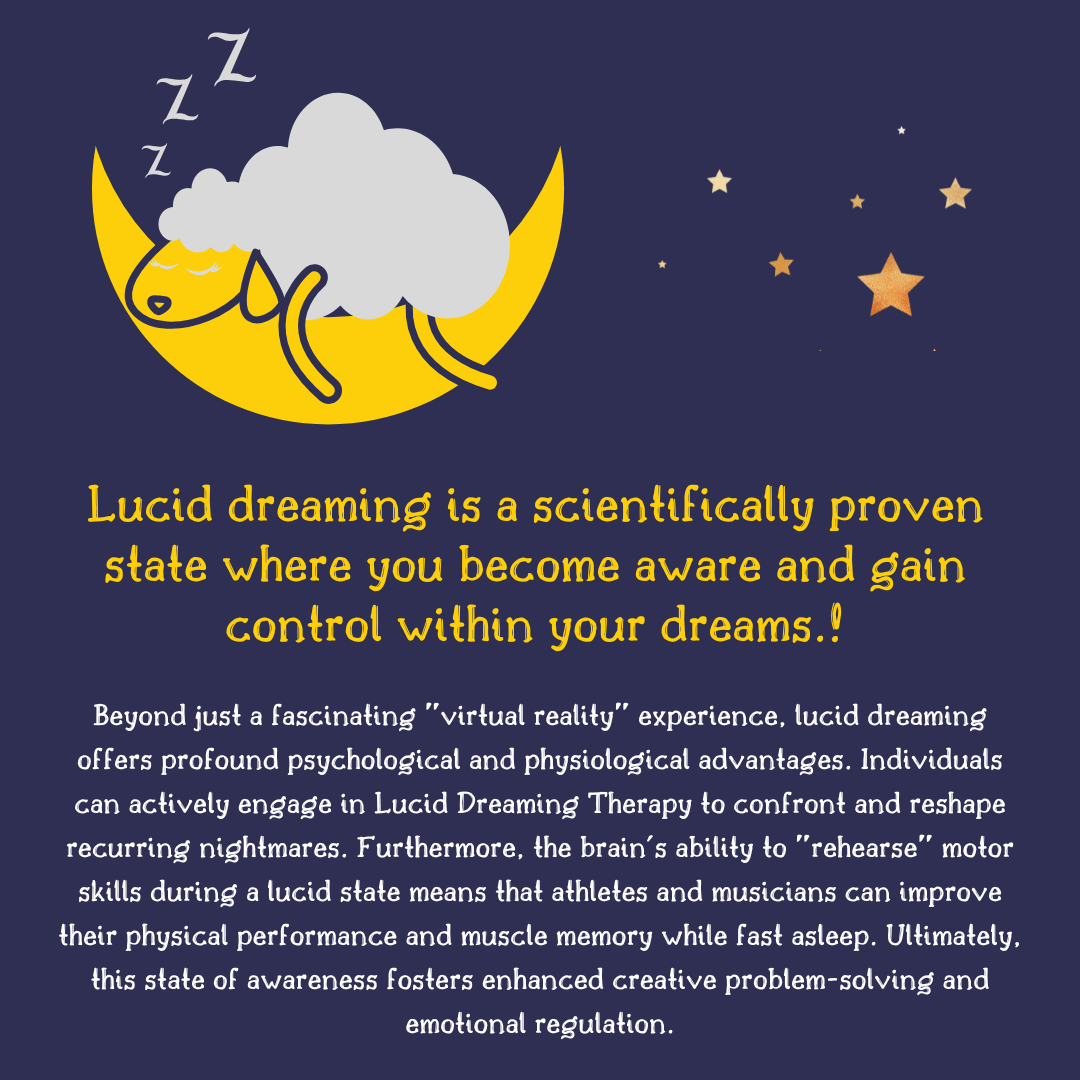
Is this just a fun "video game" in your head, or does it have real-world value? According to the science of lucid dreaming, the benefits are profound.
Ending Chronic Nightmares
For people suffering from PTSD or recurring nightmares, lucidity is a literal lifesaver. Clinical studies on Lucid Dreaming Therapy (LDT) show that when a patient realizes they are in a nightmare, they can consciously change the ending. Instead of being chased by a monster, they can turn around and ask the monster, "Why are you here?" This reduces the fear response and improves overall sleep quality.
Motor Skill Rehearsal
Your brain cannot distinguish between "real" movement and "dreamt" movement in terms of neural firing. Athletes and musicians have used lucid dreams to practice routines. A study in the Journal of Sports Sciences found that practicing a task in a lucid dream can actually improve physical performance the next day.
Creative Problem Solving
In a lucid dream, you have access to the "unfiltered" part of your brain. Many artists and engineers use the state to visualize 3D models or compose music that they "hear" within the dream.
Conclusion
The science of lucid dreaming has moved from the fringes of psychology to the forefront of neuroscience. We now know that you don't have to be a passive observer of your sleep. By understanding the clinical research behind two-way communication and practicing induction techniques like MILD and WBTB, you can take the driver's seat in your own mind.
Mastering this skill isn't just about flying or exploring fantasy worlds; it's about reclaiming your sleep health, conquering your fears, and unlocking a hidden 30% of your life. Tonight, when you close your eyes, don't just sleep—wake up.
-
Konkoly, K. R., Appel, K., Chabani, E., Mangiaruga, A., Gott, J., Perogamvros, L., ... & Paller, K. A. (2021). Real-time dialogue between experimenters and dreamers during REM sleep. Current Biology, 31(7), 1417–1427.
Baird, B., Mota-Rolim, S. A., & Dresler, M. (2019). The cognitive neuroscience of lucid dreaming. Neuroscience & Biobehavioral Reviews, 100, 305–323.
Dresler, M., Wehrle, R., Spoormaker, V. I., Koch, S. P., Holsboer, F., Steiger, A., ... & Czisch, M. (2012). Neural correlates of dream lucidity obtained from contrasting lucid versus non-lucid REM sleep: a combined EEG/fMRI case study. Sleep, 35(7), 1017–1020. (Note: While slightly older, this serves as the foundational imaging study for the more recent 2021 breakthroughs).