Dreams We All Share
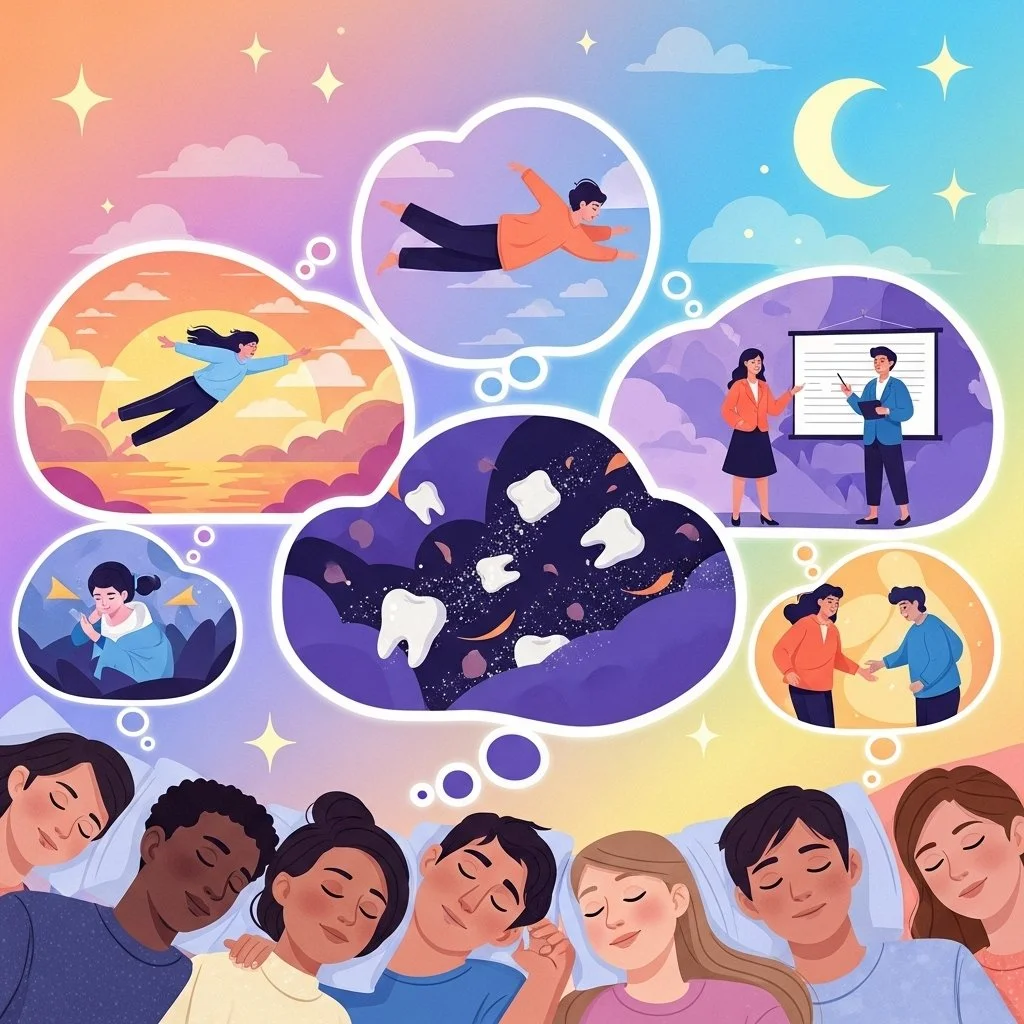
Dreams are a strange, universal phenomenon—a nightly journey where the familiar mixes with the truly bizarre. Despite the unique tapestry of our individual lives, people across cultures and ages report sharing many of the same recurring nocturnal scenes.
The Common Dream Catalogue
Large-scale surveys confirm that several core dream scenarios are nearly universal, often evoking powerful feelings:
Being Chased or Attacked: One of the most common types, typically urgent and filled with high anxiety.
Falling: Represents a sudden loss of support or control, frequently causing an abrupt, heart-pounding awakening.
Social Evaluation Themes: Scenarios like being late, naked, or unprepared for a test are deeply linked to feelings of social anxiety and embarrassment.
Losing Teeth or Body Parts: Commonly interpreted as symbolizing loss, anxiety about appearance, or profound change.
Flying or Soaring: Often an exhilarating experience associated with feelings of freedom or escape.
Recurring Nightmares: These are common, particularly following traumatic events, where the trauma is relived in sleep. In fact, nearly half of all adolescents report having unpleasant, frightening dreams involving violence or threats.
Decoding the Repetition: Why Do These Themes Persist?
Why do these handful of themes—being chased, falling, social panic—show up repeatedly in our minds when we sleep? Researchers have developed several compelling theories.
1. Dreams Mirror Waking Concerns: The Continuity Hypothesis
The leading theory is the continuity hypothesis, which suggests that dreams directly reflect your waking concerns, daily worries, and current emotional state. Think of your dreams as an altered, surreal review of your day.
Daily stressors, work anxieties, or interpersonal conflicts tend to appear in dreams, albeit in disguise. Studies show a strong link: when life circumstances change dramatically—say, during a period of high public stress like a pandemic—the intensity and themes of dreams often shift accordingly. Simply put, the emotional load you carry into bed is what spills over into your dreams.
2. The Brain's Night Shift and Emotion Processing
During REM sleep, when the most vivid dreaming occurs, neurobiology offers a key explanation. The brain’s limbic regions (involved in emotion, like the amygdala) become intensely active, while the prefrontal control regions (responsible for logic and reason) are suppressed.
This combination creates narratives that are emotionally intense and often bizarre or poorly regulated. The brain reuses fragments of your day during this overnight memory and emotion processing, reshaping them into the common, emotionally charged themes we all experience.
3. Rehearsing Threats and Social Scenarios
Some theories suggest dreams serve an adaptive function, helping to prepare us for future challenges.
Threat-Simulation Theory proposes that dreams prioritize simulating threats (like being chased) to help us practice our response to potential dangers.
Social-Simulation ideas suggest dreams help us rehearse social interactions.
This "nightly practice" may explain why scenes of threat, conflict, and social evaluation are so common—our brains are running a safety drill for social problems and dangers.
Taking Back Control
If recurring or upsetting dreams are disrupting your sleep or wellbeing, evidence-based steps can help reduce their emotional grip.
Start with Self-Help and Sleep Hygiene
Manage Daytime Stress: Since dreams reflect the emotional load you carry, reducing stress during the day is critical. Use mindfulness, scheduled exercise, or social support. These "upstream steps" are the most powerful intervention.
Improve Sleep Hygiene: Keep a regular sleep schedule, limit alcohol and caffeine, and implement a screen curfew 30–60 minutes before bed. A cool, dark room can reduce fragmented sleep, which often triggers vivid, nightmarish awakenings.
Use a Dream Journal: Write a brief record of troubling dreams immediately upon waking. Simply externalizing the dream can help lessen its emotional power and allow you to notice patterns or triggers.
Evidence-Based Therapy for Nightmares
For frequent, highly distressing nightmares, the gold standard treatment is Imagery Rehearsal Therapy (IRT).
This is a cognitive-behavioral technique where, while awake, you consciously reimagine a nightmare and give it a new, non-threatening ending. You then mentally rehearse this rewritten version during the day. Studies show that IRT significantly reduces both the frequency and distress of nightmares.
When to Seek Professional Help
If nightmares regularly wake you, cause severe anxiety, lead to daytime impairment (like fatigue or difficulty concentrating), or repeatedly replay traumatic events, it’s time to consult a qualified clinician.
A professional can evaluate you for conditions like nightmare disorder, PTSD, or sleep apnea and recommend appropriate treatments, including IRT or specialized trauma-focused psychotherapy, which often reduces nightmares as the underlying issues improve.
Understanding your dreams is like holding a mirror up to your waking life. By addressing the stressors and emotions that spill over into your sleep, you can transform these common narratives from sources of distress into powerful tools for self-discovery and better mental health.
-
Conte, F., Russo, P. M., De Pascalis, L., Zelli, F., & Sgalla, R. (2021). Changes in dream features across the first and second lockdowns. Sleep Medicine, 84, 468–475.
Maggiolini, A. (2025). The relevance of typical themes for dream interpretation. International Journal of Dream Research, 18(1), 1–7.
Nishimura, T., Kawano, Y., Onoda, K., & Yamamura, A. (2025). Association Between Dreams, Anxiety, and Depressive Symptoms Among Japanese Adolescents: A Cross-Sectional Study. Child and Adolescent Psychiatry and Mental Health, 19, 27.
Rapelli, G., Zoppini, E., De Filippi, C., & Galbiati, A. (2023). Case report: Imagery Rehearsal Therapy for COVID-19-related nightmares. Frontiers in Psychology, 14, 1198421.
Samson, D. R., Arand, B., Lally, E., Mello, L., & Schimmenti, J. (2023). Evidence for an emotional adaptive function of dreams. Scientific Reports, 13(1), 12797.
Zheng, S., Cui, W., & Zhang, W. (2025). Dreams are more “predictable” than you think. Frontiers in Sleep, 4, 1625185.