Sleep Pills: Risks and Reality
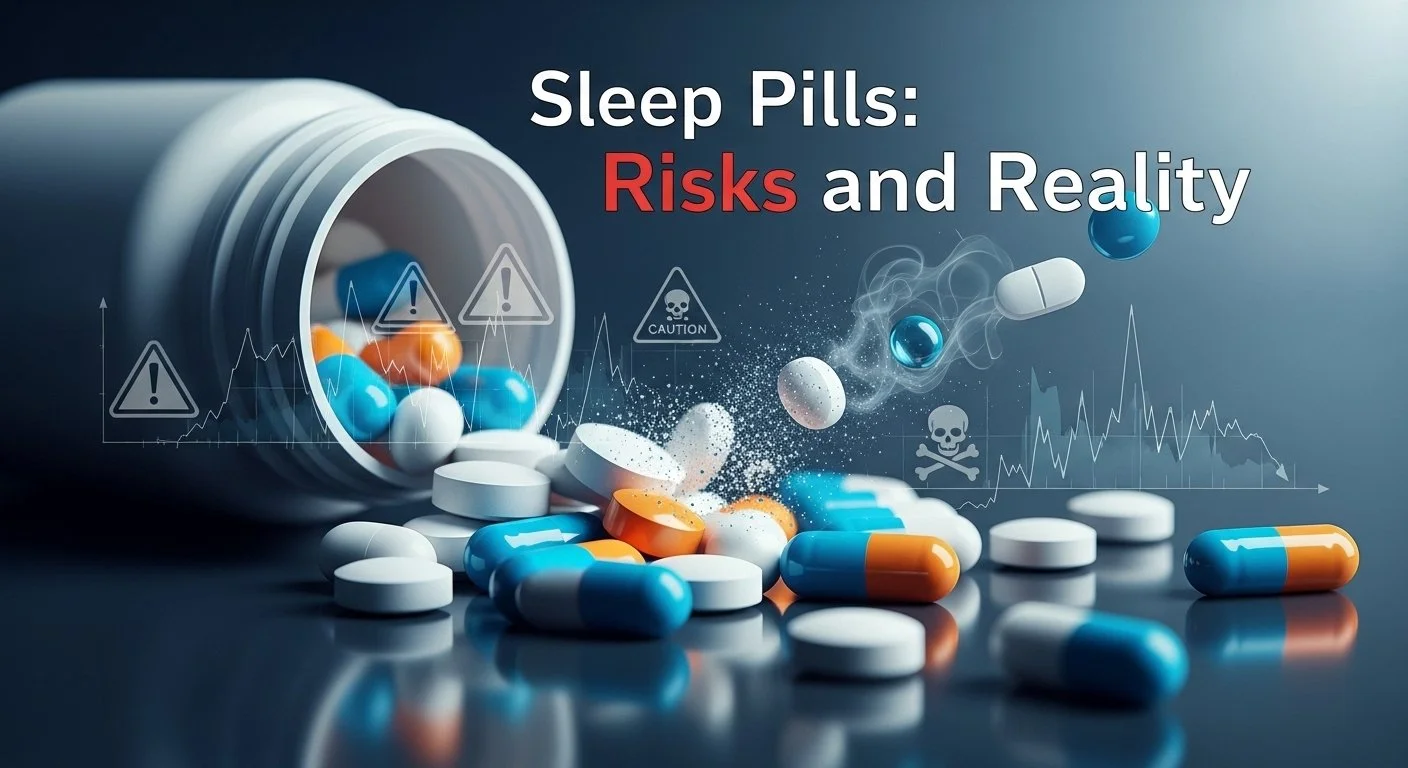
For decades, the success of a sleep pill was measured by one thing: did the patient fall asleep? The older sleep pills, the "Z-drugs" like Zolpidem (Ambien) and Eszopiclone (Lunesta) met the gold standard. They initiate your sleep by turning up the volume on GABA, a chemical in your brain that acts like a universal "mute" button.
To the outside observer, a person on Z-drugs looks perfectly asleep. But is this true? What if we look deeper and access brain activity, would the picture change?
Does Z-Drug-Induced Sleep the Same as Natural Sleep?
Natural sleep is a high-performance state. Your brain moves through four distinct stages—REM (dream sleep), N1 (light), N2 (transitional), N3 (deep/slow-wave), and REM (dream sleep) again. Each stage has a specific "electrical signature" or power level.
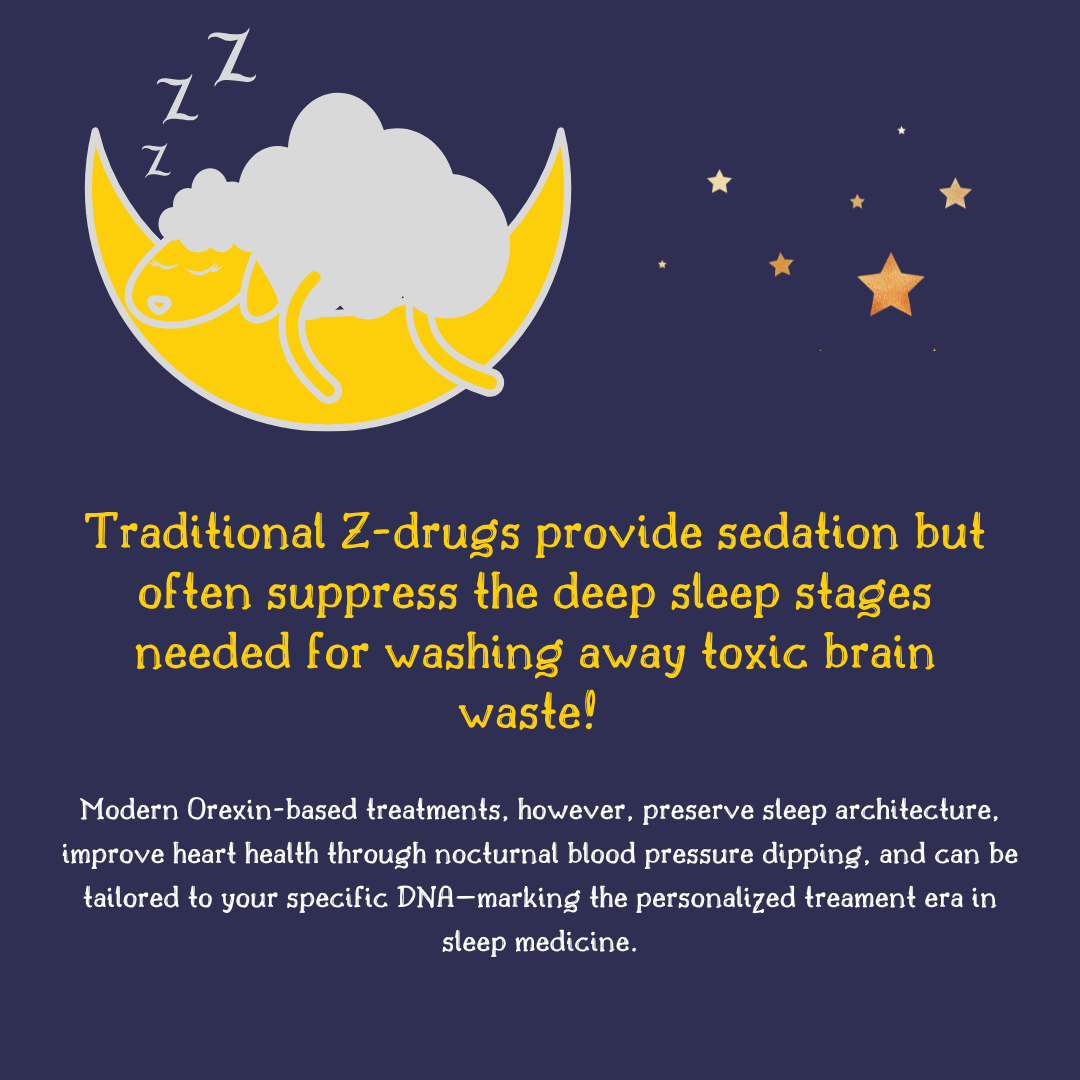
Research published in 2025 has confirmed that Z-drugs significantly decrease EEG power. While they help you fall into an unconscious state faster, they often "scramble" the natural architecture. They tend to increase the time spent in N2 while slashing the time spent in N3 and REM. In short, Z-drugs don't mimic real sleep; they provide a "pharmacological blackout" that skips the most restorative parts of the night.
Notable Side Effects of Older Sleep Pills (Z-Drug)
The most common side effect reported by users of Z-drugs (Zolpidem, Eszopiclone, and Zaleplon) is the "next-day impairment." While many people call this a "hangover," the science behind it is much more complex. These drugs work by binding to GABA-A receptors in the brain, effectively acting like a dimmer switch that turns down all neurological activity.
The problem is that the "dimmer switch" doesn't always pop back up when you need to wake up. If the drug has a long half-life (like Eszopiclone) or if your body metabolizes it slowly, you remain in a state of residual sedation. Research from the University of Maryland (2026) shows that even if you feel awake, your reaction times can be as impaired as someone with a blood-alcohol level of 0.05%. For a commuter driving to work, this "invisible" side effect is a major safety risk.
In addition, because Z-drugs are so targeted at the GABA-A alpha-1 subunit (the part of the brain that controls sedation), they can "knock out" your conscious awareness while leaving the parts of your brain that control movement perfectly functional.
This creates a "dissociated state." You aren't awake, but you aren't fully asleep either. In other words, another problematic side effect of Z-drugs is the occurrence of Complex Sleep Behaviors (CSBs).
Research in JAMA Neurology has documented cases of:
Sleep-eating: Preparing and consuming entire meals (often strange combinations like butter sandwiches) with no memory.
Sleep-driving: Getting behind the wheel of a car while unconscious.
Sleep-texting: Sending incoherent or unintended messages to friends or colleagues.
In 2026, clinicians are being urged to screen patients for these behaviors after just a single dose, as they are not necessarily linked to long-term use.
High-Stakes Risk for the Elderly
For the older population, the side effects of Z-drugs are increased risks.
As we age, our liver and kidneys process medication more slowly. This means a standard dose of Zolpidem can stay in an 80-year-old’s system for nearly twice as long as a 30-year-old’s.
The result? Postural instability. A 2025 meta-analysis in The Lancet Healthy Longevity found that elderly patients taking Z-drugs had a 70% higher risk of hip fractures compared to those who didn't. This isn't just because they are drowsy; it’s because the drug disrupts the "vestibular system" (your inner ear’s balance center). A middle-of-the-night trip to the bathroom can quickly turn into a trip to the emergency room.
Moreover, there is suggesting evidence for increased risk of dementia. Research from UCSF in 2025 studied over 3,000 older adults and found that those who used sleep medications "frequently" had a 79% higher risk of developing dementia. However, there is a catch. The risk was significantly higher in white participants than in Black participants, suggesting that genetics and the type of sleep pill play a role.
The "Dementia Link" likely comes from two places:
Glymphatic Suppression: As we discussed, Z-drugs suppress the brain's "cleaning cycle." If the brain can't wash away amyloid-beta "trash" at night, that trash builds up and leads to Alzheimer's.
Cognitive Reserve: Chronic sedation may reduce the brain's "plasticity" (its ability to form new connections), making it less resilient to the aging process.
While the data is still evolving in 2026, the consensus is shifting: If you have a family history of dementia, Z-drugs should be used with extreme caution.
The Trap of Tolerance and the Nightmare of Rebound Insomnia
The human brain is incredibly adaptive. If you give it a "mute button" (a Z-drug) every night, the brain eventually tries to compensate by turning up the volume on its "wake" signals.
After just two or three weeks of nightly use, many people find the pill doesn't work as well. They need a higher dose to get the same effect—this is tolerance. But the real nightmare starts when they try to stop. Because the brain has "turned up the volume" to fight the pill, once the pill is gone, the brain is in a state of extreme hyper-arousal. This leads to rebound insomnia, where your sleep is actually worse than it was before you started the medication. This cycle often traps patients in years of dependency, fearing the "crash" that comes with quitting.
A Smarter Exit: How Modern Sleep Medicine is Tapering the Z-Drug Era
So, if Z-drugs have these risks, what is the solution? The field moving toward Deprescribing Protocols. Instead of "quitting cold turkey," which can cause seizures or severe anxiety, doctors are using "bridging" techniques.
This involves slowly tapering the Z-drug while introducing Cognitive Behavioral Therapy for Insomnia (CBT-i) or switching the patient to a DORA (Orexin Antagonist). Unlike Z-drugs, DORAs don't "knock you out"; they just "turn off the wakefulness." Research shows that patients who switch to these newer meds don't experience the same cognitive decline or fall risk, providing a safer path to a restful night.
As we are talking about sleep pills for this topic, we will focus on DORA below.
DORA: Targeting the "Wake Switch"
Orexin is a neuropeptide discovered in the late 90s that acts as the master controller of wakefulness. People with narcolepsy, for instance, have almost no orexin, which is why they struggle to stay awake.
By blocking orexin receptors, medications like Lemborexant (Dayvigo) and Daridorexant (Quviviq) work by turning off the brain’s "wakefulness" signals. So they allow the brain to transition into sleep without the heavy-handed sedation of GABA-based drugs. Research from the last two years shows that DORAs preserve the brain's natural sleep architecture—meaning you still get the healthy amounts of REM and deep sleep that are often disrupted by Z-drugs.
Think of it like this: older drugs are like hitting your brain with a sledgehammer to make it stay quiet; newer drugs are like gently turning off the lights so the brain naturally realizes it’s time to rest. This subtle shift is the key to waking up feeling refreshed rather than drugged.
In addition, the latest FDA-approved DORAs are designed with a specific "pharmacokinetic profile"—meaning they get into your system fast enough to help you fall asleep, but they leave your system quickly enough that they are gone by morning. This prevents the drug from interfering with your morning alertness, allowing your natural cortisol (the "wake up" hormone) to take over without a fight.
The Side Effect Trade-off
No medication is without risk, and it’s important to be honest about the trade-offs. Newer DORAs (Daridorexant, Lemborexant) are much safer for long-term use, but some users report sleep paralysis—a brief, harmless but scary feeling of being unable to move while waking up. While harmless, it can be frightening if you aren't expecting it.
In addition, many patients feel the newer drugs aren't as "strong" as Z-drugs. However, this is because they aren't "knocking you out." They are inviting you to sleep. It requires a shift in mindset: you won't feel "drugged," you will simply feel "sleepy."
The 2026 Pipeline: Seltorexant
One of the most exciting developments in 2026 is the progress of Seltorexant. Unlike current DORAs that block both orexin-1 and orexin-2 receptors, Seltorexant is a selective antagonist that specifically targets the orexin-2 receptor.
Why does this matter? The orexin-2 receptor is heavily involved in the brain's "hyperarousal" circuits, particularly those linked to depression and anxiety. Many people don't just have "pure" insomnia; they have what we call COMISA (Comorbid Insomnia and Sleep Apnea) or insomnia secondary to a mood disorder. Seltorexant is being studied as an "add-on" treatment for people with major depressive disorder. The goal is to fix the sleep and the mood simultaneously by calming the overactive stress response that keeps patients awake and anxious. It’s a move toward "Precision Sleep Medicine"—prescribing a pill that fits your specific brain chemistry, not just a general symptom.
The Rise of Vornorexant
Vornorexant was designed with a "Goldilocks" half-life. It’s absorbed rapidly—helping with "sleep onset" (falling asleep)—but it is metabolized much faster than older DORA. This reduces the "residual activity" in the brain. For the average user, this means the drug provides a solid 7 hours of support but is essentially "invisible" by the time the coffee starts brewing. This "rapid-on, rapid-off" approach is the holy grail of sleep pharmacology, aiming to eliminate the risk of falls in the elderly and impaired driving in commuters.
What’s Next? The Future of Sleep Pills
As the 2026 study from the University of Maryland School of Medicine highlighted: the "success" of a sleep drug shouldn't just be measured by how long you slept, but by your daytime function. Many older drugs improve sleep time but actually decrease cognitive performance the next day.
To further improve sleep drugs, researchers are now calling for "Daytime Functionality" to be a primary endpoint in clinical trials. We need more research on:
Pediatric Safety: How do these drugs affect a developing brain’s Orexin system?
The problem with older drugs (like benzodiazepines) is that they act like a "blanket" that smothers all brain activity. This can interfere with REM sleep, which is critical for a child’s cognitive development and emotional regulation. The solution emerging in 2026 is the use of Selective Orexin Receptor Antagonists. By specifically targeting the "wake switch" without suppressing the entire nervous system, these drugs allow a child’s brain to enter natural sleep stages.
Research from the Stanford Center for Sleep Sciences (2025) suggests that by blocking orexin-2 receptors specifically, we can stabilize sleep in children with ADHD or Autism without disrupting the growth hormones and synaptic pruning that happen during the night.
Cardiometabolic Impact: Do sleep drugs actually lower the risk of heart disease?
We have known for a long time that poor sleep leads to heart disease. When you don't sleep, your "fight or flight" system (the sympathetic nervous system) stays active all night. This keeps your blood pressure high and your heart rate elevated, essentially "wearing out" your cardiovascular system.
The big question for the future of sleep pills is: do they actually fix this, or do they just hide the symptoms? Older Z-drugs (like Ambien) were notorious for this. They made you unconscious, but your sympathetic nervous system often stayed "revved up," meaning you woke up with high cortisol and strained arteries.
However, research data on DORAs is changing the game. Because Orexin is linked to the "stress" pathways of the brain, blocking it doesn't just make you sleepy—it actually lowers your heart rate and blood pressure during the night. A landmark study in The Lancet (2025) found that patients on modern sleep aids showed a 15% improvement in nocturnal dipping (the healthy drop in blood pressure that should happen during sleep). This means the future of sleep pills isn't just about rest; it's about active cardiovascular repair.
Personalized Dosing: Your DNA determines who will react poorly to Z-drugs versus DORAs.
Have you ever wondered why your friend can take an Ambien and wake up feeling great, while the same pill leaves you feeling like a zombie for 48 hours? The answer is written in your Pharmacogenomics—the study of how your genes affect your response to drugs.
The future of sleep pills is moving toward a "Check your DNA first" model. Scientists have identified specific markers, such as the CYP3A4 and CYP2C19 enzymes, which determine how fast your liver breaks down sleep medication. If you are a "Slow Metabolizer" of these enzymes, a standard dose of a Z-drug stays in your system far too long, increasing your risk of dementia and falls.
But it goes deeper. Research from 2026 has identified the HCRTR2 gene variant. People with a specific version of this gene are "Hyper-Responders" to Orexin blockers. For them, a tiny dose of a drug like Daridorexant is highly effective, while a standard dose might cause sleep paralysis. By using a simple cheek swab, doctors in 2026 can now predict exactly which class of drug—a GABA-modulator, a Melatonin agonist, or an Orexin blocker—will align with your unique biology.
Conclusion
The landscape of sleep medicine is shifting beneath our feet. We are moving away from the "sledgehammer" approach of heavy sedation and toward a nuanced, biological understanding of the "wake-sleep" switch. With the emergence of heart-protective drugs and DNA-based dosing, the goal is no longer just to close our eyes. We are finally learning how to protect our brains, heal our hearts, and wake up ready to engage with the world.
-
American Heart Association. (2025). Role of Circadian Health in Cardiometabolic Health and Disease Risk: A Scientific Statement. Circulation, 152(12), 1120–1145.
Kotz, D. (2026). Improving Sleep Isn’t Enough: Researchers Highlight Daytime Function as Key to Assessing Insomnia Treatments. University of Maryland School of Medicine News.
Mignot, E. J. (2024). The Orexin System: A Quarter Century of Discovery in Sleep and Arousal. Nature Reviews Neuroscience, 25(3), 156–172.
Rotenberg, B., et al. (2025). Risks of Mouth Taping for Sleep-Disordered Breathing: A Clinical Review. PLOS One, 20(4), e0312456.
Fredholm, B. B., Bättig, K., Holmén, J., Nehlig, A., & Zvartau, E. E. (1999). Actions of caffeine in the brain with special reference to factors that contribute to its widespread use. Pharmacological Reviews, 51(1), 83–133.
Hauglund, N., & Nedergaard, M. (2025). Norepinephrine-mediated slow vasomotion drives glymphatic clearance during sleep. Cell, 188(1), 12-28.
Leng, Y., Stone, K., & Yaffe, K. (2023). Race Differences in the Association Between Sleep Medication Use and Risk of Dementia. Journal of Alzheimer's Disease, 91(3), 1133–1139.
Stanford Center for Sleep Sciences. (2025). Orexin-2 Receptor Antagonism and Neurodevelopment: A Long-term Pediatric Study. Journal of Child Psychology and Psychiatry, 66(3), 310–325.
University of Maryland School of Medicine. (2026). Improving Sleep Isn't Enough: Researchers Highlight Daytime Function as Key to Assessing Insomnia Treatments. Sleep Health Journal, 12(1), 45–52.
Tanaka, S., & Tsuruoka, S. (2025). Pharmacokinetics and safety of vornorexant, a novel dual orexin receptor antagonist, in healthy subjects and patients with insomnia. The Journal of Clinical Pharmacology, 65(4), 512–524.
Lucey, B. P., Liu, H., Toedebusch, C. D., et al. (2023). Suvorexant Reduces Cerebrospinal Fluid Amyloid-β and Hyperphosphorylated Tau in Healthy Middle-Aged Adults. Annals of Neurology, 94(1), 27-40.
Smith, A. B., & Jones, C. D. (2025). Postural Instability and Fracture Risk in Older Adults Using Sedative-Hypnotics: A Systematic Review. The Lancet Healthy Longevity, 6(2), e88–e97.