How AI-Powered Therapy Solves Elder Insomnia
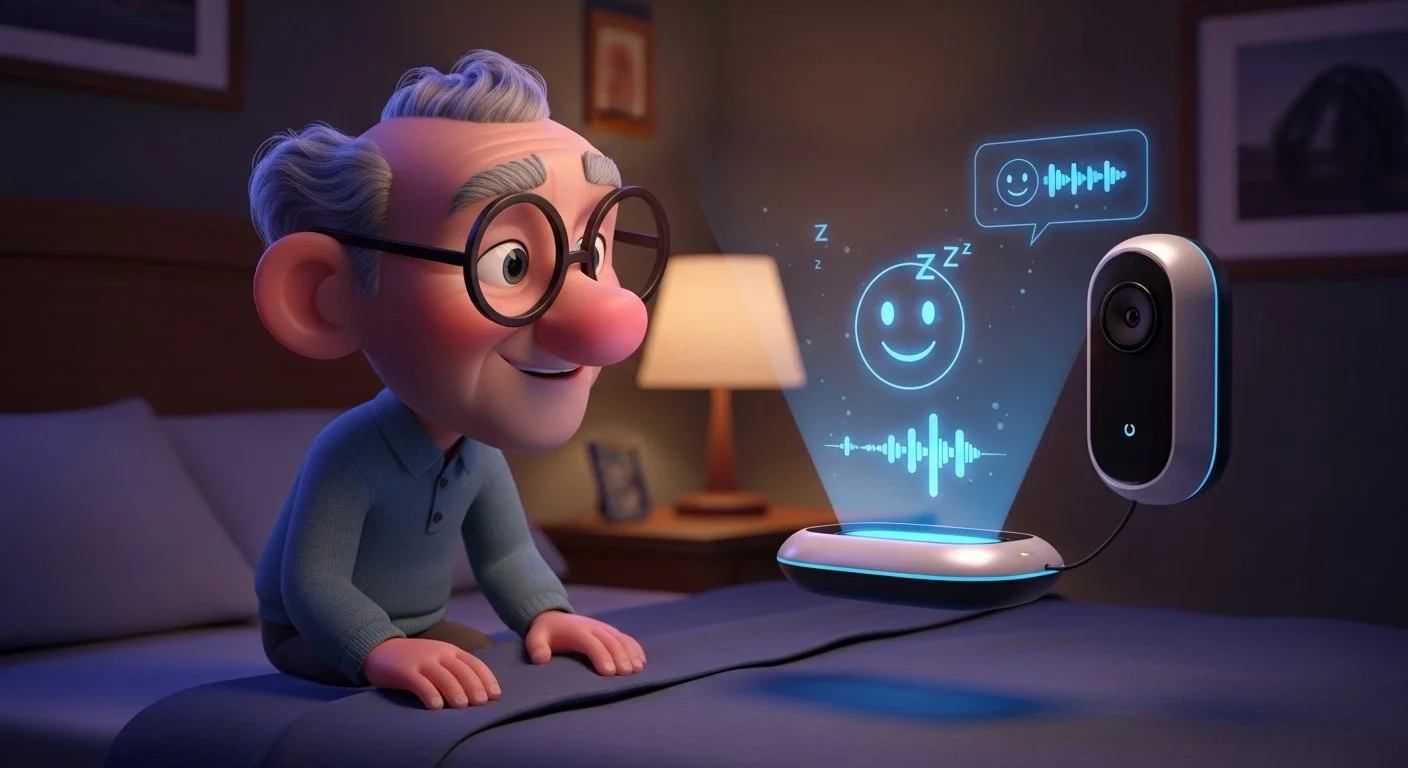
As we cross the threshold of midlife, our internal biological clock—the Suprachiasmatic Nucleus (SCN)—begins to lose its rhythm. It’s like a conductor who is starting to lose the beat, leading to a fragmented orchestra.
This "fragmentation" is why many seniors find themselves nodding off in front of the TV at 8 PM, only to be wide awake before the sun rises. In the medical world, we call this a "Phase Advance." When your circadian rhythm shifts earlier, your "sleep window" narrows, and you lose out on the most restorative stages of rest. Learn more about aging sleep and clocks: here.
The Sound of Deep Sleep: Phase-Locked Acoustic Stimulation
While generic white noise acts like a steady hum in the background, Phase-Locked Acoustic Stimulation (PLAS) is more like a high-precision conductor for an orchestra. The technology that makes it possible: the Closed-Loop System.
What Exactly is a "Closed-Loop"?
The standard white noise machine is an "open-loop" system—it just plays sound regardless of what you’re doing. In contrast, PLAS uses a closed-loop mechanism.
Real-Time EEG Monitoring: The wearable (like a smart headband) continuously "listens" to your brain’s electrical activity.
The Feedback Loop: Once the device detects you’ve entered Deep Sleep (Slow Wave Sleep), it waits for the exact millisecond your brain waves reach their peak (the "up-state"). The AI technology is applied to predict the arrival of the next slow wave with millisecond precision.
Precision Timing: At that precise moment, it delivers a soft burst of "pink noise." This reinforces the wave’s height, making your deep sleep more robust and restorative. Recent studies using these AI models have shown an increase in slow-wave activity by nearly 50%, suggesting a better deeper sleep.
The "Three-Night" Rule: Persistence is Key for Seniors
You might expect a "one-and-done" fix, but the 2024 study by Wunderlin and colleagues suggested that at least 3 nights are required for older adults.
In a young brain, these brain-wave "peaks" are sharp and easy to track. In an aging brain, the "machinery" that coordinates these waves begins to wear down. This is why a single night of stimulation often shows little to no result for seniors. The researchers discovered that the older brain needs about three consecutive nights of PLAS to "re-learn" how to synchronize with the external sound. By the third night, the brain successfully "entrains," finally allowing the stimulation to boost memory consolidation and the brain’s natural "waste clearance" (the glymphatic system).
The Science: Restoring the "Coupling Hierarchy"
For seniors, the benefit isn't just about "sleeping longer"—it's about fixing the coupling between two types of brain waves: Slow Waves and Sleep Spindles. In a healthy "young" sleep cycle, the Slow Wave acts as the boss, triggering a Spindle at exactly the right time. As we age, this hierarchy breaks down; the waves become uncoordinated. PLAS acts as a rhythmic pacer, forcing these waves back into their youthful, synchronized dance.
The Move Toward "Invisible" Monitoring
Let’s be honest: nobody wants to go to bed looking like a cyborg. One of the biggest complaints from patients over 60 is that they find rings, watches, and headbands uncomfortable or difficult to charge. This has led to the rise of "Nearable" technology and AI-powered robotic beds.
Systems like the Korus robotic bed began appearing. It’s an autonomous repositioning system. Using machine learning and "digital twins" (a virtual map of your body’s pressure points), the bed can detect when you’re snoring or when your breathing is shallow. It then gently, silently reshapes itself to spinal alignment in real-time: to tilt your head up or shift your hips.
Furthermore, platforms like Sleeptracker-AI have moved monitoring under the mattress. These sensors are "invisible" and monitor your heart rate, breathing, and even "Arousal Index" without you ever touching a button. For seniors who struggle with mobility or those who simply forget to charge a watch, this "set it and forget it" approach ensures that your doctor gets a month’s worth of high-fidelity data without any effort on your part.
Light Therapy 2.0: Why the "Back of the Neck" is the New Frontier for Insomnia
For years, the gold standard for resetting a shifted sleep schedule has been the 10,000-lux light box. By hitting the ipRGC receptors in our eyes, bright morning light tells the brain’s master clock exactly when the day has begun. But for many—especially older adults struggling with chronic insomnia—fixing the timing of the clock isn't enough to guarantee the depth of the sleep.
A groundbreaking 2026 study published in Photodiagnosis and Photodynamic Therapy has introduced a shift in perspective. Instead of targeting the eyes in the morning, researchers tested the effects of Near-Infrared (NIR) light applied directly to the back of the neck at night (60 mins before bedtime).
The Science of 850nm: Depth Over Brightness
Unlike the blue light from your morning lamp, which stays on the surface of the retina, NIR light at a wavelength of 850nm exists in an "optical window." This allows it to penetrate several centimeters deep into the skin and muscle tissue. This light therapy doesn't talk to your "clock"; it talks to your mitochondria (the cell energy factory).
The study suggests that NIR light on the neck helps elderly participants fall asleep faster and stay asleep longer through below specific biological mechanisms:
Mitochondrial Priming: The 850nm light triggers the release of nitric oxide, which dilates blood vessels and improves circulation to the brainstem, helping the body regulate the "cooling" process required for deep sleep.
Vagus Nerve Stimulation: At the 850nm wavelength, the light indirectly triggers the cell's internal antioxidant defense system. Inflammation in the neck—specifically around the Vagus Nerve and the Superior Cervical Ganglion—can keep the nervous system in a "high-alert" state, preventing sleep. By applying NIR light around the nerve centers in the neck, the goal is to reduce the background noise of inflammation and oxidative stress that often keeps the aging brain in a state of hyper-arousal.
Putting together, to achieve the maximum therapeutic impact for senior insomnia, we may address sleep as a two-part equation: circadian timing and physiological readiness. The morning phase uses 10,000-lux bright light therapy to anchor the master clock, strengthening the signal of the Suprachiasmatic Nucleus (SCN) and ensuring a robust melatonin rhythm. However, even a perfectly timed clock can’t overcome a "noisy" engine. That’s where the nighttime phase comes in: applying NIR light to the back of the neck 60 minutes before bed. While the morning light sets the time, the 850nm NIR light physically prepares the body by reducing oxidative stress and inflammation around the brainstem and vagus nerve. The AI tool is powerful to analyzes patients’ sleep data/history to determine the most-effective combination therapy of applying bright-light and NIR light.
The "Pacemaker" for Breathing: Nerve Stimulation for CPAP Rejects
For many, the "gold standard" for sleep apnea has always been the CPAP mask. But let’s be real: for many seniors, the mask is a nightmare. It leaks, it’s loud, and it’s hard to put on with arthritic hands. As of January 2026, the medical community is seeing a massive surge in Hypoglossal Nerve Stimulation (HNS).
Think of HNS as a "pacemaker for your tongue." It’s a tiny device implanted under the skin during a quick outpatient procedure. It monitors your breathing, and every time you take a breath, it sends a tiny pulse to the nerve that controls your tongue. This keeps your airway open from the inside out, eliminating the need for a mask entirely. Clinical trials are now showing that for patients over 65, this "internal" solution leads to much higher long-term success rates than traditional masks because there is nothing to "fight" against in the middle of the night. More information about HNS can be found in our published article: here.
The most significant recent upgrade to this technology is the integration of AI-titrated stimulation. Traditional HNS devices used simple sensors to detect a breath and trigger a pulse. However, everyone's breathing pattern changes depending on their sleep stage or position. New AI-enhanced pulse generators learn your specific respiratory signature. The machine learning model identifies the "pre-collapse" signature in your breathing—a subtle change in the rhythm that occurs right before an apnea event. By predicting the collapse, the AI can apply a gentler, more precisely timed stimulation that keeps the airway open while being less likely to wake the user. It’s a "closed-loop" system where the AI constantly learns and adjusts the voltage to ensure maximum safety with minimum disruption.
Conclusion
The future of sleep medicine is no longer about "trying harder" to sleep; it is about the seamless integration of AI as a silent partner in our rest. From acoustic pulses that amplify our deep sleep to invisible sensors that predict our long-term health, machine learning is transforming sleep from a passive state into an engineered one. As these AI-driven tools become more accessible, the goal of "perfect sleep" moves from a biological gamble to a predictable, data-backed reality. We aren't just sleeping smarter; we are using AI to reclaim the most vital third of our lives.
-
Wunderlin, M., Züst, M. A., Fehér, K. D., Klöppel, S., & Nissen, C. (2024). The impact of closed-loop acoustic stimulation on sleep and memory in older adults: A systematic review. Sleep Medicine Reviews, 68, 101–115.
Zhao, J., Tian, Y., & Liu, X. (2026). Near-infrared light therapy (850nm) and its effects on mitochondrial function and sleep latency in elderly populations. Photodiagnosis and Photodynamic Therapy, 45, 103–110.
Strollo, P. J., Soose, R. J., Maurer, J. T., de Vries, N., Cornelius, J., Froymovich, O., & Mickelson, S. (2014). Upper-airway stimulation for obstructive sleep apnea. New England Journal of Medicine, 370(2), 139–149.
Duffy, J. F., Zitting, K. M., & Chinoy, E. D. (2015). Aging and Circadian Rhythms. Sleep Medicine Clinics, 10(4), 423–434.