From Tears to Zzz’s: Why Your Baby Can’t Self-Soothe (Yet)
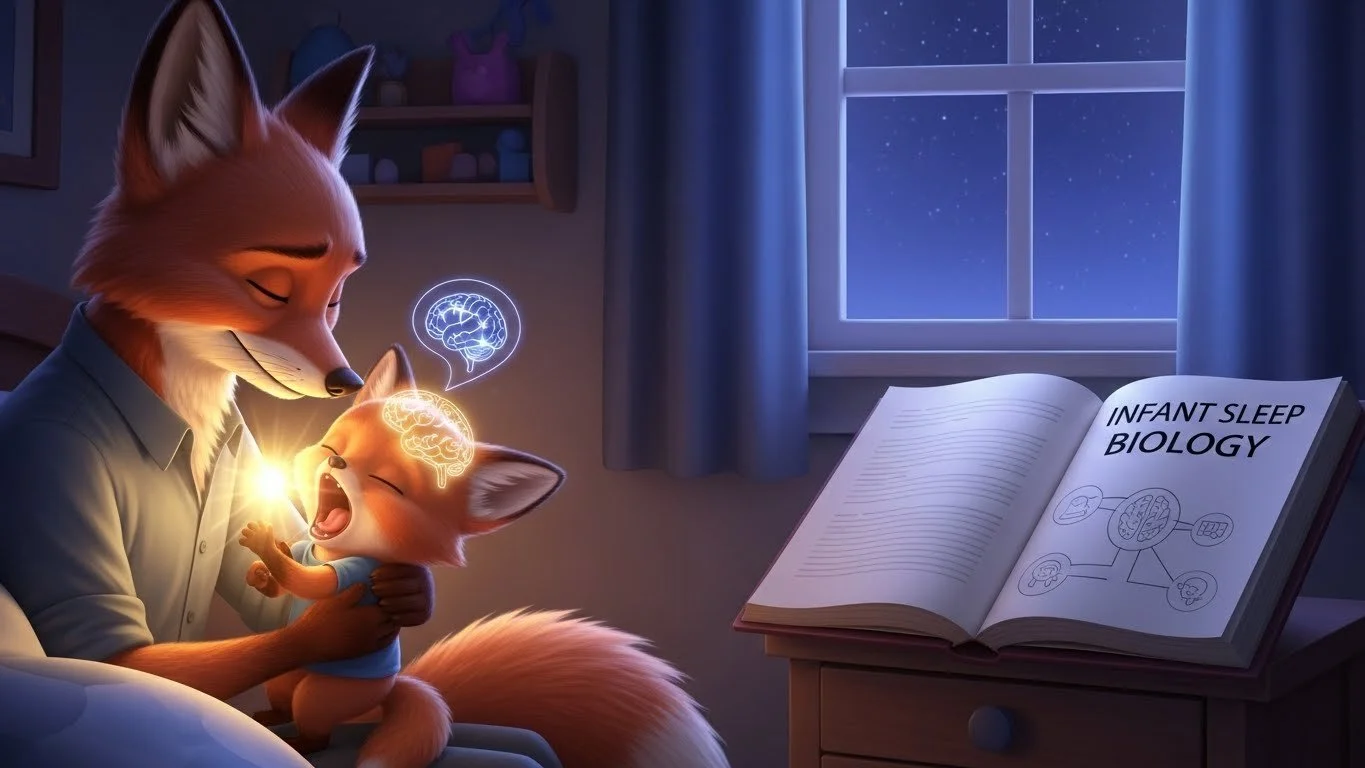
If you feel like you are failing because your baby won't sleep, I have a secret for you: it isn’t your parenting—it’s biology. Most advice treats babies like small adults, but infant sleep science reveals that their brains operate on a completely different set of rules. You’re likely wondering why your baby can’t simply close their eyes and drift off like an adult. You’ve probably heard people talk about "self-soothing," but for a newborn, that concept is physically impossible. In this post, you will discover the biological reasons why babies can’t calm themselves down and how infant sleep science proves that sleep training is a tool for brain development, not just a lifestyle choice. By the end, you’ll understand exactly what is happening inside your baby’s head.
Why is Your Baby’s Sleep So Unpredictable? The Two-Process Model Explained
To understand how your baby sleeps, we have to look at the "Two-Process Model of Sleep Regulation." This is the gold standard in sleep science. It explains that sleep isn't just one thing; it’s a tug-of-war between two different biological forces (Process S and Process C).
Process S (Sleep Pressure): Imagine a balloon filling with air. From the moment your baby wakes up, the balloon starts to fill. This is "sleep pressure." The longer they stay awake, the more pressure builds. Eventually, the pressure is so high the balloon must pop—that’s when they fall asleep.
The Adult Version: Our balloons are huge; they take 16 hours to fill.
The Infant Version: A baby's balloon is tiny. It fills up in just 90 to 120 minutes.
Process C (The Circadian Rhythm): This is the internal clock. It’s the body’s signal that says "it’s daytime" or "it’s nighttime."
Research published in Sleep Medicine Reviews highlights that the production of melatonin (the "sleep hormone") doesn't even begin to follow a regular cycle until about 9 to 12 weeks of age. For the first few months, babies are "ultradian." This means they sleep in small bursts around the clock because their brains haven't learned to link sleep to the day lights. The "Circadian Lock-In"—the moment the brain finally starts to anchor sleep to the night—doesn't typically stabilize until between 3 and 6 months of age.
Before 2-3 Months: Sleep is erratic and driven mostly by hunger and "Process S."
After 3-4 Months: The Suprachiasmatic Nucleus (the brain's clock) begins responding to light and dark cues.
Therefore, it is possible that you fail to "fix" a 2-month-old’s schedule because the hardware isn't installed yet. You are in the "grace period."

The struggle for parents is that in infants, these two processes are often out of sync. Their "balloon" (Process S) is very small, so it fills up every 90 to 120 minutes. Meanwhile, their "clock" (Process C) isn't fully set yet. When these two don't align, you get a baby who is exhausted but chemically wired to stay awake.
Why Can’t My Newborn Just Relax and Go to Sleep?
To understand why a baby can't "just relax," we have to look at the architecture of the human brain. Think of the brain as a house. In an adult, the "downstairs" (the amygdala, which handles emotions and fear) and the "upstairs" (the prefrontal cortex, which handles logic and calming down) are connected by a sturdy staircase. When we feel stressed, our upstairs brain tells our downstairs brain, "It’s okay, we are safe."
In an infant, that staircase hasn't been built yet. Infant sleep science shows us that the prefrontal cortex—the part of the brain responsible for "top-down" regulation—is incredibly immature at birth. When a baby cries, they aren't "being difficult." Their amygdala is firing an alarm, and they literally do not have the neural wiring to turn that alarm off by themselves. They require "co-regulation".
Infants have an immature parasympathetic nervous system (the "rest and digest" system). When an adult is stressed, they can take a deep breath to slow their heart rate. A baby cannot do this. They rely on co-regulation: when you hold your baby, they use your heartbeat, your breathing, and your warmth to physically lower their cortisol levels.
Furthermore, the Prefrontal Cortex—the logic center of the brain—is barely online. When a baby cries, they aren't "thinking" about anything; they are in a state of pure emotional survival.
If It’s Not Separation Anxiety, What Is Happening?
Many parents assume their newborn cries because of separation anxiety. However, separation anxiety requires "object permanence"—the understanding that Mom or Dad still exists even when they are out of the room. This doesn't typically develop until around 6 to 9 months of age. So, why does a 2-week-old scream the moment you put them in the bassinet?
The answer lies in biological proximity seeking. From an evolutionary standpoint, a lone infant is a vulnerable infant. Newborns are hardwired with a "survival reflex." When they lose physical contact with a caregiver, their brain triggers a massive release of stress hormones like cortisol and adrenaline. It isn't a conscious "I miss you"; it is a primal "I am not safe." At this stage, the brain is focused entirely on survival, not self-regulation.
This brings us to a common question: If babies are hardwired for proximity, why are some infants perfectly happy to play alone? To answer this, we have to look at the interaction between the Attachment System and the Exploratory System.
Biologically, every baby has two "thermostats" in their brain. The Attachment System is the "alarm" that goes off when they feel unsafe or far from a caregiver. The Exploratory System is the "curiosity" that turns on when they feel secure.
For many infants, "biological proximity" doesn't always mean skin-to-skin contact. If a baby has a high sense of security and a lower "reactive" temperament, their Exploratory System can turn on while the parent is simply in the same room—or even just within earshot. These babies aren't "missing" the proximity instinct; they simply have a higher threshold for what makes them feel "safe enough" to explore.
Dandelions vs. Orchids: The Role of Temperament
In infant sleep science, we often categorize babies using the "Dandelion and Orchid" framework, supported by research on infant reactivity and vagal tone (Philbrook et al., 2020).
Dandelion Babies: These infants are hardy and resilient. They can sleep almost anywhere and are comfortable playing by themselves for stretches of time. Their "attachment alarm" is set to a low sensitivity. They are the ones who seem to "self-soothe," but in reality, they just don't get distressed as easily.
Orchid Babies: These infants are highly sensitive to their environment. They are more "reactive," meaning their nervous system is constantly scanning for the caregiver's presence. They may need constant physical contact to keep their cortisol levels low.
A study by Morales-Muñoz et al. (2020) found that infant temperament—specifically "effortful control" and "reactivity"—is a major predictor of sleep patterns. If your baby needs you more, it isn't because they are "spoiled"; it’s because their biological "alarm" is more sensitive.
Is Sleep Training Science or Just a Social Rumor?
There is a lot of heated debate about sleep training, with some calling it "cruel" and others calling it a "miracle." Many parents feel conflicted: If a baby’s brain isn't ready to "soothe," how can we "train" them?
The confusion often comes from the word "soothe." In psychology, self-soothing is an emotional skill. It requires the prefrontal cortex to say, "I am sad, but I am okay." As we noted above, infants cannot do this.
However, self-settling is a behavioral transition. Sleep training is a science-based behavioral intervention. It is not about "breaking" a baby’s spirit; it is about helping the brain transition between sleep cycles. We all wakes up multiple times a night. As adults, we fluff our pillow and go back to sleep. We don't even remember doing it. This is a learned skill.
If a baby is always rocked to sleep, their brain "tags" rocking as the only way to cross the bridge between cycles. When they wake up in a still, dark crib, it feels like a "micro-emergency." Their brain doesn't know how to bridge the gap between sleep cycles without that external help. Sleep training aims to assist the babies to learn the physical habit of "settling" between sleep cycles.
What is the Science-Based Recommended Age?
Timing is Everything. The sleep training is not recommended for newborns. The recommendation to wait until 4 to 6 months is based on three biological shifts:
The Melatonin Surge: By 4 months, the body produces a reliable surge of melatonin at night.
The Vagal Tone: The nervous system becomes "sturdier." The baby starts to have a better ability to move from a high-arousal state (crying) to a lower one.
Object Permanence: Around 6 months, babies start to understand that you still exist even if you aren't in the room. This actually makes the "stress" of being alone a known, manageable challenge rather than a primal fear of vanishing.
If you want, you may also start sleep training when the baby reaches 6–12 Months. At this stage, the neurobiology is mature enough to handle behavioral conditioning, and the "Two-Process Model" (Sleep Pressure and Clock) is fully operational.
Is Sleep Training Safe?
Some crying is still inevitable even if you wait until 4 to 6 months. The biggest fear parents have regarding sleep training is the "toxic stress" argument. People worry that letting a baby cry will flood their brain with cortisol and cause permanent damage. However, infant sleep science makes a clear distinction between different types of stress:
Positive Stress: Brief, mid-level challenges (like learning to crawl or waiting a minute for a bottle).
Tolerable Stress: More intense but temporary, buffered by a supportive caregiver.
Toxic Stress: Chronic, severe neglect or abuse without any support.
Sleep training falls into the "tolerable" or even "positive" stress category when done in a loving home. When a parent implements a consistent sleep plan, the baby isn't being abandoned; they are being given the space to practice a new skill. Research shows that cortisol levels in sleep-trained infants actually decrease over time because they are getting higher-quality, more consistent rest.
Think of it like this: If a baby is learning to crawl and gets frustrated and cries, we don't call that "toxic." We call it "learning a hard skill." Sleep training, when done after 4-6 months, is treated by the brain as a developmental challenge, not an abandonment. The brain uses the check-ins as a "safety signal," which keeps the amygdala from staying in a permanent state of high alert.
Why Some Babies Struggle More Than Others
If your friend's baby sleeps through the night while yours is awake every hour, don't blame your parenting. Biology plays a massive role. Some infants have a more sensitive "sensory processing" system. These babies are more reactive to changes in temperature, sound, or the feeling of their own limbs moving.
Furthermore, the "vagal tone"—the health of the nerve that helps the body switch from "fight or flight" to "rest and digest"—varies from baby to baby. Some babies are simply born with a "sturdier" staircase between their upstairs and downstairs brains, making them naturally calmer. Others need more time, more consistency, and more practice to build those neural connections.
Conclusion
Understanding infant sleep science changes the way we look at those long, tearful nights. Your baby isn't trying to manipulate you, and they aren't "bad" at sleeping. Their brain is simply a work in progress. By recognizing that self-soothing is a biological milestone—not a personality trait—you can approach sleep training with confidence and empathy.
You aren't just "getting them to stop crying"; you are helping them build the neural pathways they need for a lifetime of healthy rest. Be patient with your baby, and more importantly, be patient with yourself. You are doing the hard work of building a brain from the ground up.
-
Bilgin, A., & Wolke, D. (2020). Parental use of ‘cry it out’ in infants: No adverse effects on attachment and child development at 18 months. Journal of Child Psychology and Psychiatry, 61(11), 1188–1196.
Morales-Muñoz, I., et al. (2020). The role of infant temperament in sleep development: A longitudinal study. Sleep Medicine, 68, 140–147.
Philbrook, L. E., et al. (2020). Infant vagal tone and reactivity: Links to nighttime sleep quality. Journal of Sleep Research, 29(4), e12933.
Gradisar, M., et al. (2016). Behavioral Interventions for Infant Sleep Problems: A Randomized Controlled Trial. Pediatrics, 137(6), e20151486.
Bathory, E., & Tomopoulos, S. (2017). Sleep Regulation, Physiology and Development, Sleep Duration and Patterns, and Sleep Hygiene in Infants, Toddlers, and Preschool-Age Children. Current Problems in Pediatric and Adolescent Health Care, 47(2), 29–42.