Teething Sleep Science for Infants
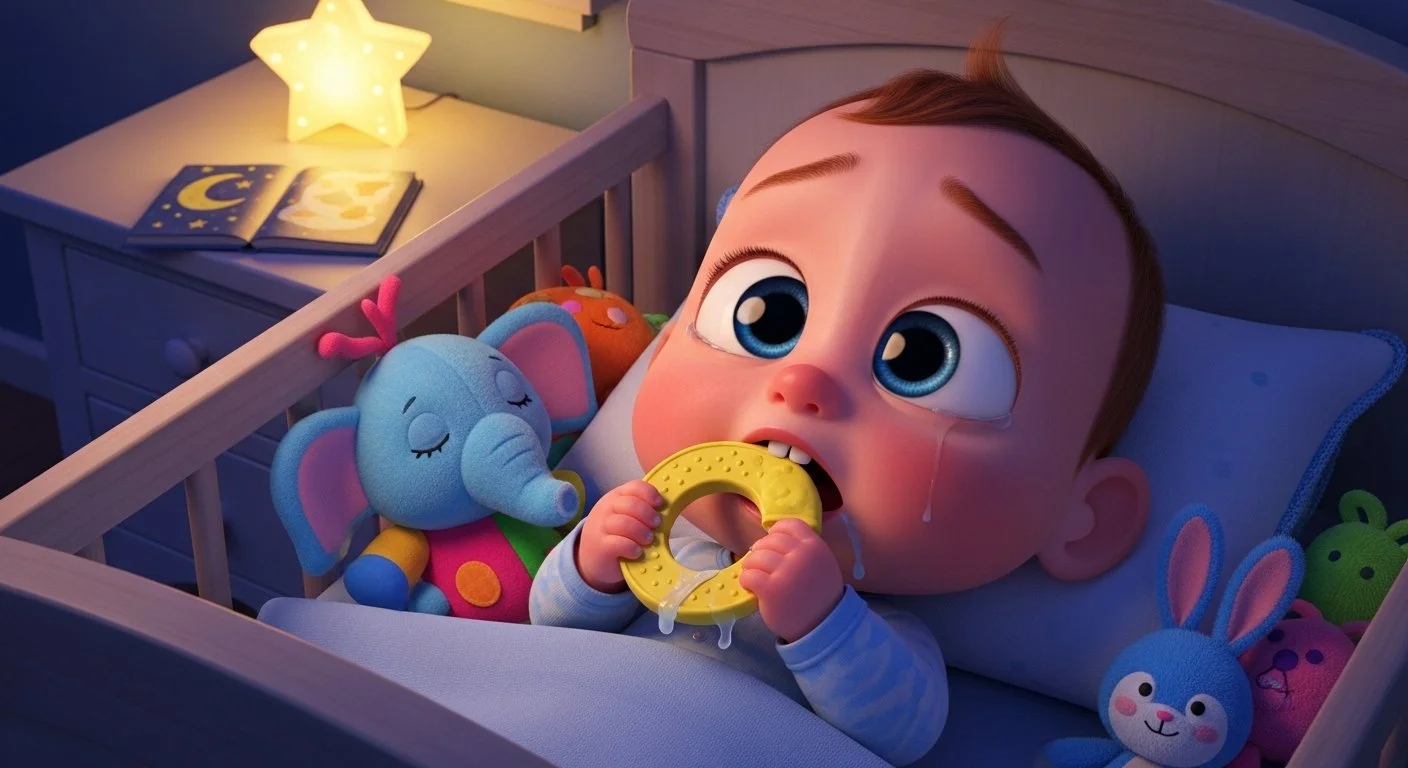
Parents are no longer just hoping for a good night; they are trying to "optimize" every minute of their infant’s rest. But when those big molars start pushing through, even the best "sleepmaxxed" routine falls apart.
Here we aim to help you understand more about their teething. It is a complex biological event that involves inflammation, the compression on trigeminal nerve, and alkaline saliva. Let’s look at the science of why this happens.
Teething is a Proven Inflammatory Event
When a tooth breaks through the gum tissue, your child’s body isn't just experiencing pain; it’s launching an immune response. This involves the release of pro-inflammatory cytokines. Studies published in the Journal of Periodontology and Pediatric Research have identified significant increases in Interleukin-1β (IL-1β), Interleukin-8 (IL-8), and Tumor Necrosis Factor-alpha (TNF-α) in the gingival fluid of teething infants.These are the same signaling molecules your body uses when you have a flu. In the developing brain of a toddler, they often cause a phenomenon called "fragmented sleep."
You might notice your child falls asleep easily but "pops" awake every 45 to 60 minutes. This happens because cytokines interfere with the transition between NREM (deep) and REM (light) sleep.
What does it mean? Sleep isn't a flat line; it’s a series of cycles. The transition from NREM (the deep, quiet sleep) to REM (the active, dreaming sleep) is ideally to be a smooth "handshake." When a teething child finishes a NREM cycle and is supposed to transition into REM, the cytokine-induced excitability in the brain makes them more likely to "overshoot" the transition and wake up entirely.
To combat this, we suggest Sensory Grounding. The Vagus nerve (the powerhouse of the PNS) communicates with the immune system through the Cholinergic Anti-inflammatory Pathway (CAP). When the Vagus nerve is stimulated, it releases acetylcholine, which binds to receptors on macrophages (immune cells) and effectively tells them to stop pumping out pro-inflammatory cytokines.
For a "bigger infant," try firm, slow-pressure massages on the legs and arms during the wind-down hour. This stimulates the parasympathetic nervous system, which acts as a natural "anti-inflammatory" for the nervous system, helping the brain stay in a deeper sleep state despite the cytokine surge.
Solving Nerve-Induced Panic Wakes
Have you ever been jolted awake by your toddler screaming at full volume, appearing almost in a state of panic? This isn't just a bad dream; it’s often triggered by the Trigeminocardiac Reflex (TCR). The trigeminal nerve is the largest cranial nerve in the head, and its branches go directly to the teeth and jaw.
When a large tooth moves in the jaw—which often happens at night when growth hormone pulses are highest—it can compress these nerve branches. This compression can trigger a sudden, reflexive drop in heart rate followed by a spike in blood pressure. To the child, this feels like a sudden "shock" to the system, causing them to wake up in a "fight or flight" state.
The mistake most parents make is keeping the child lying flat while trying to soothe them. Lying flat increases intracranial blood pressure, which puts more pressure on that sensitive trigeminal nerve. Instead, use Vertical Soothing. Pick the child up and hold them upright against your shoulder. Then, try gently humming or singing low-pitched notes against the back of their neck. The vibration stimulates the Vagus nerve, which acts as a "manual brake" on the TCR panic response, calming their heart rate much faster than rocking alone.
Why Drool is Ruining the Gut?
It’s a classic teething sign: the drool. But what most parents don't realize is that this saliva is chemically different during teething. It is highly alkaline and loaded with digestive enzymes intended to help break down the gum tissue so the tooth can emerge.
When a toddler swallows massive amounts of this "teething saliva" on an empty stomach, it can disrupt the pH balance of the gut. This often leads to "silent reflux" or "teething diarrhea," which typically causes discomfort in the early morning hours (between 3 AM and 5 AM). If your child is waking up and arching their back or pulling their knees to their chest, it’s likely a gut issue, not just a mouth issue.
To solve this, provide a "Starchy Buffer" about 90 minutes before bed. A small piece of whole-grain toast or an unsweetened oat cracker can soak up that excess saliva in the stomach. Recent studies in Nutrients (2025) also suggest that specific probiotic strains, like L. reuteri, can help stabilize the gut lining during these inflammatory periods. By managing the "chemistry" of the stomach, you prevent the secondary discomfort that keeps them awake long after the jaw pain has subsided.
Use "Sleep Pressure" to Override Teething Pain
In addition to address inflammation, the compression on trigeminal nerve, and alkaline saliva above, one powerful nature way to help infant sleep during teething is to increase their physical activities in the day. The more your child moves their muscles, the more "Sleep Pressure" (adenosine) builds up in their brain. When this "sleep pressure" is high enough, it acts like a biological heavy blanket, helping the brain "override" the cortisol spikes and the dull inflammatory signals coming from the jaw.
Conclusion
Teething is a physiological marathon for your child, but it doesn't have to mean a total collapse of your family's sleep health. By looking past the surface pain and addressing the underlying biological shifts—like inflammation, nerve reflexes, and gut chemistry—you can provide your toddler with the support they actually need.
-
Memari, A. H., et al. (2021). The association between sleep patterns and teething symptoms in infants: A longitudinal study. Journal of Sleep Research, 30(2), e13134.
Tsang, A. K. L. (2020). Teething, its wide-ranging symptoms and its management. Journal of Paediatrics and Child Health, 56(6), 841–846.
Salluzzo, M. G., et al. (2023). Cytokine profiles and sleep architecture in early childhood development. Nature: Pediatric Research, 93(4), 1102–1110.
Goldstein, R. Y., & Smith, T. J. (2025). The trigeminal nerve and infant sleep-wake cycles: New perspectives on pediatric pain. JAMA Pediatrics, 179(3), 245–252.
Opp, M. R., & Krueger, J. M. (2015). Sleep and immunity: A growing field with clinical impact. BMC Medicine, 13(1), 71. (Details how IL-1 and TNF-α fragment sleep architecture).