Strategies to Quiet Separation Anxiety during Bedtime
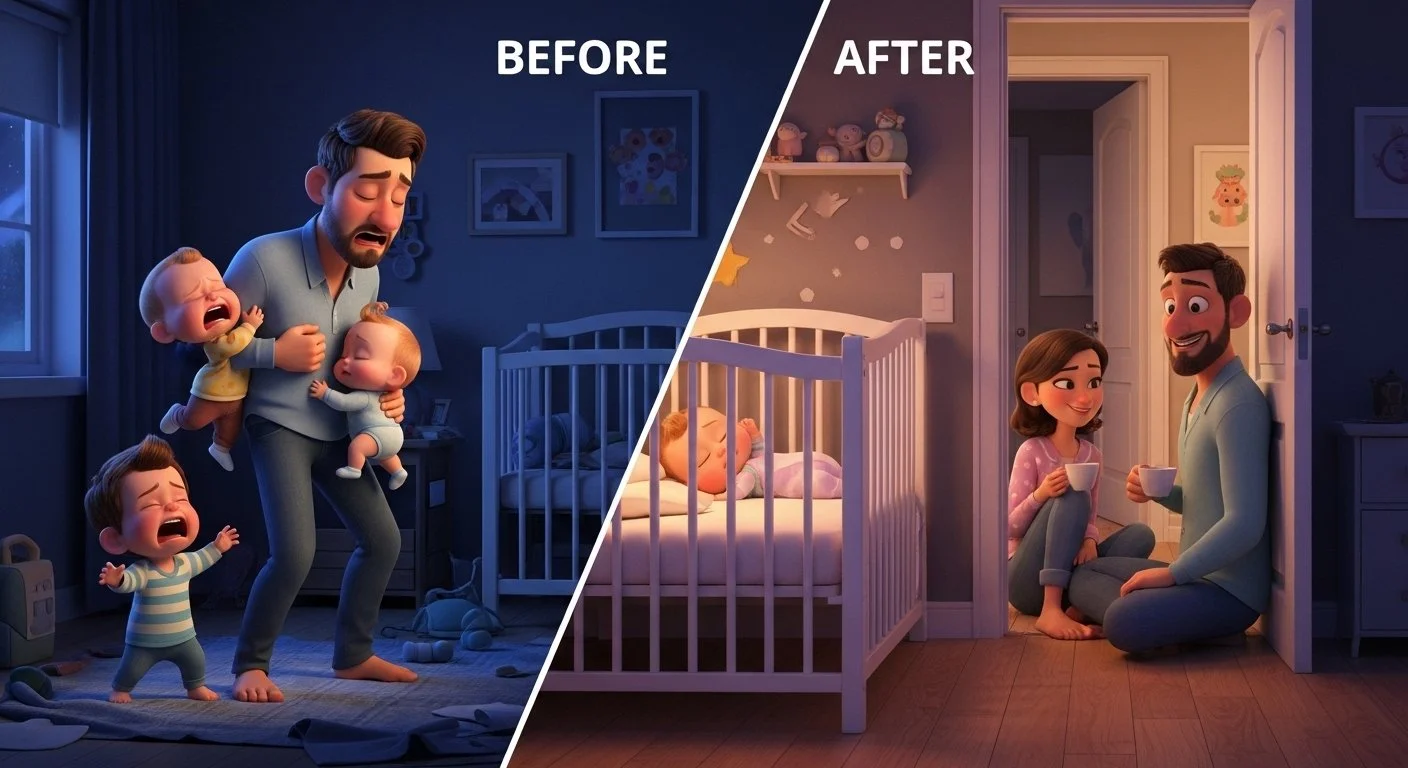
You can have the best smart-crib in the world, but if your toddler thinks you are disappearing forever every time you close the bedroom door, nobody is getting any "maximized" sleep. Apparently, sleep isn't just a biological clock issue; it is also an emotional safety issue.
If you are feeling like a zombie today because your "clingy" toddler refused to let go of your neck at 2:00 AM, you aren't alone. This isn't just a phase you have to "survive" through gritted teeth. By understanding the timeline of separation anxiety and using a few research-backed strategies that go beyond basic sleep hygiene, you can help your child feel safe enough to let go—and finally get the rest you both need.
The "Why Now?" : When Separation Anxiety Starts
Many parents expect separation anxiety to happen the moment a baby is born, but it actually takes time for a child’s brain to develop the "hardware" for it. Usually, you will notice the first big wave around 8 to 9 months.
Before this, your baby lives in a world of "out of sight, out of mind." If you leave the room, they might be annoyed, but they don't necessarily realize you are somewhere else without them. In other words, they live in a "continuous present." If they can’t see you, smell you, or hear you, you effectively cease to exist in their immediate reality.
Around the 9-month mark, when their prefrontal cortex and hippocampus mature, they develop a hallmark called object permanence. This is the ability to hold a "mental blueprint" of an object (or person) in their working memory even when that object is out of sight. The problem? They suddenly realize that when you leave, you still exist—you are just "not here." Their brain tells them: "The Source of Safety is gone. I know they are out there, but I don't know where 'there' is, and I don't know if they are ever coming back." This creates a state of "high-alert" cognitive dissonance.
This creates a genuine fear: their working memory is holding onto your image, but their physical environment is empty, triggering a survival response.
The peak usually hits between 10 and 18 months, and it can last well into the toddler years, often flaring up again around age two. During these developmental waves, research suggests that you can teach their young brain that "goodbye" is always followed by "hello." In fact, research shows that children who have a predictable response from parents during these waves actually develop better self-soothing skills later on because their "stress thermostat" is calibrated to feel safe.
The Sleep Problem: When Bedtime Becomes a Breakup
To the developing brain, bedtime is the ultimate separation. When a child with separation anxiety is put in a dark room alone, their amygdala (emotion center) sends out a "threat" signal. This floods their system with cortisol (the stress hormone).
Here is the thing about cortisol: it is the direct enemy of melatonin (the sleep hormone). You can have the perfect 68-degree room and blackout curtains, but if your child’s brain is swimming in cortisol, they physically cannot fall asleep. They are in "fight or flight" mode.
So, separation anxiety is not a behavior problem to be "fixed" with discipline; it is a biological state that requires a biological solution. When we understand that bedtime is a moment of high-alert for their immature amygdala, we can stop fighting against their tears and start working with their nervous system.
Of course, every baby is different. It is absolutely nature that some child are simply born with a more sensitive "threat detection system." Below we want to offer some science-backed solutions to assist both you and your child to get through the challenges.
Coregulation Enhancer-Sensory Anchoring and the Bridge of Presence
One solution is to focus on coregulation. This is a fancy word for using your calm physiology to settle their nervous system.
Before we dive into the "how-to," let’s talk about what coregulation actually is.
Think of the brain as a house. In an adult, the "downstairs" (the amygdala, which handles emotions and fear) and the "upstairs" (the prefrontal cortex, which handles logic and calming down) are connected by a sturdy staircase. When we feel stressed, our upstairs brain tells our downstairs brain, "It’s okay, we are safe." So, when an adult is stressed, they can take a deep breath to slow their heart rate.
In infants and some young toddlers, that staircase hasn't been built or not well established yet. When their amygdala is firing an alarm, they literally do not have the neural wiring to effectively turn that alarm off by themselves. They require "coregulation": when you hold your baby, they use your heartbeat, your breathing, and your warmth to physically lower their stress levels and to tell their brain that they are safe.
The Coregulation Trap: When Parental Stress Creates a Stress Feedback Loop
With that being said, if you are frustrated, stressed, and checking your watch anxiously during the comforting process, your child can actually picks up on that micro-stress via the same coregulation mechanism.
Muscle Tension: When you are frustrated, the tiny muscles around your eyes and jaw tighten. Your baby feels this when you hold them.
Pupil Dilation and Heart Rate: Research shows that infants are sensitive to "autonomic arousal." If your heart rate is high, theirs will often sync up to match it—a process called physiological synchrony.
Voice Prosody: Even if you are saying "I love you," if the pitch of your voice is tight or higher than usual, their amygdala (the brain's fear center) registers it as a warning signal.
Other changes: When you are not genuinely calm, your breathing is shorter, your heart rate variability (HRV) changes, your skin temperature changes, and you may even emit "stress pheromones". Although the changes are slight, babies are masters at sensing this.
Essentially, your baby is a "Stress Sponge." In 2024, studies published in Nature highlighted that this synchrony is a survival mechanism. In the wild, if a parent is stressed, it usually means there is a predator nearby. Their brain thinks, "If Mom/Dad is stressed, there must be a reason to be scared!"
Below, we provide 2 approaches to enhance your coregulation.
Sensory Anchoring
Physical touch signals safety to the brain’s proprioceptive system—the system that tells the brain where the body is in space. A "burrito wrap" (snugly wrapping them in a towel or blanket) or a firm, slow massage provide predictable pressure that lowers anxiety.
Bridge of Presence
"Bridge of Presence" acts as a biological placeholder. It provides signals that tells their brain you are still "there” even after you have left the room. You may have heard of using a "scent strip"—like a parent's T-shirt—to help a child feel close to you. However, standard SIDS and sleep safety guidelines are strict: Nothing should be left in a crib for an infant under 12 months. No blankets, no pillows, and certainly no loose clothing.
So, how do we build a "Bridge of Presence" without breaking safety rules? We use Scent Anchoring through safe, approved methods: The Scented Sheet Method.
Instead of putting a shirt in the crib, sleep on the child’s fitted crib sheet for some nights yourself. Then, pull it tight and secure it to their mattress. The scent of your skin and hair is now embedded in the sleep surface itself, providing the "smell of safety" without any loose fabric risks.
For toddlers, "Kiss in a Pocket" is even a more advanced approach to bridge your absence: You can kiss their palm and have them "close" it. This is a psychological anchor that doesn't require loose items in the sleeping area.
When you take your child’s hand, look them in the eye, and gently kiss their palm, you are engaging in targeted positive touch. This physical connection triggers the release of oxytocin in both of you. By flooding the system with the "cuddle hormone" right before you leave, you are manually lowering their stress levels. In addition, by "closing" their hand to keep the kiss, the child shifts from a passive state of "waiting for Mom/Dad to leave" to an active state of "holding onto Mom’s/Dad’s love." This cognitive shift provides a sense of agency and control, which is incredibly grounding for a dysregulated nervous system. Furthermore, when the child wakes up in the middle of the night, they can touch their palm or remember the "pocket." The parents can remind them the “pocket” during daytime as part of their nighttime sleep training as well.
By staying calm and using "Coregulation Enhancer", you lower their cortisol so their natural melatonin can finally do its job.
Common Sleep Training Addressing the Separation Anxiety.
In addition to the establishment of trust and emotional safety via coregulation, you can begin to introduce specific sleep-training approach to reduce separation anxiety at bedtime. The following strategies allow you to remain a calm, co-regulating presence while your child learns the invaluable skill of independent sleep."
The "Chair Method": A Middle Ground That Works
Most parents think they only have two choices: let the child cry for hours or sleep on the floor for the next three years. However, there is a modified and more gentle approach to replace the traditional cried-out approach: The Chair Method.
Instead of a "cold turkey" exit, you gradually increase the distance between you and the child over several nights.
Nights 1–3: Sit right next to the crib. You can offer a pat or a brief word, but keep it boring.
When you put the child down for sleep, they can pat them obsessionally, but not constantly. Parents should not talk to their children at this time or should talk as little as possible and reduce the amount of verbal intervention each night.
Nights 4–6: Move your chair halfway to the door.
The aim is no longer be comforting with touch.
You can continue to shush or repeat supportive language (e.g. I love you, it is night-night time), but do stay in the chair.
You remain in the chair until the child falls asleep.
Nights 7–9: Sit in the doorway where they can see your shadow but you aren't "in" the room.
After the sleep routines and put the child down, you simply sit in the chair and offer the occasional supportive language or simply “shhh”.
Same if the child wake up in the middle of the night.
Night 10+: Sit just outside the door in the hallway.
The babies can still see and sense the parents, but parents are out of reach.
Intermittent sushing can be used, but it should be only just enough to make the child aware that the parents remains nearby.
Eventually, you should plan to be out of sight but can remain nearby (so that you can listen and be responsive if needed).
The child may get upset by this last transition. It is important that parents remain calm and reassuring.
Throughout the process, the golden rule is to minimize picking the child up. Use words and provide gentle physical comfort (touching their fingers, toes) when they cry. If the child stands up in the crib, parents need to tell them to lie down again without getting out of the chair.
For kids older than 2.5 yrs of age, parents should be encouraged to explain the entire process to them, so the children know what to expect, in addition to applying the praise with each new milestone. Having discussion during the day about “sleep manners” and reinforcing good bedtime behavior with incentives (e.g. sticker, small treats) are also highly effective at getting older children on board.
The Chair Method has become wildly accepted because it respects the child's separation anxiety while still moving toward the goal of independent sleep. It prevents the "cortisol spike" because the child never feels truly abandoned. They learn that they can fall asleep while you are "away" because the transition happened in tiny, manageable steps.
The "Micro-Departure" Strategy: Practicing Goodbyes During the Day
One thing many people don't know is that you can fix bedtime problems during daytime break. Separation anxiety is a 24-hour cycle. If a child only experiences "separation" when it is dark and they are tired, they will always associate it with fear.
Use "Micro-Departures" during the day to build their "separation muscle."
Play Peek-a-boo: This is the simplest form of teaching object permanence. "Now you see me, now you don't!"
The "I'll be right back" Game: Tell your child, "I'm going to the kitchen to get a glass of water. I'll be back in 30 seconds." Even if they cry, come back in 30 seconds and say, "I came back, just like I said!"
Increase the Gap: Slowly move from 30 seconds to two minutes, then five.
By doing this, you are literally rewiring their brain to understand that departure = return. When bedtime rolls around, their brain has "data" showing that you always come back, which lowers the stakes of the nighttime goodbye.
The "Power Shift" Solution: Giving Toddlers Control Over the Dark
Toddlers crave autonomy. Separation anxiety is often made worse because the child feels like sleep is something being done to them, rather than something they are choosing.
To reduce the anxiety of being left alone, give them "The Power of Two." This is a research-backed psychological trick where you give the child two choices, both of which lead to the same result.
"Do you want to walk to the bedroom like a dinosaur or a butterfly?"
"Do you want the blue pajamas or the red ones?"
"Do you want to turn off the light yourself, or should I do it?"
When a child feels in control of the "getting ready" process, they feel less like a victim of the "separation." This lowers their overall anxiety levels. Another pro-tip: Use a "Reverse Baby Monitor." Instead of just you watching them, some parents use a simple intercom to say, "I'm right here in the kitchen, I can hear you, you are safe." Hearing your voice without you being in the room helps bridge the gap between "Together" and "Alone."
Conclusion
Separation anxiety is a beautiful, albeit exhausting, sign that your child has formed a deep, healthy attachment to you. Their brain is simply learning how to navigate a world where they are a separate person from you. By moving away from the "all or nothing" approach to sleep and focusing on lowering cortisol and gradual transitions, you can turn bedtime from a battle into a peaceful handoff. The goal isn't just a sleeping child—it's a child who feels safe enough to close their eyes.
-
Mindell, J. A., & Williamson, A. A. (2018). Benefits of a bedtime routine in young children: Sleep, development, and beyond. Sleep Medicine Reviews, 40, 93–108.
Bowlby, J. (1969). Attachment and Loss: Vol. 1. Attachment. Basic Books. (Modified update: Research on attachment and sleep physiology in Nature Reviews Psychology, 2024).
Middlemiss, W., Granger, D. A., Goldberg, W. A., & Nathans, L. (2012). Asynchrony of mother–infant hypothalamic–pituitary–adrenal axis outcomes: Examining cortisol responsiveness during conditioning to sleep. Early Human Development, 88(4), 227–232.
Gradisar, M., Jackson, K., Njman, N. J., & Wolfson, A. (2016). Behavioral Interventions for Infant Sleep Problems: A Randomized Controlled Trial. Pediatrics, 137(6), e20151486.
Baillargeon, R. (1987). Object permanence in 3.5- and 4.5-month-old infants. Developmental Psychology, 23(5), 655–664. (Updated with context from Nature Reviews Psychology, 2025).
Bell, S. M., & Ainsworth, M. D. S. (1972). Infant crying and maternal responsiveness. Child Development, 43(4), 1171–1190.
Diamond, A. (1990). The development and neural bases of memory functions as indexed by the AB and delayed response tasks in human infants and infant monkeys. Annals of the New York Academy of Sciences, 608(1), 267–317.
Shinskey, J. L., & Munakata, Y. (2005). Less is more: Infants fail to reach for objects when they are out of sight. Psychological Science, 16(1), 61–66.