Cancer and the 24/7 Life: Understanding Circadian Disruption as a Risk Factor
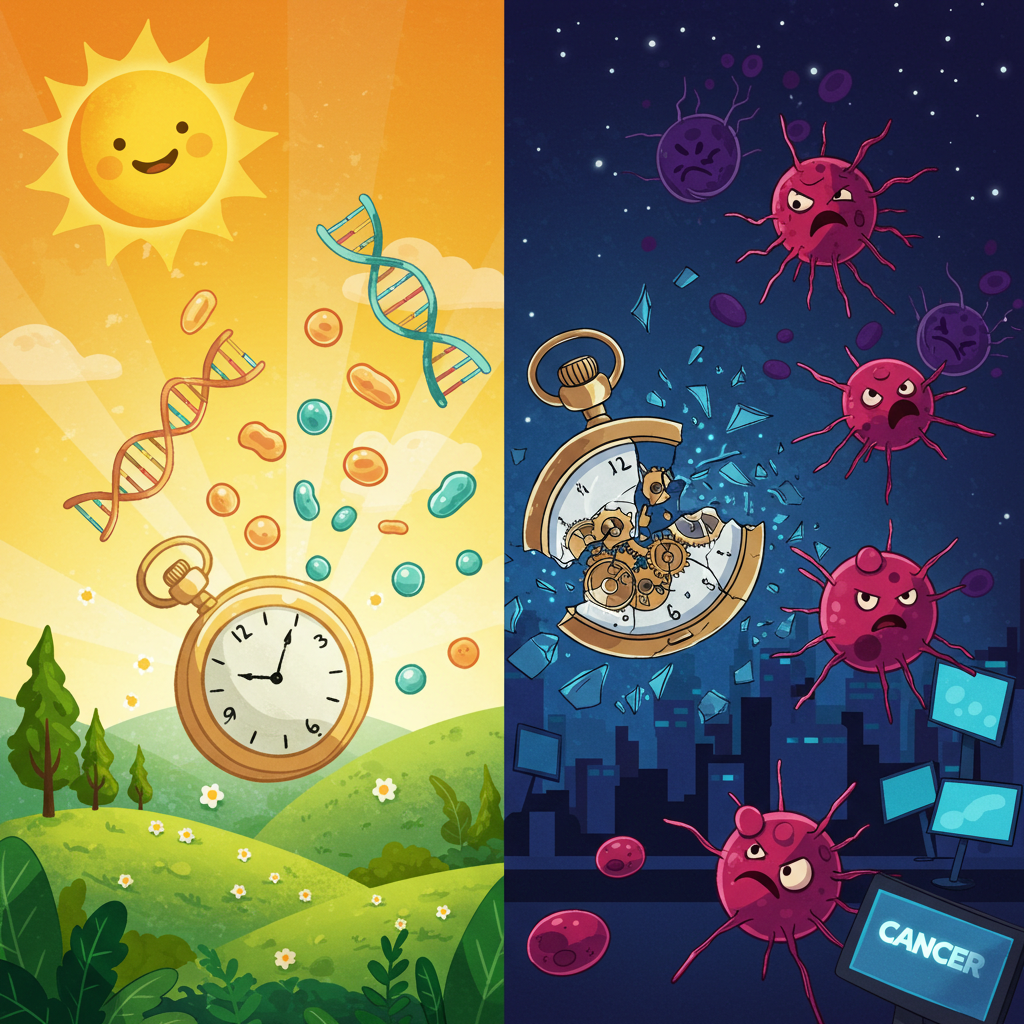
If you were to Google the connection between your circadian clock and cancer, you might be met with some alarming headlines: suggestions that something as simple as sleeping with the lights on or working a night shift could put you at risk. It sounds dramatic—is it really that easy?
The reality, as with many diseases, is complex. Cancer is the result of a complicated dance between our genes and our environment, but it's often an environmental trigger that tips the scales. For many of us, the potential risks associated with constantly disrupting our body's internal timing system may be closer than we realize.
More Than Just a Sleep-Wake Schedule
Your internal clock, or circadian timing system, is far more sophisticated than a simple sleep timer. This biological timekeeper is an intricate network of "clock genes" that influence the function of virtually every cell and organ in your body. Because of this wide-reaching impact, a disturbed internal clock is being linked to a growing number of health issues, with cancer research currently taking center stage.
Consider this striking example from animal studies: researchers found that exposing mice to a cancer-inducing stimulus at different times of the day could dramatically alter the outcome. When the mice were exposed to ultraviolet (UV) light during their natural sleeping hours—when their DNA repair mechanisms were at their peak—they had a much lower cancer rate compared to exposure during their waking hours, when that repair work was sluggish.
The importance of this internal rhythm doesn't end with prevention. Interestingly, studies on cancer patients have shown that a patient's circadian strength might even predict survival. Patients with breast or colorectal cancer who maintained a strong, defined sleep-wake cycle or steady cyclical changes in the stress hormone cortisol tended to have higher survival rates than those whose rhythm was weak or "damped." Your internal clock is literally an indicator of your body's robustness.
The WHO Warning: Night Shifts and the 24/7 World
In our modern, technological world, we're no longer limited by the sun. Light sources and food are available 24 hours a day, giving rise to night shift work—a lifestyle that forces people to receive artificial light and eat during their "biological night," when the body should be resting.
The research linking this lifestyle to cancer has raised serious global concerns. So much so that the International Agency for Research on Cancer (IARC), which operates under the World Health Organization (WHO), has classified night shift work involving circadian disruption as a Group 2A probable human carcinogen. This means the evidence from human populations, combined with ample supporting data from animal experiments, is strong enough to consider it a significant cancer risk factor.
The risk appears most consistent and pronounced concerning breast cancer in women. In fact, the Danish government began compensating female breast cancer patients with over 20 years of night shift experience, acknowledging the scientific consistency of the findings. Similarly, those who frequently cross time zones, like flight crews, also show an elevated risk of breast or skin cancer, though factors like radiation are also at play.
Melatonin: The Key to the Connection
At the very core of why working the graveyard shift is linked to cancer is the suppression of a vital hormone: melatonin.
Often called the "sleep hormone," melatonin is produced mainly by the pineal gland during darkness. It acts as the brain’s signal that it's nighttime, helps regulate our rhythms, and crucially, has significant anti-cancer effects. It works by suppressing estrogen signaling in breast cancer cells and inhibiting tumor metabolism and growth.
When people are exposed to light at night—especially the blue-enriched spectrums common in workplaces and screens—melatonin secretion is dramatically inhibited. This reduction is critical. One alarming 2014 study illustrated this pathway clearly: researchers transplanted human breast cancer cells into rats. When those rats were subjected to light pollution at night, their melatonin was suppressed, and their tumors grew significantly faster in less than a month compared to rats kept in a normal light-dark cycle.
Protecting Your Clock and Your Health
Cancer is essentially a disease of cell reproduction gone haywire, and your internal clock acts like a conductor, influencing the genes that regulate this process. When the clock is disturbed, the risk of cell division spinning out of control increases.
Since a disrupted clock can accelerate cancer, researchers are now exploring whether repairing the clock can slow tumor progression—an exciting area of study showing promise as a potential addition to traditional therapy.
For the rest of us, especially those with irregular schedules, adopting lifestyle strategies to reduce circadian disruption is critical:
Embrace Darkness: Prioritize sleeping in an environment that is as dark as possible (think blackout curtains or eye masks). Even modest light can inhibit melatonin production.
Filter Blue Light: Reduce exposure to blue-enriched light in the evening. This means dimming the lights, wearing blue-light-blocking glasses during night shifts, or using night-shift modes on electronic devices.
Be Proactive: If you have a long history of night work, discuss personalized cancer screening with your clinician.
The evidence is mounting and clear: your internal clock is not just about feeling tired or hungry. These risks often require years of chronic disturbance to manifest, but understanding them empowers us to make informed choices and encourages us to advocate for employers and governments to treat long-term shift work as a legitimate occupational health risk.
-
Hansen, J., & Pedersen, J. E. (2024). Night shift work and breast cancer risk – 2023 update of epidemiologic evidence. Journal of the National Cancer Center.
Lingas, E. C. (2023). A Narrative Review of the Carcinogenic Effect of Night Shift and the Potential Protective Role of Melatonin. Cureus.
Schernhammer, E., Bogl, L., Hublin, C., Strohmaier, S., Zebrowska, M., Erber, A., Haghayegh, S., Papantoniou, K., Ollikainen, M., & Kaprio, J. (2023). The association between night shift work and breast cancer risk in the Finnish twins cohort. European Journal of Epidemiology.