Blue Light Suppresses Teen Melatonin Differently Than Adults
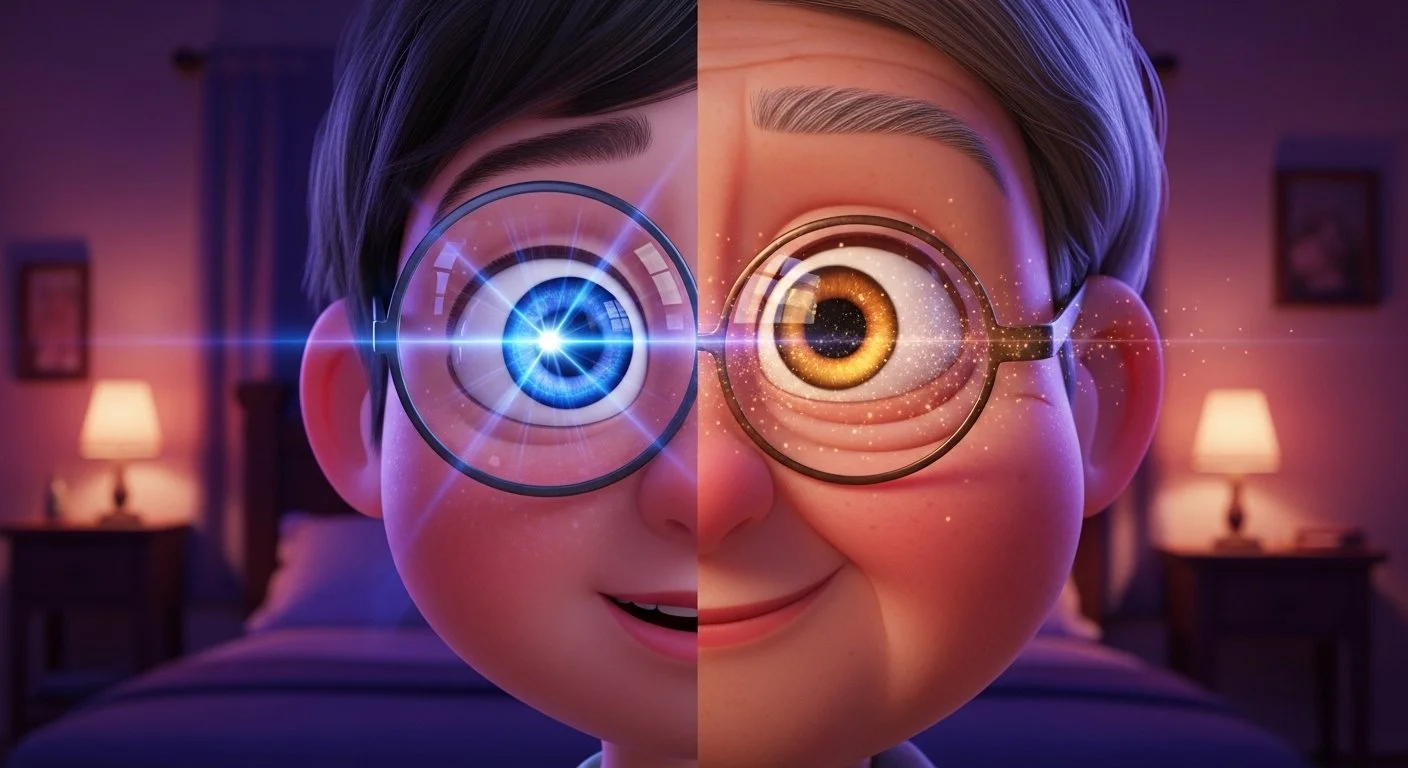
We often talk about "blue light" as a general boogeyman, but we rarely talk about the physical anatomy of the eye. As we age, the lens of our eye slowly yellows. This natural aging process actually acts as a built-in pair of "blue-blocker" glasses, filtering out some of the short-wave light before it hits the retina.
Teenagers, however, have incredibly clear, crystalline lenses. This means that a much higher percentage of blue light reaches the back of the adolescent eye compared to an adult. Specifically, the light hits the intrinsically photosensitive retinal ganglion cells (ipRGCs). These cells aren't for seeing shapes or colors; they are dedicated timing sensors that talk directly to the suprachiasmatic nucleus (SCN)—the master clock of the brain. Because the teen lens is much more clear than adults, these "clock-setting" cells receive a massive, unfiltered dose of blue light, which immediately halts melatonin production. What might be a "dim" screen to a parent feels like a stadium floodlight to a teenager's internal clock.
The Melatonin Suppression: Adults vs. Adolescents
Scientific studies measuring melatonin levels have found a dramatic difference in suppression rates. In one landmark study, exposure to the same amount of evening light suppressed melatonin by about 25% in adults, but by a staggering 50% to 70% in pre-pubertal and mid-pubertal adolescents.
As mentioned briefly above, the difference is rooted in physiological and developmental biology:
Lens Clarity:
As humans age, the crystalline lens in the eye gradually yellows (a process called lenticular yellowing). This yellowing acts as a natural filter that blocks short-wavelength blue light. Teens have very clear lenses, allowing more blue light to reach the retina
Pupil Size:
Adolescents generally have larger resting pupil diameters than older adults. A larger pupil allows more "luminous flux" (light energy) to enter the eye and stimulate the ipRGCs that regulate the clock.
Circadian Shift
During puberty, the circadian rhythm naturally shifts later (the "night owl" phase). This biological delay makes the system particularly vulnerable to evening light, which can further delay the onset of sleep and make it harder to wake up the next morning.
Together, this means that a teenager is nearly twice as sensitive to light at night as their parents are. Even "low-level" room light—the kind we think is harmless—can be enough to tell a teen’s brain to stop preparing for sleep, creating a chemical "second wind" that overrides their natural exhaustion.
The Neuroplasticity Connection: Why Sleep is Non-Negotiable
The adolescent brain is undergoing a massive "remodeling" project. During sleep, the brain performs a process called "synaptic pruning," where it clears out weak connections and strengthens the ones that matter. This is the physiological basis for how teenagers learn, regulate their emotions, and develop executive function—the ability of the prefrontal cortex to make sound decisions.
When blue light suppresses melatonin and delays sleep, it isn't just causing morning grogginess; it is effectively interrupting a biological construction site. Without sufficient Slow-Wave Sleep (the deep sleep), the prefrontal cortex—the part of the brain that controls impulses—cannot mature and function properly. This creates a vicious cycle: the sleep-deprived teen lacks the impulse control to put the phone away, which further suppresses melatonin and continues to stall the very brain development they need to break the habit.
Fixing the Glow: Respect Teen Biology
Because the teen eye is hyper-sensitive, standard adult sleep hygiene often falls short. The goal is to create a "virtual sunset" that respects their unique threshold for light.
Early Dimming: Because a teen's suppression threshold is significantly lower than an adult's, the "dim light" period should begin at least 90 to 120 minutes before the desired bedtime. Shift home lighting to warm, amber tones during this window.
Hardware Over Software: While "Night Shift" modes help, they often don't filter enough blue light for a teen's sensitive ipRGCs. For late-night homework, high-strength blue-blocking glasses (orange-tinted) provide a more effective physical barrier than software alone.
The "Anchor Sleep" Rule:The most powerful tool is consistency. By keeping a wake time—even on weekends—within one hour of their school-day wake time, we prevent "Social Jetlag." This consistency anchors the circadian rhythm, making the Sunday night "melatonin surge" predictable rather than elusive.
Conclusion
Navigating the teenage years is a challenge for both parents and adolescents, but understanding the "hidden" biology of sleep can remove much of the friction. It is easy to label a late-night scroller as "undisciplined," but the science tells a different story—one of a hyper-sensitive biological clock struggling to find its rhythm in a glow-in-the-dark world. By acknowledging that a teenager’s eyes and brain are physically more vulnerable to light, we can move away from conflict and toward biological solutions. When we respect the "melatonin surge" and provide the right environmental cues, we don't just get a better-rested teen; we support the fundamental development of the adult they are becoming.
-
Carskadon, M. A. (2011). Sleep in adolescents: The perfect storm. Pediatric Clinics of North America, 58(3), 637–647.
Crowley, S. J., Cain, S. W., Burns, A. C., Acebo, C., & Carskadon, M. A. (2015). Increased sensitivity of the circadian system to light in early/mid-puberty. The Journal of Clinical Endocrinology & Metabolism, 100(11), 4067–4073.
Dahl, R. E., & Lewin, D. S. (2002). Pathways to adolescent health sleep regulation and behavior. Journal of Adolescent Health, 31(6), 175–184.
Sliney, D. H. (2016). What is light? The physics and biology of light. Eye & Contact Lens, 42(2), 76–83.
Turner, P. L., & Mainster, M. A. (2008). Circadian photoreception: Ageing and the eye’s important role in systemic health. British Journal of Ophthalmology, 92(11), 1439–1444.