Matcha and Sleep: Why This Green Powder Doesn't Affect Sleep Like Coffee
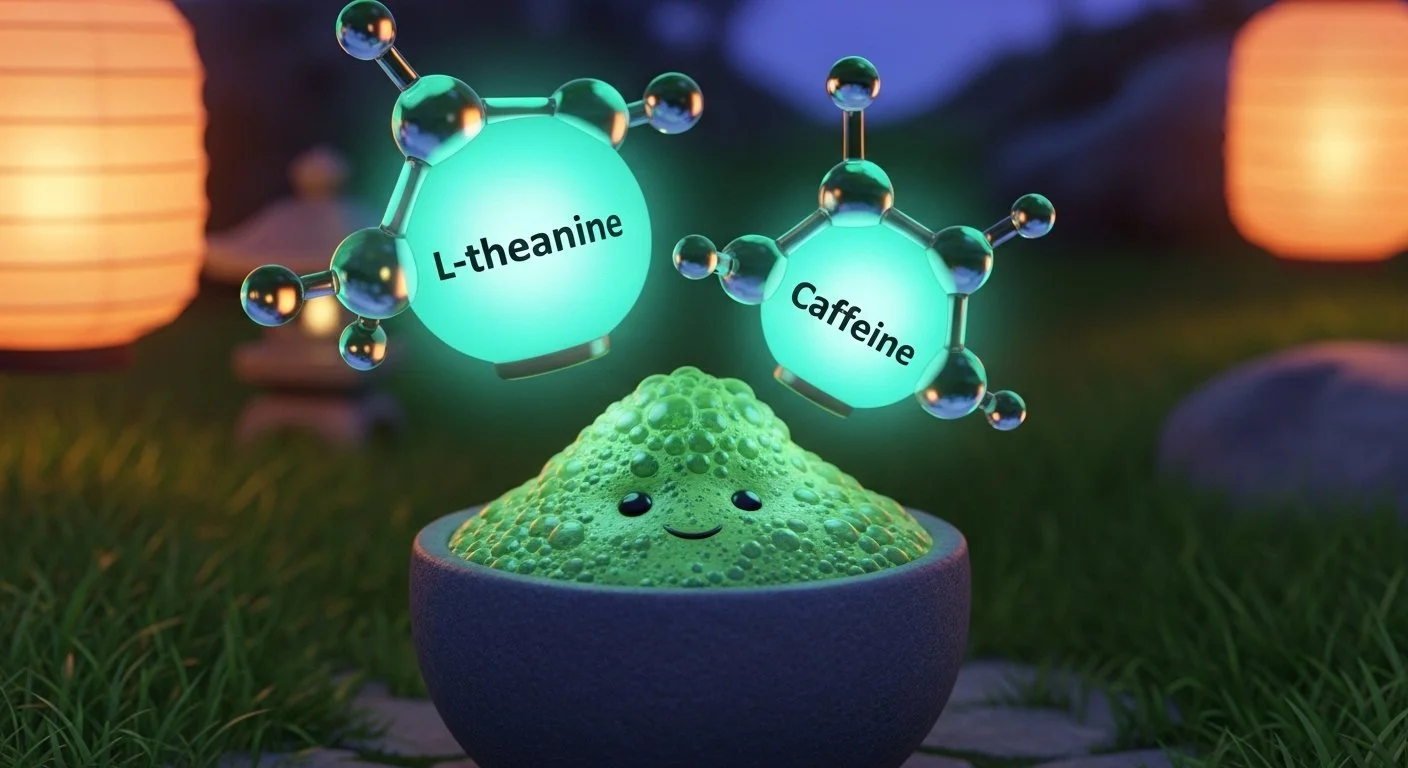
If we were to look under a microscope, the caffeine molecule in coffee and the caffeine molecule in matcha are identical. However, the way your sleep is impacted by them could not be more different.
Even though a cup of matcha usually has less caffeine than a cup of espresso or regular americano, the magic of matcha lies with a unique amino acid: L-theanine.
The L-Theanine Factor
While matcha may also contains significant levels of caffeine, its physiological impact is distinct from coffee due to a unique amino acid called L-theanine.
L-theanine is almost exclusively found in tea plants, and matcha contains significantly higher concentrations of it than standard green tea because the plants are shade-grown for weeks before harvest. This amino acid is fascinating to sleep researchers because of its unique ability to cross the blood-brain barrier. Once it enters your brain, L-theanine gets right to work altering your electrical brain wave patterns.
When you drink coffee, your brain shifts into producing high levels of beta waves. Beta waves are associated with intense concentration, but also with stress, anxiety, and a hyper-alert state. It is the brain wave of the "alerting mode”. If beta waves linger into the evening, falling asleep becomes nearly impossible.
L-theanine, remarkably, promotes the generation of alpha brain waves. Alpha waves vibrate at a frequency of 8 to 12 Hertz and are the exact same brain waves you produce during deep meditation, right before you fall asleep, or when you are in a state of relaxed creativity. By co-administering caffeine with a massive dose of L-theanine (which happens naturally when you drink matcha), L-theanine acts as a neurological "buffer."
You get the cognitive focus of the caffeine, but the L-theanine fundamentally alters your neurological state, preventing the nervous system from crossing over into the anxious, hyper-aroused state that damages your evening sleep drive.
The GABA-Glutamate Balance
The "calm" of matcha is further explained by L-theanine’s role as a structural analog to glutamate.
Glutamate is your brain’s primary excitatory neurotransmitter. It is the gas pedal. GABA is your brain’s primary inhibitory neurotransmitter. It is the brake pedal. For you to fall asleep smoothly and stay asleep, GABA needs to rise and dominate the brain, successfully pressing the brakes on your nervous system.
Heavy coffee consumption, especially later in the day, is notorious for promoting excessive glutamate activity while simultaneously suppressing GABA. This is the exact biochemical recipe for racing thoughts, sleep anxiety, and midnight awakenings. You are pressing the gas pedal to the floor while the brakes are completely cut.
Here is where matcha acts as a neurological buffer. L-theanine has been shown in clinical research to directly stimulate the production of GABA in the brain. At the same time, it subtly blocks the receptors for glutamate, preventing glutamate-led over-excitation. By co-administering caffeine with L-theanine, matcha provides the cognitive benefits of a stimulant while attenuating the peripheral "jitters" and sympathetic nervous system over-arousal often triggered by coffee.
Can I simply have matcha instead of coffee at night?
Many people proudly claim, "I can drink a double espresso after dinner and fall asleep perfectly fine!" While they might lose consciousness, clinical sleep studies using EEG monitors tell a much more alarming story about their sleep architecture.
Falling asleep is not the same as getting restorative sleep. Our sleep cycles move through distinct stages, oscillating between light sleep, REM (Rapid Eye Movement) sleep, and deep, slow-wave sleep (NREM Stage 3). Slow-wave sleep is the most critical phase for physical recovery. It is when your body releases human growth hormone, repairs tissue, and activates the glymphatic system—the brain's waste clearance system that flushes out cellular toxins accumulated during the day.
Standard caffeine heavily suppresses slow-wave sleep. Even if you fall asleep quickly after drinking coffee, the lingering caffeine in your system keeps your brain trapped in lighter stages of sleep. You wake up feeling groggy, unrefreshed, and desperate for another cup of coffee.
How about drinking matcha instead? Well, it is a clinical oversimplification to claim that matcha "does not wreck your sleep." While L-theanine reduces the perception of stress and anxiety, it does not alter the fundamental half-life of caffeine, which remains approximately 5 to 6 hours for most adults. In other words, people who are sensitive to caffeine (i.e. slower metabolism to remove caffeine from the blood), their sleep can still be impacted if they have late-day matcha.
Timing Your Matcha for Optimal Circadian Alignment
Our circadian clock dictates our core body temperature, hormone release, and sleep-wake cycle. Around 2:00 PM to 3:00 PM, most humans experience a natural circadian dip. This is when adenosine levels have built up enough to make us drowsy, but it is too early for melatonin (our darkness hormone) to take over. Reaching for highly concentrated, fast-acting coffee at this time is highly disruptive, as the caffeine will still be heavily circulating during your Dim Light Melatonin Onset (DLMO)—the crucial window in the evening when your body prepares for rest.
Matcha serves as the perfect circadian bridge for this afternoon slump. If consumed in the early afternoon, the caffeine provides sustained focus to get through the rest of the workday while, simultaneously, the L-theanine begins to actively cultivate alpha waves and support GABA production.
Conclusion
At the end of the day, sleep quality is deeply influenced by the invisible chemical cascades triggered by what we drink hours before bedtime. The "magic" of matcha is shifting the high-arousal beta wave states often triggered by coffee into the "calm focus" of alpha wave activity. However, for the health-conscious consumer, it is vital to distinguish between how you feel and what your molecules are doing. Matcha is a tool for better days—but only a disciplined approach to timing will ensure it doesn’t lead to restless nights.
-
Baba, Y., Inagaki, S., Nakagawa, S., Kaneko, T., Kobayashi, M., & Takihara, T. (2021). Effects of l-Theanine on cognitive function in middle-aged and older subjects: A randomized placebo-controlled study. Journal of Medicinal Food, 24(4), 333–341.
Hidese, S., Ogawa, S., Ota, M., Ishida, I., Yasukawa, Z., Ozeki, M., & Kunugi, H. (2019). Effects of L-Theanine administration on stress-related symptoms and cognitive functions in healthy adults: A randomized controlled trial. Nutrients, 11(10), 2362.
Unno, K., Furushima, D., Hamamoto, S., Iguchi, K., Yamada, H., Morita, A., Horie, H., & Nakamura, Y. (2021). Stress-reducing function of matcha green tea in animal experiments and clinical trials. Nutrients, 10(10), 1468.