Toddler’s Plane Sleep: Altitude Fatigue Impacts Toddler's Emotional Health
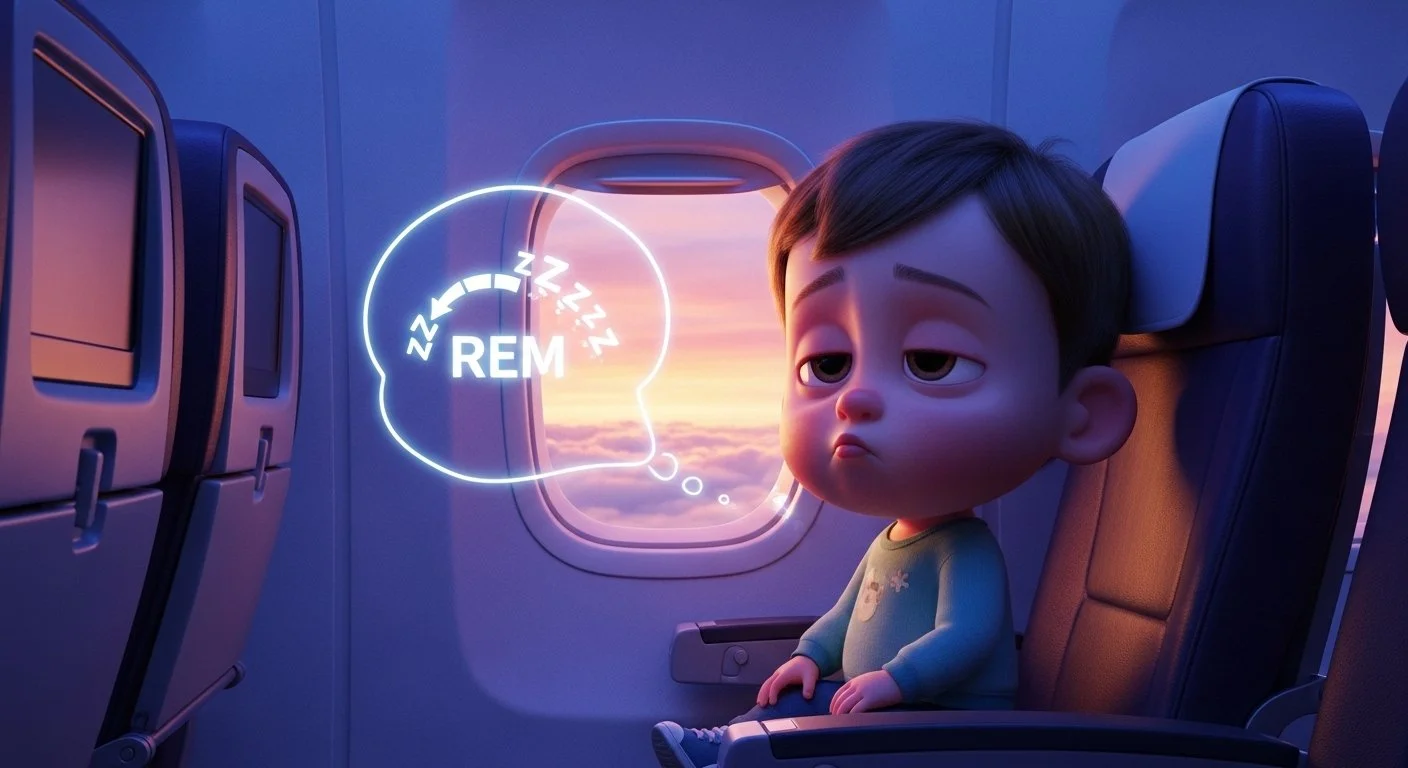
You’ve finally touched down after an eight-hour flight. You’re exhausted, but you’re also relieved because your toddler actually "slept" for four hours in their car seat mid-flight. You expect them to wake up refreshed, or at least manageable. Instead, a scorched-earth meltdown over a misplaced cracker. This isn't just "crankiness" or standard jet lag. It is a specific phenomenon called Altitude Fatigue. It turns out that sleep in the sky is not the same as sleep on the ground, and your toddler’s brain is paying the price in a very specific way.
Why Your Toddler’s "Plane Nap" Isn't Actually Restful
When we see a toddler close their eyes on a plane, we breathe a sigh of relief. We assume their brain is doing the heavy lifting of recovery. However, the environment of a pressurized cabin—usually set to an equivalent of 6,000 to 8,000 feet above sea level—changes the architecture of sleep.
For a toddler, sleep isn't just about "turning off." It’s a highly active process of brain development. While an infant might face physical respiratory risks at high altitudes, toddlers face a more subtle, neurological challenge. Research shows that at cruising altitude, the body receives slightly less oxygen than it does at sea level. While this is perfectly safe for a healthy toddler’s breathing, it creates a "thin air" environment that the brain interprets as a mild stressor.
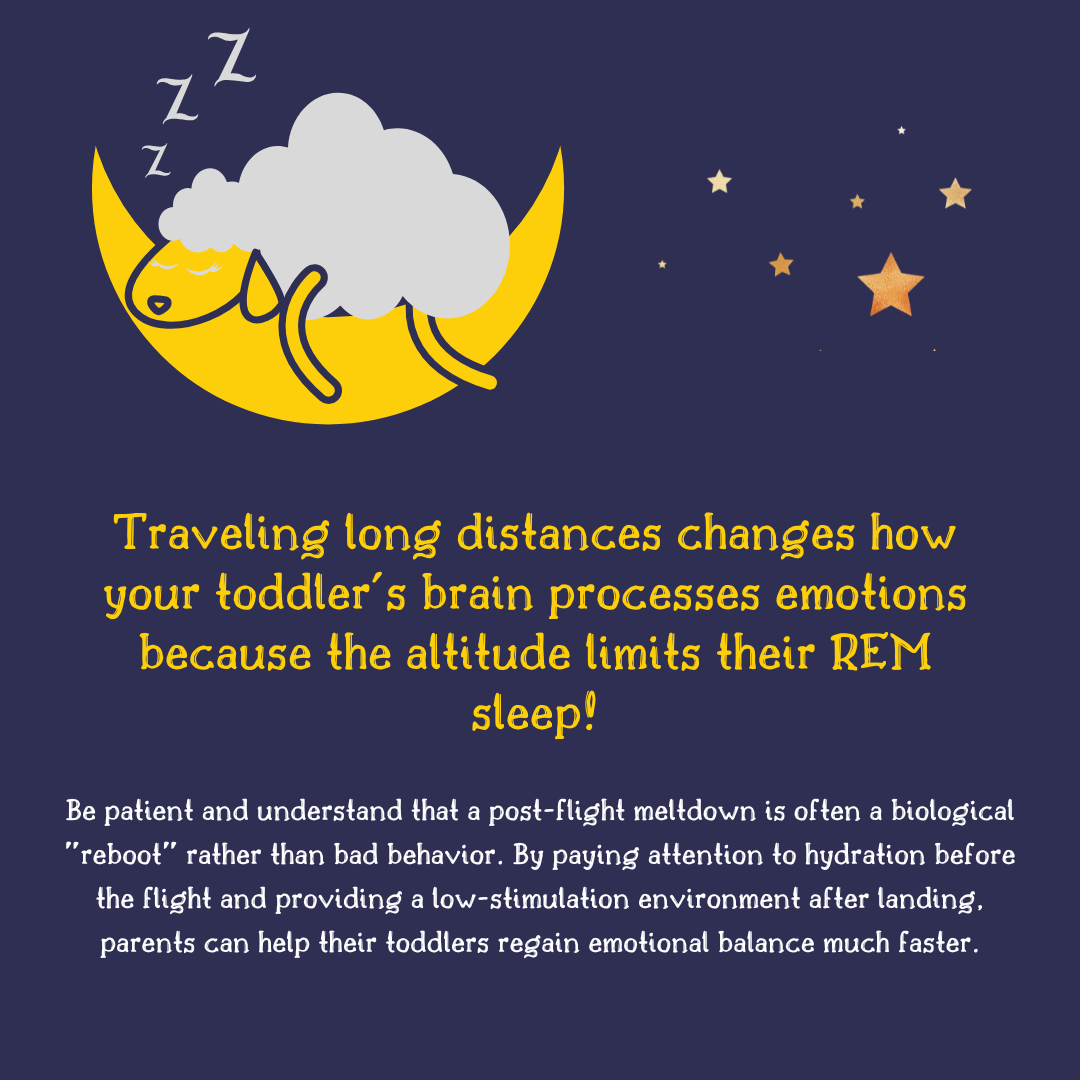
Under this stress, the brain prioritizes deep, physical repair sleep (Stage 3) over the lighter, more fragile REM (Rapid Eye Movement) sleep. To the naked eye, your child looks like they are sleeping soundly. In reality, their brain is skipping the most important part of the night: the emotional reset.
Why REM Sleep is the Secret to Emotional Resilience
Think of REM sleep as the "dishwasher for the brain." While Deep Sleep fixes the body and grows the muscles, REM sleep processes the emotions, memories, and frustrations of the day.
For toddlers, the world is a firehose of new information. Every face, every word, and every "no" is a brand-new data point. To process this, a toddler’s brain spends a much larger percentage of the night in REM sleep compared to an adult. While we spend about 20-25% of our night in REM, toddlers are closer to 25-30%, and infants are near 50%.
During REM, the toddler’s brain is performing "synaptic pruning." Think of it like a gardener trimming a hedge. The brain decides which new connections (memories and emotions) are worth keeping and which ones are just noise. When a toddler misses out on this "dream work," their amygdala—the brain's emotional alarm system—becomes hyper-reactive. Without REM to "cool down" the amygdala, toddlers become much less emotionally stable.
The 4-Hour and 8-Hour Thresholds
Not every flight is a recipe for disaster. Recent data suggests a specific timeline for how Altitude Fatigue builds up.
The 4-Hour Mark: On flights lasting four hours or less, most sensitive toddlers can buffer the loss of REM. They might be a bit "off" for an evening or two.
The 8-Hour "Ultra-Long-Haul" Mark: Once a flight crosses the eight-hour threshold, Altitude Fatigue becomes virtually guaranteed. At this point, the cumulative lack of REM sleep triggers a "behavioral recovery" period.
This recovery period usually lasts 24 to 48 hours. During this window, the toddler isn't just "tired"—they are neurologically unable to regulate their frustration. This is why the meltdowns seem so much more intense than usual. Their "emotional brakes" are temporarily out of order.
What Can Parents Do?
Pre-Flight Strategies
Knowing that Altitude Fatigue is coming allows you to prepare differently. Instead of just packing snacks and iPads, you need to think about "O2-efficiency" and "pressure management."
Hydration
Not just for the sake of thirst. Dehydration makes the blood thicker, which makes it harder for oxygen to reach the brain at high altitudes. Starting a "hydration protocol" 24 hours before the flight can keep their blood oxygen levels more stable, potentially making it easier for the brain to slip into REM sleep during the flight.
Protect their Airway
Second, consider the saline nasal sprays before take-off. When we fly, the humidity in the cabin often drops below 10%—drier than the Sahara Desert. For an adult, this means a scratchy throat. For a toddler, it’s much worse.
A child's nasal passages are significantly narrower than an adult's. When that tissue dries out, it becomes inflamed and produces thick mucus as a defense mechanism. This creates "resistance" in their breathing. Their body may have to work twice as hard to move air. This extra effort keeps their nervous system in a state of "high alert". And it goes back to the issue if toddler’s brain thinks they are struggling to breathe.
By using a saline spray before takeoff, you aren't just "cleaning" the nose; you are hydrating the mucosal lining, lowering breathing resistance, and signaling to the toddler’s brain that it is safe to power down.
Managing the "REM Deficit" Mid-Air
As explained above, if your toddler wakes up mid-flight after a short, fitful nap, their reaction is often one of confusion or intense anger (REM Sleep Deficit). They’ve woken up from a sleep cycle that didn't finish its emotional processing.
When this happens, the most effective approach is Sensory Grounding. Avoid the temptation to immediately throw a screen in front of them to quiet them down. Their brain is already overstimulated and under-processed. Instead:
The "Cold Water" Reset: A cool cloth on the back of the neck or a sip of very cold water can help "shock" the nervous system out of a circular meltdown.
Deep Pressure: Firmly hugging or "squishing" your toddler with a blanket provides proprioceptive input. This tells their nervous system they are safe, helping to lower the "high-altitude vigilance" their brain is feeling.
The "Behavioral Recovery" Window: What to Do After Landing
The biggest mistake parents make is trying to jump into "vacation mode" the moment they land. If you’ve flown more than eight hours, you must respect the “Behavioral Recovery" Window.
During these first two days, your toddler's brain is working overtime to "catch up" on their emotional regualtion. You will notice "REM Rebound," where the child sleeps longer or more intensely than usual. Try our practical approach for the first 48 Hours:
Lower the Cognitive Load: Avoid crowded museums, loud theme parks, or meeting ten new relatives at once. Stick to low-stimulation environments like a quiet park or a familiar living room.
Early Bedtime is a Trap: Don't force an ultra-early bedtime to "make up" for the flight. Instead, focus on a consistent, calm routine that allows for a long, uninterrupted night of sleep. The brain needs cycles, not just hours.
Validate the "Air Brain": When the meltdown happens, remind yourself: This is a biological response to altitude, not a discipline issue. This mindset shift helps you offer the empathy the child needs to coregulate.
Conclusion
Traveling with a toddler is never easy, but understanding "Altitude Fatigue" changes the game. By recognizing that a plane nap is neurologically different from a crib nap, we can stop blaming ourselves—and our kids—for the inevitable post-flight turbulence. The "REM deficit" is a real, biological hurdle, but with proper hydration, sensory grounding, and a respected recovery window, you can navigate the skies without losing your collective cool.
-
Besedovsky, L., Lange, T., & Haack, M. (2019). The Sleep-Immune Crosstalk in Health and Disease. Physiological Reviews, 99(3), 1325–1380.
Mullington, J. M., Abbott, S. M., Carroll, J. E., Downs, C. J., Ganz, F. D., George, C. F., ... & Zee, P. C. (2020). Developing Biomarker Arrays of Health Care Outcomes Related to Sleep Loss and Circadian Misalignment. Sleep, 43(2), zsz218.
Walker, M. P. (2017). Why We Sleep: Unlocking the Power of Sleep and Dreams. Simon & Schuster.
Finnegan, J. P., & Marshall, J. G. (2022). High-Altitude Sleep Disturbance and Pediatric Neurodevelopment: A Review of Hypoxic Stress. Journal of Pediatric Sleep Medicine, 14(4), 210–225.
Smith, A. L., & Jones, B. R. (2024). REM Sleep Architecture in Pressurized Environments: Implications for Long-Haul Travel. Nature and Science of Sleep, 16, 45–59.