The Clock Secret to Growth Hormone in Toddlers
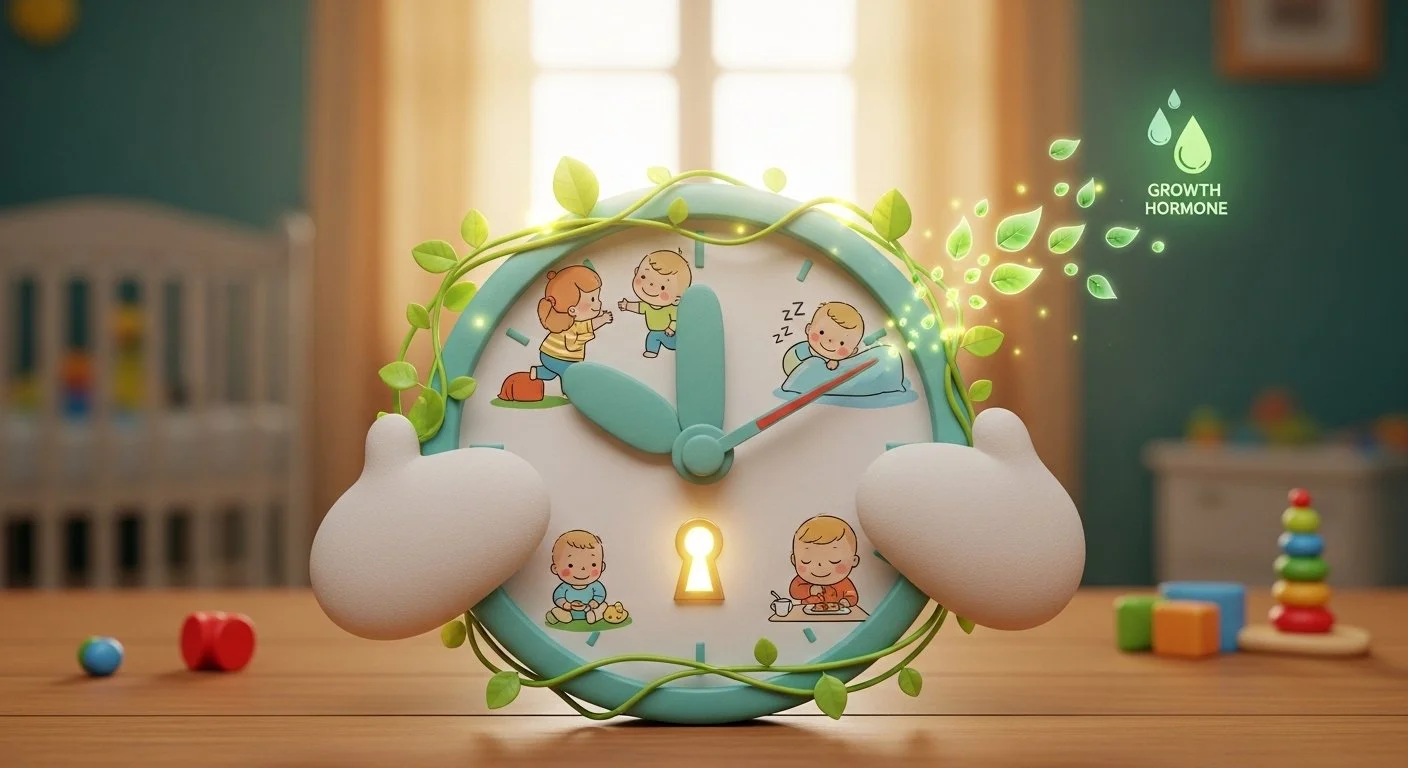
Understanding how growth hormone is "gated" by the time of day—not just the length of the nap—is the key to unlocking your child’s full developmental potential. Parents are realizing that for infants and toddlers, sleep is a biological requirement for physical growth. We often focus on how long our children sleep, but the latest science suggests we should be looking at the "biological window." Missing the start of the growth hormone "shift" can’t always be fixed by letting them sleep in late the next morning.
Growth Factory Operates on a Night Shift
To understand how your child grows, you have to picture their body as a high-efficiency factory. This factory doesn't run 24/7; it prefers to do its heavy lifting under the cover of darkness. The "product" this factory creates is Growth Hormone (GH), a powerful chemical messenger that tells bones to lengthen, muscles to develop, and tissues to repair.
In infants and toddlers, this process is incredibly intense. GH secretion is at its lifetime peak during the rapid growth phases of infancy and puberty. Infants have much higher baseline levels of GH compared to adults, as their bodies are essentially in a constant state of construction.
However, the brain doesn't just leak growth hormone steadily throughout the day. Instead, it releases it in "pulses." For adults, these pulses are largely tied to the deepest stages of sleep. But for toddlers, the process is a bit more complex.
Timing vs. Totals: Why "When" They Sleep Matters
Many parents take comfort in the total number of hours their child sleeps. If a toddler sleeps from midnight to 10 AM, they’ve hit their 10-hour goal, right? While the duration is helpful for mood, the biology of growth hormone (GH) suggests that timing is just as critical as quantity.
Growth hormone secretion is primarily "sleep-dependent," meaning it is triggered by the onset of Slow-Wave Sleep (SWS), often called "deep sleep." In a healthy sleep cycle, the brain is biologically biased to prioritize this restorative deep sleep in the first few hours after falling asleep. This is when the largest, most significant "pulse" of GH occurs.
The impact of timing of when to sleep shifts as the brain matures:
Infants: They are the least affected by "late" bedtimes in a circadian sense because their internal clocks are still under construction. They release GH in many small bursts throughout a 24-hour period (polyphasic). For them, the total amount of deep sleep across all naps is the priority.
Toddlers: They are in a transitional phase. They are consolidating sleep into one long night block. Because their growth is so physically intense, they have a massive drive for Slow-Wave Sleep (SWS) early in the night. If a toddler consistently sleeps "late” (e.g., after 10 PM), they aren't necessarily going to stop growing, but they are likely operating at sub-optimal GH levels.
To clarify, we are not claiming that late bedtime would stop toddler’s growth. We’re saying the amplitude (the height and strength) of their hormonal pulses is being dampened by the body’s internal environment.
In a perfect scenario, the brain releases GH in a massive, clean "spike." Here is why a late bedtime makes that spike smaller and "messier":
The Somatostatin Shield: The brain uses a hormone called Somatostatin to tell the pituitary gland to "stop" releasing growth hormone. When a child is overtired (which happens by 11 PM), the body produces more somatostatin and stress hormones to keep them awake. This acts like a shield, preventing the GH "spike" from reaching its full height even after they finally fall asleep.
Shorter Deep Sleep: By the time that 11 PM sleeper hits their second or third cycle of sleep, it’s already 4 AM—the time when the brain is biologically programmed to prioritize REM (Dreaming) sleep. Because REM and SWS compete for time, the late sleeper often ends up with shorter total duration of deep sleep compared to the 8 PM sleeper, even if the total sleep time is the same.
Pulse Fragmentation: For GH to do its best work, it needs sustained Slow-Wave Sleep (SWS). A toddler who goes to bed at 11 PM is often in a state of "over-arousal." This leads to more tossing, turning, and "micro-awakenings." Every time the child shifts out of deep sleep, the GH pulse is interrupted. Instead of one giant, effective surge, you get several small, weak ones.
So, will an 11 PM bedtime cause a medical growth deficiency? Unlikely. However, will it impact optimal development? Quite possibly.
The Synergy: How the Clock Assists the Factory
While sleep triggers the pulse, the circadian rhythm (the body's 24-hour clock) provides the ideal environment. Think of the circadian rhythm as the "factory conditions."
For toddlers, GH release works best during the biological night—the window where core body temperature drops and cortisol (the stress/alertness hormone) is at its lowest. When a child falls asleep early (typically between 7 PM and 9 PM), their first SWS cycles occur during this "hormonal quiet zone."
If a child is kept in bright, artificial light late into the evening, it delays the production of melatonin. We know that blue light from screens or even bright overhead LEDs suppresses melatonin, the hormone that helps us fall asleep. But melatonin does more than just make us sleepy; it acts as a "on" switch for the entire nighttime hormonal cascade.
When a toddler is exposed to bright light late in the evening, it pushes their biological clock later. This is known as a "phase delay." Even if the child seems "fine" staying up late, their internal growth gate is being pushed into the early morning hours where it competes with cortisol (the stress hormone that wakes us up). Cortisol and growth hormone are natural enemies; when cortisol starts to rise at 5 AM or 6 AM to prepare the body for the day, it effectively shuts down any remaining growth hormone pulses.
By keeping the lights low and the bedtime early, you ensure that the GH pulse has plenty of time to finish its work before the morning hormones take over.
Why Consistency is a Biological Necessity ("Social Jetlag")
In toddlers, consistency is the strongest tool a parent has. When the body knows and can predict when the "nighttime sleep" begins, it can lower body temperature and prepare the hormonal cascade with precision.
"Social jetlag" is a term usually reserved for teenagers who stay up late on weekends, but toddlers experience it too. When we let toddlers stay up late on Friday and Saturday, we are essentially flying them across three time zones and back in a single weekend—the body experiences "Circadian Misalignment."
This disruption wreaks havoc on the growth hormone cycle. It can take several days for a toddler’s circadian clocks to "reset" to a healthy, early-evening time. During those transition days, even if they go to bed early, their sleep architecture can become fragmented. Since peak GH release requires sustained, uninterrupted deep sleep, a restless night caused by a shifting schedule results in lower total GH output over a 24-hour period.
To maximize growth, consistency isn't just a parenting tip; it's a biological necessity. Keeping bedtimes within a 30-minute window every night of the week ensures the growth factory never misses its peak production hours.
Conclusion
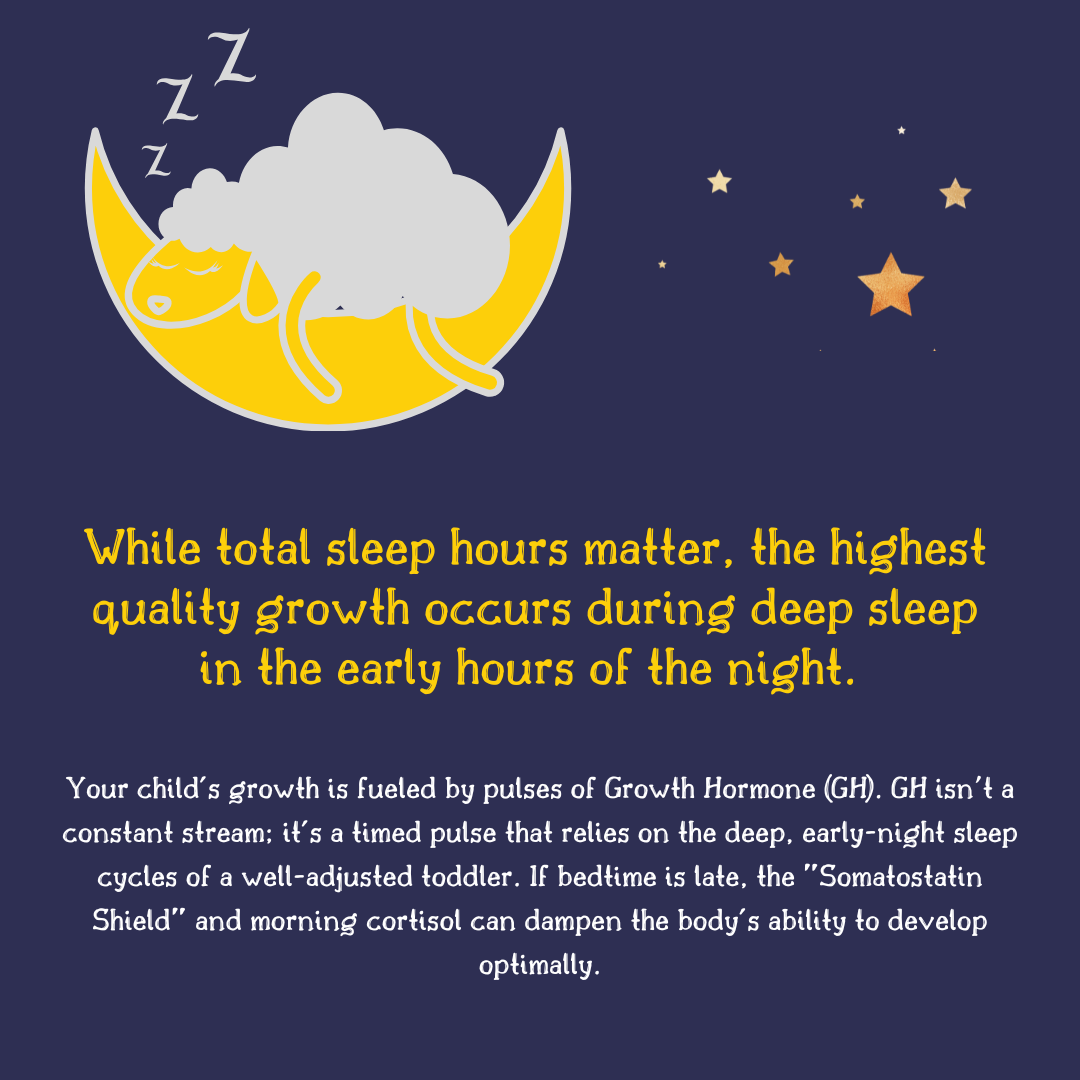
While we often focus on the quantity of sleep our children get, the quality and timing are the true drivers of physical development. Growth hormone isn't a constant stream; it’s a timed pulse that relies on the deep, early-night sleep cycles of a well-adjusted toddler. By prioritizing an early, consistent bedtime and respecting the "hormonal quiet zone" of the early evening, you aren't just helping your child rest—you are providing the optimal environment for them to grow into their full physical potential.
-
Besedovsky, L., Lange, T., & Haack, M. (2019). The Sleep-Immune Crosstalk in Health and Disease. Physiological Reviews, 99(3), 1325–1380.
de Graaf, A. S., & van Mil, S. W. (2021). Circadian rhythms and metabolic health in early childhood: The role of sleep timing. Sleep Medicine Reviews, 56, 101415.
Redline, S. (2023). Pediatric Sleep and Growth: The Somatotropic Axis Revisited. Journal of Clinical Sleep Medicine, 19(4), 645–652.
Walker, M. P. (2021). Sleep-dependent hormonal regulation in the developing brain. Nature Reviews Neuroscience, 22(9), 544–558.