The Surprising Science of Sleep-Learning.
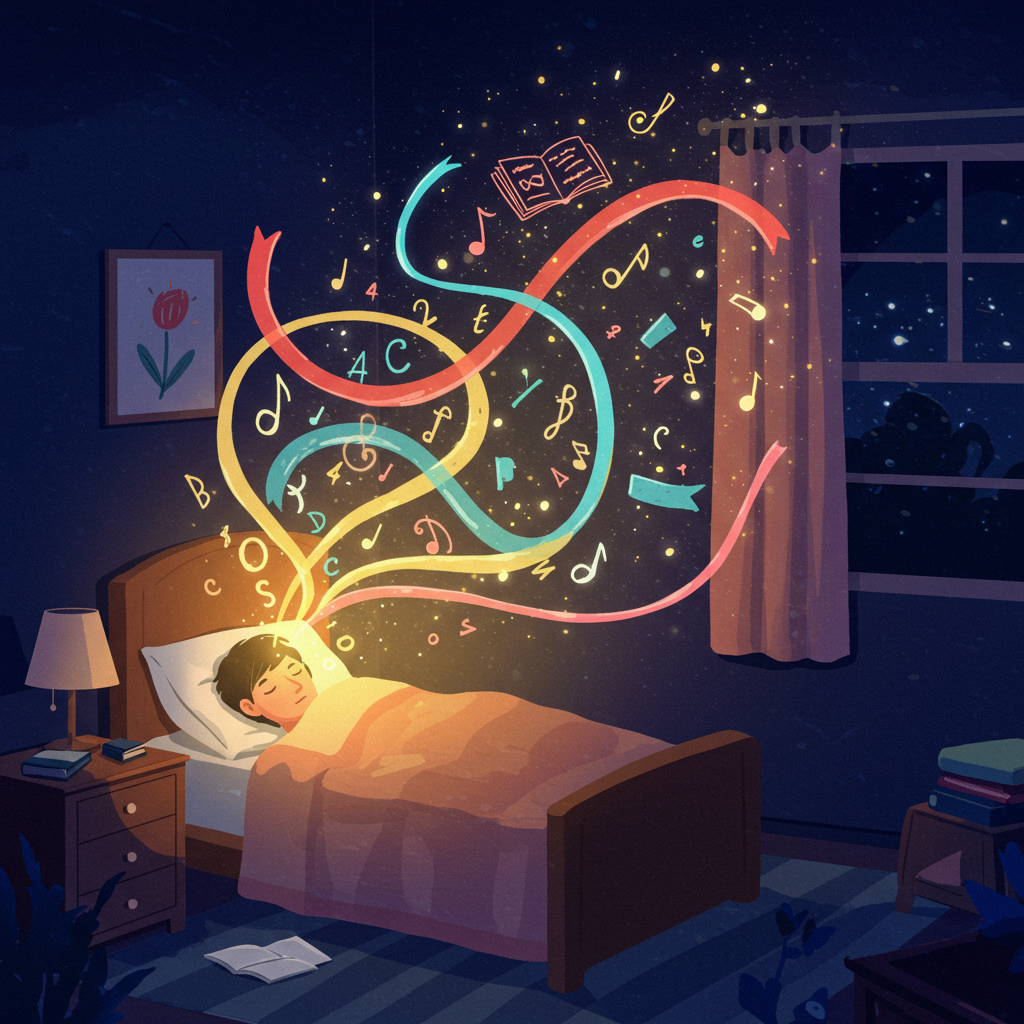
Imagine waking up knowing a handful of new German words, an unfamiliar piano melody, or maybe even a math formula—all without cracking a book.
It sounds like a trick from a sci-fi novel (like Aldous Huxley's Brave New World), but recent research has quietly confirmed that your brain can, in fact, learn new information while you're deep in slumber. This concept is called hypnopædia, and it’s much more than just a myth.
The Catch: It’s All About Timing
The idea of playing a language CD while you sleep has been around for decades. The problem? Simply having noise on all night is usually just disruptive. The actual science shows that sleep-learning isn’t about quantity; it’s about precision.
The key to learning in your sleep lies in a specific phase of deep rest known as Slow-Wave Sleep (SWS). If you’ve ever seen a brain wave graph, SWS is characterized by big, lazy, rolling waves. Scientists have discovered that your brain only opens a tiny window for new information during the "up-states," or peaks, of these slow waves.
Think of your brain during deep sleep as an exclusive nightclub with a very strict door policy:
Up-State (The Peak): The bouncer opens the door for a split second. Neural activity surges, and your brain is momentarily ready to process an external sound, like a new word.
Down-State (The Trough): The bouncer slams the door shut. Words played during this low activity moment are completely ignored.
This level of precision means that in current studies, researchers must use Electroencephalography (EEG) monitoring—those little caps with wires—to perfectly time the delivery of a new word. Just playing a podcast all night simply won’t cut it; it needs to be moment-by-moment tailoring.
What Can Your Sleeping Brain Actually Absorb?
If you were hoping to master organic chemistry overnight, you’re out of luck (for now). Sleep-learning is powerful, but it has boundaries.
The most important finding is that sleep-learning facilitates implicit memory—the intuitive, subconscious kind—not explicit memory, which is what you use for active recall.
Here’s the difference:
Waking Learning: You hear the German word "Hund" and consciously think, "That means dog." (Explicit)
Sleep-Learning: You hear "Hund" while sleeping. When you wake up, you might not be able to actively recall it, but in a test, you'll feel an intuitive link between the sound "Hund" and the concept of a dog, performing better than pure chance.
In fact, people who learn word pairs in their sleep often perform just as well as those who learned them awake when tested on these intuitive memory tasks. They just can't remember when or how they learned it!
Forming New Semantic Links
The evidence is strong for simple connections, such as pairing a foreign word with its native translation (e.g., "tofer" with "house").
One groundbreaking study proved this learning isn't just a simple echo in the memory banks. Participants learned new pseudo-words paired with object names while sleeping. When they woke up, they were able to correctly match those words to pictures of the objects. This cross-modal transfer suggests the brain formed a genuine, abstract link to the concept, not just a simple sound-to-sound connection.
The Future
While current scientific sleep-learning is confined to labs and simple tasks like vocabulary, the future potential is huge.
Auxiliary Power for Learning
Hypnopædia isn't a replacement for traditional learning; it's a powerful auxiliary tool. Imagine spending your daytime hours on active conversation and practice, while your sleeping hours are dedicated to consolidating new vocabulary or basic grammar rules. This could effectively double your study time without adding fatigue.
Wearable Tech is Coming
The main limitation today is the bulky lab equipment required for SWS-targeting. However, as sleep-monitoring technology advances, we may soon see accessible, wearable devices—perhaps a headband or smart earplugs—that can track your brain waves and precisely deliver learning cues at the exact right moment.
The dream of effortless, overnight learning is still a fantasy, but the science is clear: your brain is already a night-school student, and soon, we might all get to choose its curriculum.
-
Kleespies, K., Paulus, P. C., Zhu, H., Pargent, F., Jakob, M., Werle, J., Czisch, M., Boedecker, J., Gais, S., & Schönauer, M. (2025). Sleep resolves competition between explicit and implicit memory systems. bioRxiv. https://doi.org/10.1101/2025.02.21.639581
Newbury, C. R., Crowley, R., Rastle, K., & Tamminen, J. (2021). Sleep deprivation and memory: Meta-analytic reviews of studies on sleep deprivation before and after learning. Psychological Bulletin, 147(11), 1215–1240. https://doi.org/10.1037/bul0000348
Oghenero, O. A. (2021). Hypnopaedia or sleep learning: Overview on methods and results. Research, Society and Development, 10(7). https://doi.org/10.33448/rsd-v10i7.16870