Behavioral Insomnia
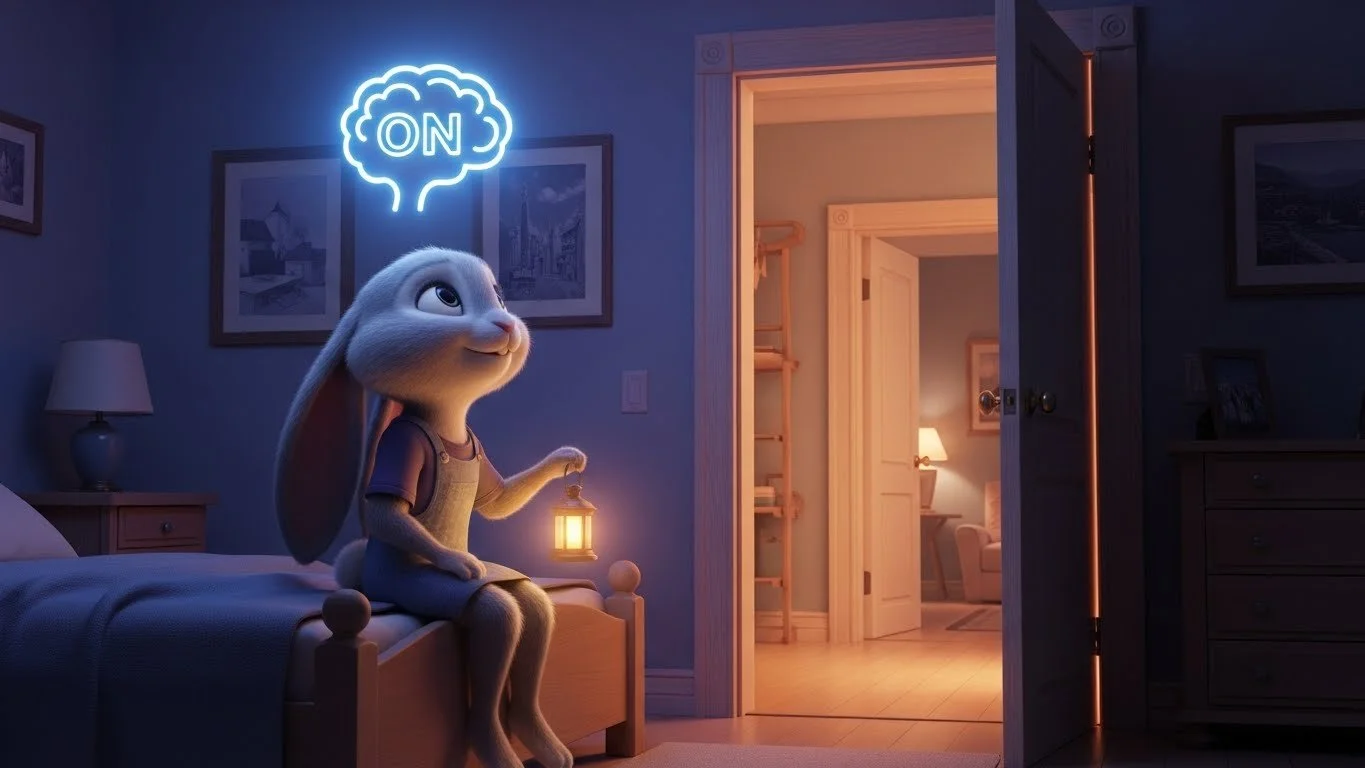
Do you ever find yourself exhausted all day, but the moment your head hits the pillow, your brain switches on like a neon sign? You aren't "broken," and it isn't just the afternoon coffee. You might be experiencing behavioral insomnia. This isn't just about bad habits; it is a learned response where your brain connects your bed with being awake instead of asleep. In this blog post, you will learn why this happens and how to "unlearn" wakefulness so you can finally get the rest you deserve.
What Exactly Is Behavioral Insomnia and Why Does It Happen?
Most people think insomnia is a biological "glitch"—like a fever or a broken bone. But behavioral insomnia (often called psychophysiological insomnia in adults) is different. It is a condition where your behavior and your environment team up to keep you awake.
Think of it like Pavlov’s dogs. In the famous experiment, dogs were trained to salivate at the sound of a bell because they associated the bell with food. In behavioral insomnia, your "bell" is your bedroom. Because you have spent so many nights tossing, turning, and feeling frustrated in bed, your brain has formed a powerful, unconscious link: Bed = Stress and Wakefulness.
Recent research published in the journal Frontiers in Psychiatry highlights that this isn't just "in your head." It involves a state of hyperarousal. Even when you are tired, your central nervous system stays on high alert because it perceives the bedroom as a place of effort and struggle rather than a sanctuary for rest (Zeng et al., 2020).
Why Your Bed Might Be Your "Wakefulness Trigger"
If you can fall asleep on the couch while watching a boring movie but find yourself wide awake the moment you walk into your bedroom, you are experiencing conditioned arousal. This is the hallmark of behavioral insomnia.
When you struggle to sleep, you likely do things to "fix" the problem, such as:
Staying in bed longer to "try" to sleep.
Checking the clock to calculate how many hours you have left.
Worrying about how tired you will be tomorrow.
These actions actually tell your brain that the bed is a place for "work" and "problem-solving." Over time, the environment itself triggers your body to release stress hormones like cortisol. Instead of your heart rate slowing down for sleep, it stays slightly elevated. This creates a "mismatch" between how tired your body feels and how alert your brain is.
Who Is Most Susceptible to Behavioral Insomnia?
Insomnia doesn't affect everyone equally. It often follows a specific pattern based on age and gender.
The Gender Gap: Is It Biological or Behavioral?
While it is well-known that women are roughly 1.4x to 1.5x more likely to have insomnia, researchers are finding that women may be specifically more prone to the behavioral perpetuators of the condition.
A study on gender differences in perpetuating factors (2019) found that while men were more likely to use napping as a (often unhelpful) coping mechanism, women reported significantly higher pre-sleep arousal. This means that for many women, the "conditioning" happens through internal stress—the brain effectively "trains" itself to be alert the moment it enters the bedroom because of a higher tendency toward pre-sleep rumination. This makes the behavioral "unlearning" process (like Stimulus Control) particularly vital for female patients.
The Age Connection: From Kids to Seniors
Behavioral insomnia looks different depending on your stage of life:
In Children: It is often called "Behavioral Insomnia of Childhood." This affects up to 25% to 30% of kids. It usually shows up as "limit-setting" problems (the child keeps asking for one more glass of water) or "sleep-onset associations" (the child can only sleep if a parent is present).
In Adults: The peak often occurs in middle age. A study in Pediatrics found that children with insomnia symptoms are significantly more likely to continue struggling as adults. In fact, 43% of children with sleep issues carry them into young adulthood (Fernandez-Mendoza et al., 2022).
In Seniors: As we age, our sleep becomes naturally lighter. This "fragile" sleep makes it easier for bad behavioral habits—like napping too long or staying in bed while awake—to take root and turn into chronic insomnia.
Why "Trying Harder" Is the Greatest Enemy of Sleep
If you had a difficult task at work, "trying harder" would usually help you succeed. But sleep is the only human function where effort equals failure.
Experts call this "Sleep Effort." When you focus intensely on the act of falling asleep, you activate the brain's "executive control" regions. These are the same parts of the brain used to solve math problems or drive a car. Sleep, however, requires these regions to shut down.
A 2022 study in the Journal of Sleep Research emphasizes that chronic insomnia is maintained by this "inability to inhibit wakefulness" (Riemann et al., 2022). By trying to force sleep, you are essentially slamming on the gas pedal while trying to park the car. This is why standard sleep hygiene—like "don't drink coffee"—often fails. You can have zero caffeine in your system, but if your "sleep effort" is high, you still won't sleep.
How to "Unlearn" Insomnia Without Using Pills
The good news is that because behavioral insomnia is a learned response, it can be unlearned. The "gold standard" treatment is called Cognitive Behavioral Therapy for Insomnia (CBT-I). Unlike sleeping pills, which just mask the symptoms, CBT-I retrains your brain.
Here are the most effective strategies that go beyond basic hygiene:
1. The 20-Minute Rule (Stimulus Control)
To break the Pavlovian link between your bed and wakefulness, you must follow one strict rule: The bed is only for sleep and intimacy. If you are not asleep within roughly 20 minutes (don't check the clock—just go by feel), you must get out of bed. Go to another room, keep the lights dim, and do something boring, like reading a manual or folding socks. Do not return to bed until you feel "sleepy-tired" (heavy eyelids, nodding off), not just "exhausted."
2. Sleep Compression
Many people with insomnia try to spend 9 or 10 hours in bed hoping to "catch" 6 hours of sleep. This makes sleep "thin" and fragmented. By temporarily restricting your time in bed to only the hours you actually sleep, you build up "sleep hunger." This makes your sleep deeper and more consolidated, eventually retraining your brain to stay asleep throughout the night.
3. Creating a "Worry Window"
Since behavioral insomnia is fueled by nighttime rumination, move your "worrying" to the afternoon. Spend 15 minutes at 4:00 PM writing down everything you are stressed about. When those thoughts pop up at 2:00 AM, you can tell your brain, "I already handled that today; it’s on the list."
Conclusion
Behavioral insomnia is a frustrating cycle, but it is not a life sentence. The transition from a "frustrated sleeper" to a "natural sleeper" doesn't happen overnight. It requires consistency. You are essentially rebuilding a relationship with your bedroom. If you aren't sleeping, don't suffer in bed. Stand up, walk out, and give your brain the space it needs to reset. You have the power to turn your bedroom back into the sanctuary it was meant to be.
-
Fernandez-Mendoza, J., He, F., Clinton, N., Bhushan, B., & Vgontzas, A. N. (2022). Childhood insomnia symptoms and adult insomnia: A 15-year follow-up of a general population sample. Pediatrics, 149(3), e2021054362.
Zeng, L. N., Zong, Q. Q., Yang, Y., Zhang, L., Hall, B. J., & Xiang, Y. T. (2020). Gender difference in the prevalence of insomnia: A meta-analysis of observational studies. Frontiers in Psychiatry, 11, 577429.
Riemann, D., Krone, L. B., Wulff, K., & Nissen, C. (2022). The neurobiology, psychophysiology, and psychology of sleep and insomnia—An update. Journal of Sleep Research, 31(6), e13704.
El Rafihi-Ferreira, R., de Medeiros, R., et al. (2022). Gender differences in cognitive-emotional factors as predictors of pre-sleep arousal in insomnia. Journal of Sleep Research.
Bixler, E. O., Papaliaga, M. N., et al. (2009). Women sleep objectively better than men and the sleep of young women is more resilient to external stressors: effects of age and menopause. Journal of Sleep Research, 18(2), 221–228.