Biological Clockwork: Why You’re Waking Up at the Same Time Every Night
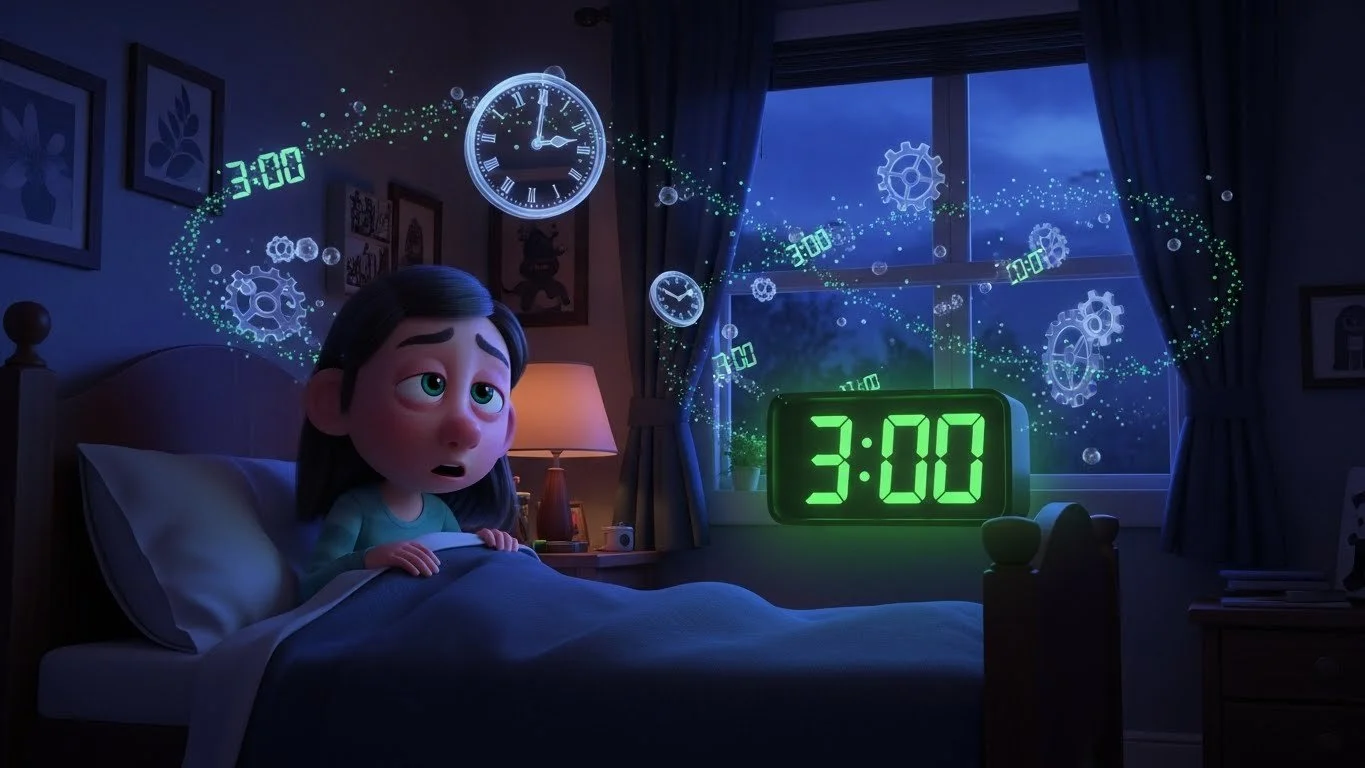
Precision is usually a good thing, but not when it involves your brain "clicking" awake at 3 or 4 AM every single morning. While most people blame work stress, the real culprit is a predictable chain reaction involving your hormones, your internal thermostat, and your liver's "night shift." Here we will explain how these systems interact to trigger those scheduled wake-ups and provide a clear roadmap to help you stay asleep until your alarm actually goes off.
Why Is an Early Cortisol Peak Waking You Up at the Same Time Every Night?
To understand why you wake up at a specific time, we first have to look at the "master rhythm" of your hormones. Most people know cortisol as the hormone that helps us handle a crisis. However, in the world of sleep medicine, cortisol is actually your primary "alertness signal." In a perfect world, your cortisol levels drop to their lowest point around midnight, allowing for deep, restorative sleep. Then, they are supposed to begin a slow, gentle climb starting around 2:00 AM or 3:00 AM, eventually peaking right as you wake up to give you the energy to start your day.
The problem arises when this "cortisol slope" becomes too steep, too early. Research published in the journal Sleep (2024) suggests that chronic physiological pressure—which can be anything from lingering inflammation to mental burnout—causes the HPA axis (the body’s stress control center) to become "hyper-responsive." Instead of a gradual sunrise of hormones, your body experiences a sharp, sudden spike.
When this spike happens, it acts like a biological loud-hailer. Even if you are in a deep sleep, that sudden surge of cortisol tells your brain that the day has started. Because your body is a creature of habit, it begins to "expect" this surge. If you have woken up at 3:00 AM for three nights in a row, your brain learns that 3:00 AM is the new "start time." This creates a feedback loop where the hormonal spike becomes a scheduled appointment that your brain refuses to miss. This is often why you wake up feeling "wired"—your heart rate is slightly elevated, and your mind is immediately ready to scan for problems, even though you are exhausted.
Does Your Core Body Temperature Rise Too Fast for Deep Sleep?
Your hormones do not work in a vacuum; they act as the thermostat for your entire body. There is a powerful, direct link between that early cortisol spike and your core body temperature. For you to stay in the deepest stages of sleep, your core temperature must remain at its lowest point. As cortisol begins to rise, it signals the body to begin warming up in preparation for movement.
A 2025 study in Somnologie found that individuals who struggle with "sleep maintenance"—the ability to stay asleep—often have a "shifted" temperature curve. Instead of their temperature bottoming out and staying low until dawn, it begins to rise prematurely.
Think of your sleep like a cooling system in a high-end computer. If the processor (your brain) starts running "hot" too early, the system shuts down or reboots. When your core temperature rises just half a degree too quickly, it triggers a "micro-arousal." You might not feel "hot" in the sense of sweating, but your brain detects the rising heat as a signal to transition from deep sleep to light sleep, or to wake up entirely.
This temperature rise is often the "how" behind the "why" of the cortisol spike. They are two sides of the same coin. If your cortisol spikes at 3 AM, your core temperature will follow suit minutes later. By the time you look at the clock, your body has already physically prepared itself to be awake, making it incredibly difficult to fall back into a deep slumber.
The Liver’s "Night Shift": Is Your Internal Janitor Waking You Up?
While we often think of sleep as a time of total rest, your liver is actually working its hardest while you dream. In circadian medicine, we refer to this as the "metabolic midnight." The liver is responsible for two massive tasks during the night: processing toxins (including metabolic waste and any alcohol or medications) and managing your body’s energy stores.
When the liver is overwhelmed, it creates a "bottleneck" in your biology. If you have a diet high in processed foods, consume alcohol within three hours of bed, or are dealing with chronic low-grade inflammation, your liver has to work much harder to "clean" your system. This extra workload requires blood flow and oxygen, which creates internal heat.
Recent findings in Nature Communications (2023) have highlighted how liver-specific circadian rhythms influence systemic alertness. When the liver is struggling to keep up with its "nightly chores," it can trigger a metabolic stress response. This stress response signals the adrenal glands to release more cortisol—bringing us back to that initial problem of the early hormonal spike.
Connecting the Dots: The "Chain Reaction" of a Nighttime Wake-up
To stop waking up at the same time every night, you have to see these three factors as a single, connected chain. To break this chain, you must address the root—the metabolic and hormonal "timing."
Cool the "Engine": Since a rising core temperature is one of the triggers, you can counteract it by keeping your external environment significantly cooler than you think. A lukewarm bath 90 minutes before bed helps by forcing blood to the surface of the skin, which then allows the core temperature to dump heat more efficiently once you get into bed.
Ease the Liver’s Workload: Stop eating at least three hours before your head hits the pillow. This gives your liver a "head start" on digestion so it can focus on its deep-cleaning duties and glucose management by the time you reach the 3:00 AM mark.
The Morning "Anchor": To fix a cortisol spike that is happening too early, you must reinforce the "correct" spike time. You do this by getting 10 minutes of direct sunlight as soon as you wake up. This "resets" the timer for 24 hours later, telling your brain exactly when the next cortisol peak should occur.
Conclusion
Waking up at the same time every night is a frustrating experience, but it is also an incredible example of how precise your body's internal systems are. It is not a random glitch; it is a coordinated response between your liver, your hormones, and your internal thermostat. When you stop viewing these wake-ups as "insomnia" and start viewing them as a "rhythm" that needs adjusting, you regain control.
By easing the burden on your liver and anchoring your morning with light, you can smooth out those early cortisol spikes and keep your core temperature stable.
-
Minkel, J., & Banks, S. (2024). Daily associations between salivary cortisol and electroencephalographic-assessed sleep: a 15-day intensive longitudinal study. Sleep, 47(9), zsae087.
Niu, H., & Wang, L. (2025). Effects of nocturnal decline in core body temperature and heart rate on sleep in middle-aged and young adults. Somnologie, 3(1), 185–192.
Sato, S., & Sassone-Corsi, P. (2023). The liver circadian clock: Coordinating metabolic and detoxification cycles. Nature Communications, 14(2), 412–425.
Fredholm, B. B., Bättig, K., Holmén, J., Nehlig, A., & Zvartau, E. E. (1999). Actions of caffeine in the brain with special reference to factors that contribute to its widespread use. Pharmacological Reviews, 51(1), 83–133.