The Wild Rollercoaster of Your Biological Clock
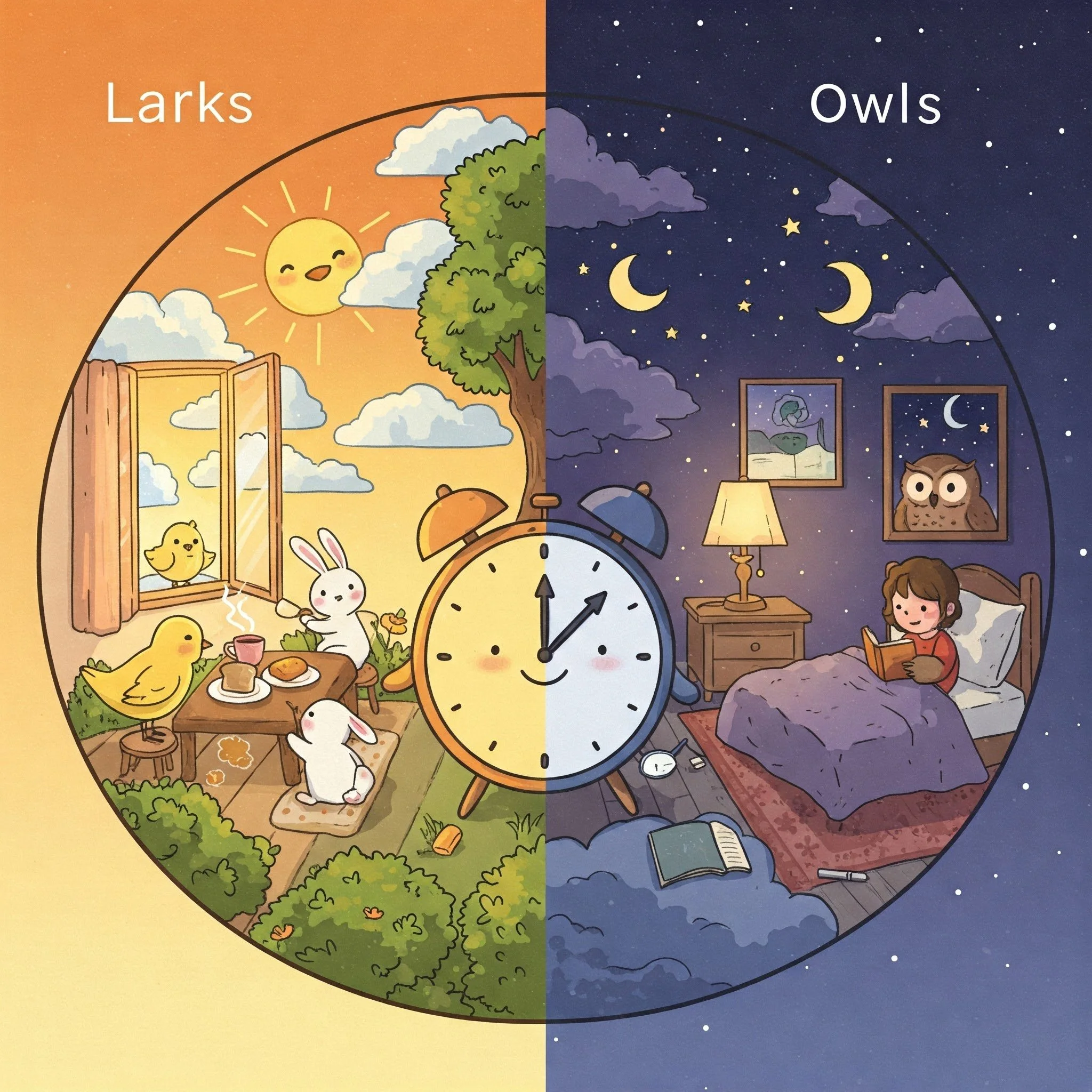
Have you ever noticed how your wake-up time changes drastically over the years? You’re not imagining it. This natural, often frustrating, phenomenon is tied directly to your body's physiological time clock, or chronotype. Understanding this internal rhythm is key to optimizing your health, reducing daily conflict, and improving your overall well-being.
Lark, Owl, or Somewhere in Between?
Your chronotype reflects the time of day you naturally prefer to be active. We typically simplify this into two main types: the Morning type (the Early Bird or Lark) and the Evening type (the Night Owl). While some people spring out of bed before the alarm, others feel utterly crushed by a metaphorical boulder, begging for five more minutes of sleep.
Interestingly, most people fall somewhere in the middle, displaying a flexible blend of traits. About half of your chronotype is determined by genetics, but the rest is shaped by your environment, including light exposure, social activities, and even gender. For example, women are statistically more likely to be early birds than men, who lean slightly toward being night owls, though this difference fades after the age of 50.
The Chronological Rollercoaster: How Your Clock Changes with Age
The most fascinating part of the chronotype is its constant fluctuation, which moves through distinct phases from childhood to old age.
The Childhood Lark
Young children are classic morning types. Their melatonin (the hormone that controls sleep) is secreted earlier than adults, causing them to sleep early and wake early. Evolutionarily, this early-bird tendency might have helped vulnerable children stay in sync with their parents’ active hours, potentially boosting their survival rate.
The Teenage Night Owl
Once puberty hits, hormones cause a major overhaul. Melatonin secretion delays by two to three hours, and the adolescent brain’s sensitivity to light shifts. Teenagers naturally transform into night owls, often staying awake until 1 AM without feeling tired. This later schedule is a biological imperative, not a choice, and may have historically supported group survival by keeping teens vigilant during late hours.
The Adult and Senior Recalibration
After about age 25, as hormones stabilize, the internal clock gradually starts shifting back toward the morning type. By 50, most people have returned to being classic early birds. For older adults, the routine shifts even earlier—sometimes earlier than children's. However, their sleep often becomes fragmented, leading to daytime naps and more frequent nighttime awakenings. This early-rising pattern may have allowed older individuals to take on "guardian" roles, active during the safest time of day to monitor the environment.
The Conflict of Social Jet Lag
While our biological rhythms fluctuate naturally, modern society often imposes a rigid, one-size-fits-all "early bird" schedule on everyone. This rigid structure creates a massive conflict, especially for night owls (hello, teenagers!).
When your internal clock demands late sleep and wake times, but society forces you into an early schedule, you suffer from sleep deprivation and a condition similar to jet lag, aptly named social jet lag. This constant mismatch between your biological need and your daily schedule can severely impact mood regulation and metabolism. Long-term social jet lag increases risks for emotional disorders, obesity, lower athletic performance, and poor academic or work results.
How to Live in Harmony with Your Inner Clock
Understanding and respecting these physiological differences can lead to improved quality of life and even reduce family and workplace conflicts.
For Students and Parents: Acknowledge that a teenager’s later schedule is a natural, biological change, not laziness. Furthermore, studies in the U.S. have shown that delaying middle and high school start times by just one hour significantly increases total sleep time, improves mood, and boosts academic performance. This is one of the most powerful policy changes we can make to help adolescents thrive.
For Professionals: Employers can utilize chronotype awareness to optimize efficiency. Scheduling night owls for night shifts and reducing the frequency of early shifts for morning types aligns the work schedule with an individual's natural sleep "time type." Research confirms that this alignment not only increases work efficiency but also leads to better sleep quality and increased employee well-being.
By listening to the natural turning of our internal clock, we can move beyond simply managing our sleep and instead embrace a lifestyle truly aligned with our inner rhythm.
-
Kim, J. H., et al. (2022). Circadian Rhythm Sleep-Wake Disorders in Older Adults. Sleep Medicine Clinics, 17(2), 241-252.
Hu, J., et al. (2023). Mendelian randomization and colocalization analyses reveal an association between short sleep duration or morning chronotype and altered leukocyte telomere length. Communications Biology, 6(1), 1014.
Vetter, C., et al. (2015). Aligning work and circadian time in shift workers improves sleep and reduces circadian disruption. Curr Biol 25, 907-911.
G. P. Dunster et al., Sleepmore in Seattle: Later school start times are associated with more sleep and better performance in high school students. Sci Adv 4, eaau6200 (2018).
T. Roenneberg et al., A marker for the end of adolescence. Curr Biol 14, R1038-1039 (2004).