Hidden Biology in Teen Sleep
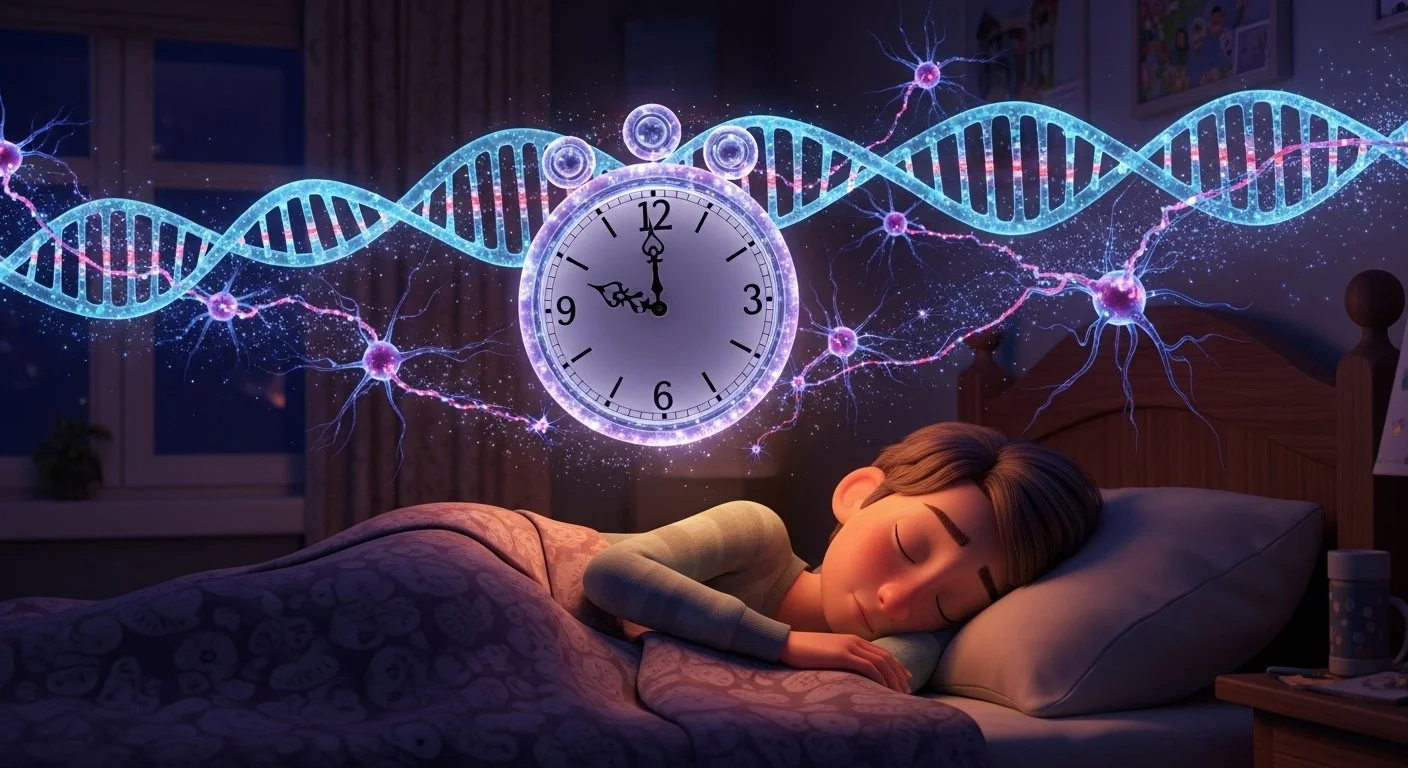
Is your teenager "moody"? Most parents see a grumpy teen and think it’s just a phase. However, the truth can be something else, something much deeper. Sleep deprivation in teenagers has reached epidemic levels, and it is directly linked to the rising rates of anxiety, depression, and self-harm. In this article, you will learn why teen biology makes sleep difficult and how to protect your child’s mental health using science-backed strategies.
Biology (Not Laziness) Is Driving Teen’s Sleep Habits
To help a teenager, we first have to stop blaming them for staying up late. Despite impacts from TikTok or video games; there is indeed a biological shift called a "circadian phase delay."
During puberty, the brain starts releasing melatonin—the hormone that tells us it’s time to sleep—about two hours later than it does in children or adults. This means a teenager’s body isn't biologically ready to sleep until midnight. This is resulted from different biological mechanisms:
A Slower Sleep Drive: the sleep pressure builds up throughout the day. The longer you are awake, the sleepier you feel. In teenagers, this pressure builds up much more slowly. Even if a teen has been awake for 15 hours, their brain doesn’t feel the same "need" to sleep as an adult's brain would. This is combined with a shift in their circadian rhythm (the internal clock), which pushes the release of melatonin to a later hour.
The "Night Watchman" Theory (Evolutionary Benefit): Evolutionary biologists have a compelling theory for why this happens called the Sentinel Hypothesis. In early human history, survival depended on the group being protected from predators or rival tribes 24/7. If everyone in a tribe slept at the exact same time (say, 10:00 PM to 6:00 AM), the group would be vulnerable for eight hours.
By having different age groups with different sleep schedules:
Grandparents (who tend to wake up very early) covered the dawn shift.
Adults covered the middle of the day and evening.
Teenagers and Young Adults (who stay up late) covered the midnight shift.
This "staggered" sleep schedule reduced the time the entire tribe was unconscious and vulnerable by up to 40%. In this light, your teen staying up until 1:00 AM isn't being difficult; they are biologically programmed to be the tribe's "night watchman."
The Drive for "Social Autonomy": There is also a developmental reason. Adolescence is the time when humans are hard-wired to seek independence from their parents and bond with their peers. The late-night hours are often the only time when adults are asleep and teens can interact with one another without supervision. This "vampire" schedule provides a private space for social development, which is a critical milestone in becoming a functional adult.
Taking together, we commonly see teenagers struggling to wake up in the early morning. And When we force them to wake up at 6:00 or 7:00 AM for school, we are essentially asking them to function while their brain is still in a "biological night."
Research published in Nature Communications (2022) highlights that this shift is a universal part of human development. When we ignore this shift, we create a "sleep debt" that accumulates throughout the week. By Friday, many teens are functioning with the cognitive impairment of someone who is legally intoxicated. Understanding that this is a matter of biology, not behavior, is the first step in solving the mental health crisis.
How "Social Jetlag" Is Secretly Damaging Your Teen’s Emotional Health
You have probably heard of jetlag from flying across time zones. But have you heard of "social jetlag"? This happens when there is a massive difference between a teen’s sleep schedule on school days and their schedule on weekends.
Many teens "catch up" by sleeping until noon on Saturdays. While this feels good, it actually resets their internal clock every single weekend. When Monday morning rolls around, their body thinks it is still 3:00 AM. This constant shifting creates a state of permanent physical stress.
A study in the journal Sleep (2023) found that teenagers with high levels of social jetlag—specifically a difference of more than two hours between weekday and weekend mid-sleep times—showed significantly higher markers for depressive symptoms. The brain thrives on consistency. Even if the "perfect" amount of sleep isn't possible every night, keeping the wake-up time within a 60-to-90-minute window every day of the week can stabilize the mood-regulating centers of the brain.
The biggest obstacle to solving sleep deprivation in teenagers is often the structure of the school day. Most high schools start before 8:00 AM, which contradicts every piece of biological evidence we have about the teenage brain.
When a teen is forced to wake up during their biological midnight, they miss out on the most important stage of sleep for mental health: REM (Rapid Eye Movement) sleep. REM sleep happens mostly in the later hours of the night. It is the time when the brain processes emotions and "files away" the day’s memories.
If a teen goes to bed at midnight and wakes at 6:00 AM, they aren't just losing two hours of sleep; they are losing the majority of their emotional processing time. This is why many experts are now calling early school start times a public health issue. Several states have begun passing laws to push start times later, recognizing that an extra hour of sleep in the morning can do more for a teen’s mental health than many medications.
The Brain’s Nightly "Trash Pickup": Why Sleep Deprivation in Teenagers Affects Logic
We used to think sleep was a passive state where the body just rested. We now know that the brain is incredibly active during sleep, performing a process similar to a "nightly trash pickup."
This is handled by the glymphatic system. While we sleep, the space between brain cells increases, allowing cerebrospinal fluid to wash away toxic proteins that build up during the day. In teenagers, whose brains are still under heavy construction, this cleaning process is vital.
When a teen experiences chronic sleep deprivation, these "waste products" stay in the brain. This leads to "brain fog" and an inability to process complex thoughts. This is why a sleep-deprived teen might struggle with a math problem they knew how to do the day before. They aren't "losing" their intelligence; their brain’s hardware is literally cluttered with the leftovers of yesterday’s stress.
Why Teenagers Feel Emotions Twice as Intensity Without Sleep
Have you noticed that a sleep-deprived teen reacts to a small problem—like a lost of socks—as if it’s the end of the world? There is a neurological reason for this.
In the adolescent brain, the amygdala (the emotional gas pedal) is already highly active. Meanwhile, the prefrontal cortex (the logical brake pedal) is still developing and won't be fully "wired" until their mid-20s. Sleep is the glue that keeps these two regions talking to each other.
Research in JAMA Network Open (2021) showed that sleep-deprived adolescents have a "disconnected" brain. The amygdala becomes hyper-reactive to negative images or comments, while the prefrontal cortex fails to step in and say, "Hey, this isn't a big deal." Without enough sleep, a teenager is living in a state of constant emotional high alert. This makes them much more vulnerable to the spiraling thoughts that lead to clinical anxiety and depression.
Moving Beyond "No Phones": Strategies to Support Your Teen’s Biological Needs
We often tell parents to "take away the phone" to solve sleep issues. While blue light is a factor, it is only a small piece of the puzzle. To truly address sleep deprivation in teenagers, we need to focus on "circadian hygiene."
First, encourage them to have the sunlights. Bright, natural sunlight within 30 minutes of waking up is the strongest signal to the brain to "reset" the clock for the day. It tells the brain to stop producing melatonin and start the countdown for when to produce it again 16 hours later.
Second, consider the "Temperature Drop." The body needs its core temperature to drop by about two degrees to initiate sleep. Many teens keep their rooms too warm. A cool room (around 65 to 68 degrees Fahrenheit) can help "trick" the body into sleep mode even if the brain is still buzzing with thoughts.
Finally, we must validate their struggle. When we treat sleep deprivation as a biological challenge rather than a behavioral failure, we reduce the stress that keeps them awake. Encouraging a "wind-down" hour that doesn't feel like a punishment can help bridge the gap between their high-energy evening and the rest they desperately need.
Conclusion
Sleep is a fundamental requirement for teenagers’ mental survival. When we address sleep deprivation in teenagers, we aren't just helping them get better grades—we are giving them the tools to manage their emotions, clear their minds, and build resilience against the pressures of the modern world.
Your teen’s "moodiness" might actually be a cry for rest. Today, take one step: talk to your teen about their "social jetlag" and see if you can work together to find a more consistent rhythm. Their mental health depends on the sleep they get tonight.
-
Dutil, C., Walsh, J. J., Featherstone, R. B., Gunnell, K. E., Tremblay, M. S., & Chaput, J. P. (2022). Influence of sleep on the relationship between social jetlag and mental health in adolescents. Nature Communications, 13(1), 1–12.
Peltz, J. S., Rogge, R. D., & Connolly, H. (2023). The daily and longitudinal associations between social jetlag and adolescent mental health. Sleep, 46(3), 45–58.
Fan, J., Gu, X., & Liu, Y. (2021). Neural mechanisms of emotional dysregulation in sleep-deprived adolescents. JAMA Network Open, 4(10), e2127048.
Samson, D. R., Crittenden, A. N., Mabulla, I. A., Mabulla, A. Z., & Nunn, C. L. (2017). Chronotype variation drives night-time sentinel-like behaviour in hunter-gatherers. Proceedings of the Royal Society B: Biological Sciences, 284(1858).
Samson, D. R., & Nunn, C. L. (2015). Sleep intensity and the evolution of human cognition. Evolutionary Anthropology: Issues, News, and Reviews, 24(6), 225-237.
Troxel, W. M. (2020). Teens Are Driven to Stay Up Late, but Why? RAND Corporation Commentary.
Jenni, O. G., Achermann, P., & Carskadon, M. A. (2005). Homeostatic sleep regulation in adolescents. Sleep, 28(11), 1446–1454.
Taylor, A. B., Jenni, O. G., Mansdotter, A., & Carskadon, M. A. (2005). Sleep tendency during extended wakefulness: Insights into adolescent sleep regulation and behavioral sleepiness. Journal of Sleep Research, 14(3), 239–244.