The Evolution of ADHD: From "Moral Defect" to Circadian Science
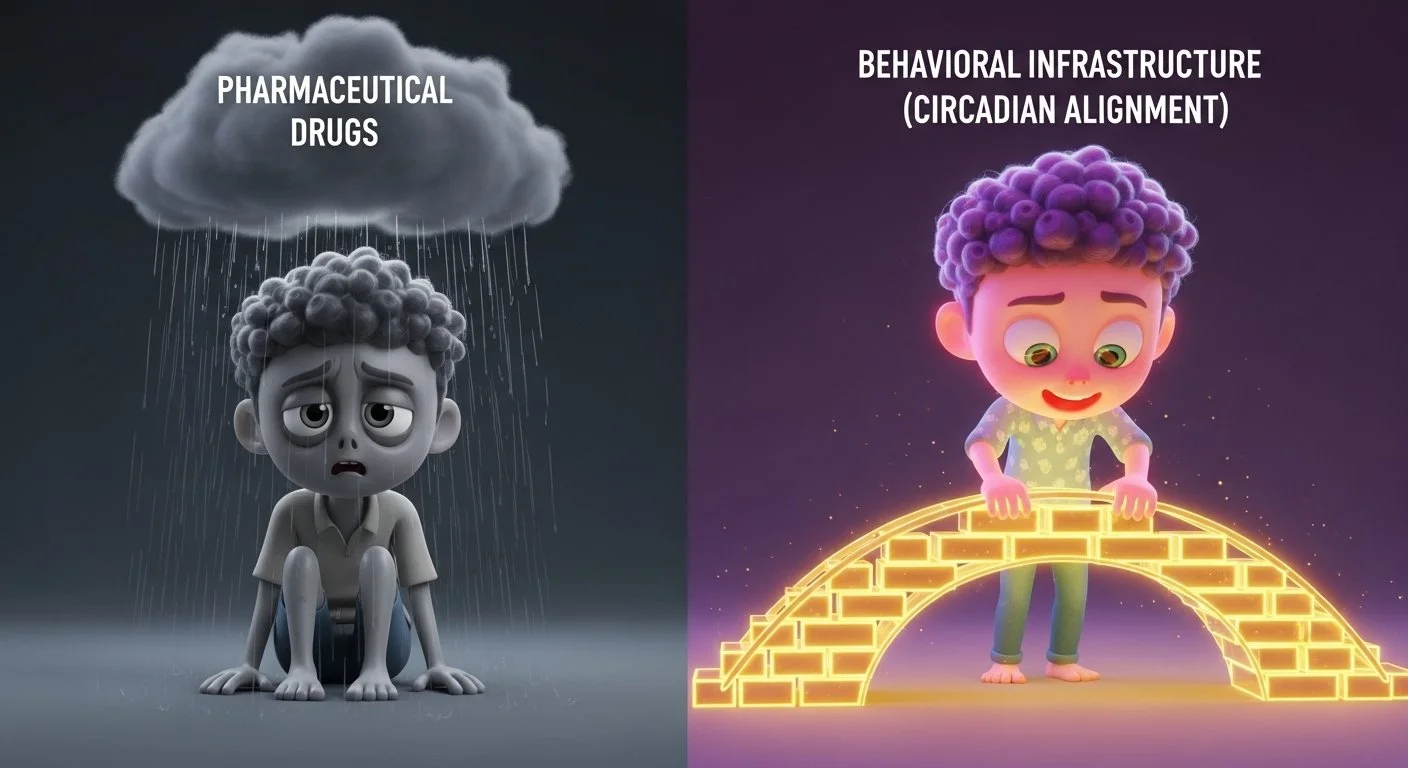
While pharmaceutical treatments like Methylphenidate and Amphetamines are the most common interventions for Attention-Deficit/Hyperactivity Disorder (ADHD), they often come with a "biological tax." Beyond the well-documented suppression of appetite and increased heart rate, many patients experience significant mood-related side effects. These include emotional blunting (a "zombie-like" state), heightened irritability during the "rebound" period as medication wears off, and an increase in physical anxiety. For some, these stimulants can even provoke or worsen underlying mood disorders, leading to a growing interest in behavioral and metabolic therapies that address the root causes of executive dysfunction without the pharmacological trade-offs.
A Brief History of Discovery: How We Defined ADHD
The journey to understanding ADHD has been long and often controversial. It was not always seen as a neurobiological condition; for centuries, it was viewed through the lens of character and discipline.
1798: Sir Alexander Crichton described "mental restlessness" in his book An Inquiry into the Nature and Origin of Mental Derangement, noting some people were born with an inability to attend to one object.
1902: Sir George Still presented lectures to the Royal College of Physicians describing children with a "morbid defect of moral control." He was the first to suggest the condition was biological rather than just "bad parenting."
1950s–1960s: The disorder was termed "Minimal Brain Dysfunction" (MBD) and later "Hyperkinetic Impulse Disorder."
1980: The DSM-III officially named the condition Attention Deficit Disorder (ADD), with or without hyperactivity, shifting the focus from just "fidgeting" to the internal struggle of maintaining attention.
Present Day: We now recognize ADHD as a complex neurodevelopmental disorder involving the prefrontal cortex and the brain's reward system.
What We Know vs. What We Don't Know
Despite decades of research, ADHD remains a puzzle with several missing pieces.
What We Know
Neurotransmitters: We know that ADHD involves a dysregulation of Dopamine and Norepinephrine. The brain either produces too little or the receptors are not "sticky" enough to catch the signals.
Brain Structure: Neuroimaging shows that the prefrontal cortex (the brain impulse controller) and the basal ganglia (responsible for motor control and habits) often develop more slowly in those with ADHD.
Heritability: It is one of the most heritable conditions in psychiatry, with a genetic component estimated at 74–81%.
What We Don't Know
The Precise Trigger: We still don't know why two children with similar genetics might have vastly different symptom severities. The role of epigenetics (how environment turns genes on or off) is the current frontier.
The Microbiome Link: Emerging research is looking at whether gut health influences the brain's dopamine production, but definitive human trials are still pending.
Remission: Why do some individuals "grow out of it" while others struggle into their 70s? The mechanism of adult neuroplasticity in ADHD is still being mapped.
Behavioral Therapy: The Case for a "First-Line" Practice
Many experts argue that Behavioral Therapy should be the first-line practice, especially for children and newly diagnosed adults. The SMART Trial (Pelham et al., 2016) provided robust evidence for this. The trial showed that starting with behavioral modifications—such as organizational training and parent-led contingency management—led to better long-term social and academic outcomes than starting with medication alone.
Behavioral therapy focuses on skill acquisition. While medication provides a temporary chemical "bridge," therapy builds the actual "infrastructure" of the brain, teaching individuals how to manage time, regulate emotions, and break down complex tasks.
The Circadian Connection: Light and Sleep Interventions
ADHD is increasingly characterized as a "disorder of timing." About 75% of adults with ADHD suffer from a Delayed Sleep Phase (DSP), where the body's clock is 2–3 hours behind the standard social clock.
Bright Light Therapy (BLT)
Clinical trials have shown that exposure to 10,000 lux of blue-enriched white light in the early morning can "phase-advance" the circadian rhythm. A 2017 study in European Neuropsychopharmacology found that BLT not only improved sleep but directly reduced core ADHD symptoms like inattention. By resetting the "Master Clock" (the Suprachiasmatic Nucleus), the brain functions more efficiently during daylight hours.
Time-Restricted Feeding (TRF): Metabolic Focus
A groundbreaking area of study involves Time-Restricted Feeding (TRF), often called intermittent fasting. ADHD is increasingly viewed as a "disorder of timing. When the internal circadian clocks are out of sync, ADHD symptoms like brain fog and irritability worsen. TRF acts as a secondary zeitgeber (time-giver). By restricting food to a consistent 8–10 hour window, you force the peripheral clocks to align with the central clock. This synchronization reduces the "internal jetlag" that manifests in ADHD brains.
Evidence from Animal Models
In the Spontaneously Hypertensive Rat (SHR)—the primary animal model for ADHD—researchers found that restricting food intake to specific windows (e.g., an 8-hour window) led to a marked reduction in motor hyperactivity and improved performance on tasks requiring sustained attention.
Researchers observed that TRF triggers a surge in Brain-Derived Neurotrophic Factor (BDNF) in the hippocampus and prefrontal cortex. This "Miracle-Gro" for the brain enhances synaptic plasticity, essentially helping the ADHD-modeled brain "rewire" itself for better impulse control.
Human Clinical Trials
Direct clinical trials specifically for ADHD symptom reduction are in the "emerging" phase. It is important to be candid: we currently lack a large-scale, multi-center Randomized Controlled Trial (RCT) that proves TRF is as effective as stimulants. However, there are promising indirect evince:
There is evidence in human neuroscience that periods of fasting can upregulate dopamine D2 receptor availability. Since the ADHD brain is often "dopamine starved," increasing receptor sensitivity could theoretically make the brain's existing dopamine more effective.
Conclusion
The narrative of ADHD is rapidly shifting from one of "managing a deficit" to one of "optimizing a complex biological system." While pharmaceuticals remain a potent tool for many, the emerging science suggests they are most effective—and least taxing—when used as a supplement to a robust biological and behavioral foundation. The evidence from animal models (like the SHR rat) regarding dopamine receptor sensitivity, combined with the clinical success of "Behavioral-First" approaches (such as the Pelham SMART Trial), underscores a critical truth: the ADHD brain does not just need stimulation; it needs synchronization.
By integrating Bright Light Therapy to anchor the central circadian clock and Time-Restricted Feeding to align peripheral metabolic signals, we address the physiological "timing" issues that lie at the heart of the disorder. This multimodal approach offers a way to bypass the "zombie-like" emotional blunting and irritability often associated with high-dose stimulants. As we move through 2026, the goal for clinicians and patients is to move beyond temporary chemical bridges and toward a personalized framework that respects the unique chronobiology of the ADHD brain—creating a sustainable environment where focus, mood, and long-term brain health can finally flourish in tandem.
-
Arns, M., et al. (2013). "Delayed sleep phase, ADHD and bright light therapy." Journal of Attention Disorders.
Caillet, P., et al. (2023). "The relationship between food timing, melatonin, and cognitive performance in neurodevelopmental disorders." Sleep Medicine Reviews.
Crichton, A. (1798). An Inquiry into the Nature and Origin of Mental Derangement.
Manly, T., et al. (2025). "Metabolic cues and executive function: The role of TRF in ADHD models." Journal of Neuroscience.
Pelham, W. E., et al. (2016). "Treatment Sequencing for Childhood ADHD: A Multiple-Randomization Study." Journal of Clinical Child & Adolescent Psychology.
Sood, A., et al. (2024). "Dopamine receptor up-regulation through intermittent fasting: A pilot study." Frontiers in Psychiatry.
Van Veen, M. M., et al. (2010). "Delayed total sleep time and melatonin rhythms in adults with ADHD." Biological Psychiatry.
Vogel, S. W., et al. (2017). "Circadian rhythm disruption in ADHD: A focus on Bright Light Therapy." European Neuropsychopharmacology.