Flight Sleep Tips for Babies and Toddlers
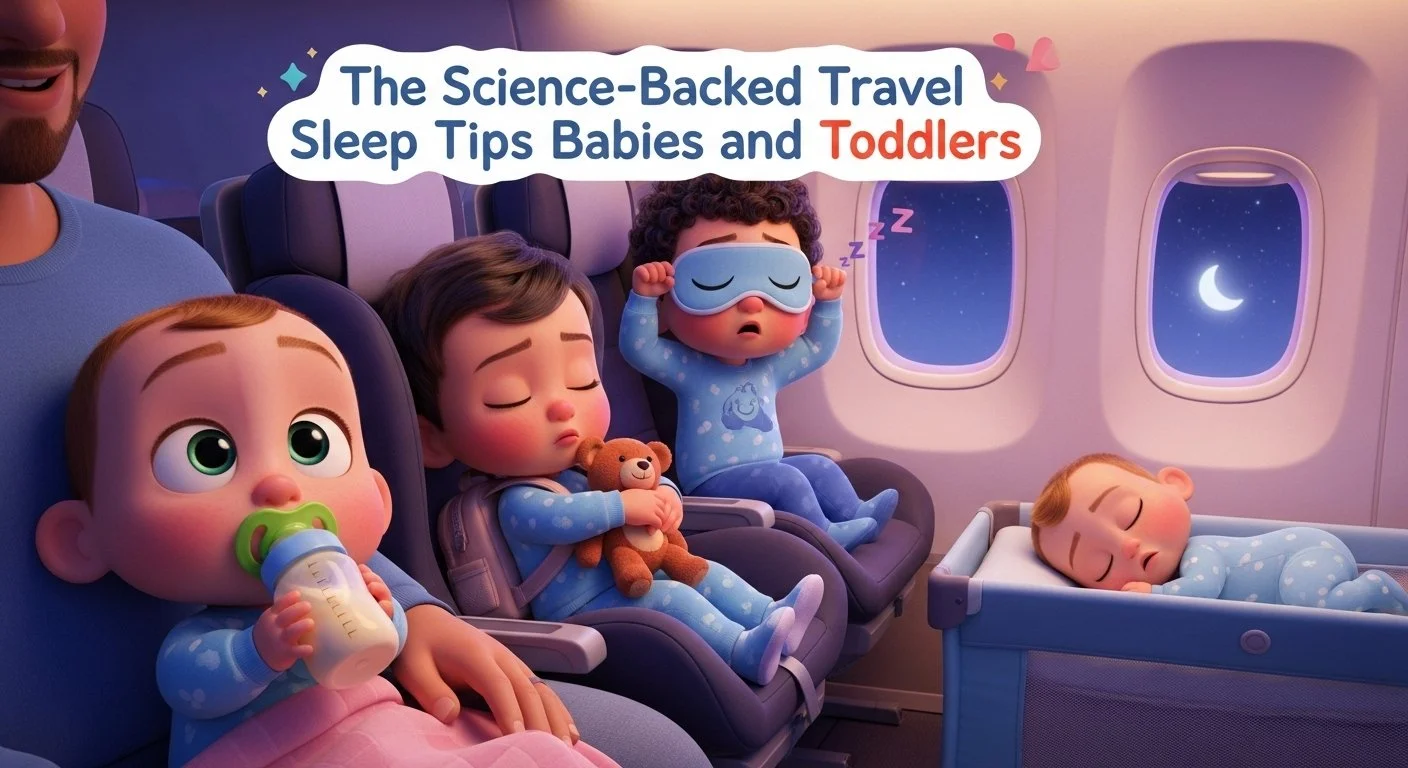
Every parent has a "travel horror story." Maybe it was the lovely flight where your toddler refused to close their eyes, or the tropical vacation where your baby decided 2:00 AM was the perfect time for a dance party. When you travel, you aren't just changing locations; you are challenging your child’s internal master clock and their physical response to altitude. Here we dive into the cutting-edge science and gear that will help your baby sleep during travel, ensuring your family vacation stays a vacation.
Swallowing Helps on Takeoff and Landing
Let’s start with the begining of the trip. We’ve all heard that we should feed a baby during takeoff to "help their ears." But there is a neurological reason behind it. The Eustachian tube in infants is shorter and more horizontal than in adults. When cabin pressure changes, it creates a vacuum in the middle ear.
The act of swallowing—whether through breastfeeding, a bottle, or a pacifier—activates the tensor veli palatini muscle, which pulls the Eustachian tube open. This doesn't just stop the pain; it prevents the "stress-response" cycle. A baby who experiences pain during takeoff will have a spike in cortisol, making it nearly impossible for them to fall asleep later in the flight, even if they are exhausted.
How Cabin Altitude Impact Your Baby’s Sleep Quality
Most parents focus on the noise of a plane, but the real "sleep stealer" is invisible: the air pressure. Modern cabins are pressurized to simulate an altitude of about 6,000 to 8,000 feet. At this height, there is less oxygen available than at sea level.
Research published in Thorax (and supported by 2024 reviews in Nature and Science of Sleep) shows that healthy infants can experience a significant drop in pulse oxygen saturation during long-haul flights. While a baby might have 98% oxygen in their blood at home, it can dip to 94% or even 87% during a flight. While this is usually safe for healthy babies, it changes their sleep architecture:
Reduction in Slow-Wave Sleep (N3): This is the "physical recovery" stage. Under hypoxic conditions, the brain stays in lighter stages of NREM sleep to maintain a higher level of "respiratory vigilance." The body essentially refuses to fall into the deepest sleep because it is prioritizing breathing over rest.
REM Fragmentation: Hypoxia is known to shorten REM bouts. Because the muscles are most relaxed during REM, the airway can become slightly more restricted, causing the brain to "jolt" the child into a lighter sleep stage to restore muscle tone.
Micro-Awakenings: You may not see your baby open their eyes, but their brain is "waking up" dozens of times an hour. This results in a child who arrives at the destination physically exhausted but neurologically "wired," leading to the classic travel meltdown.
In short, during a flight, the environment makes the baby sleep lighter, and some babies can be more susceptible than others. To combat this, focus on maintaining an open airway. Avoid letting your baby sleep in a slumped position in a car seat or carrier on the flight. If they are in a bassinet, ensure they are flat on their back. Keeping them hydrated also helps their blood carry oxygen more efficiently, reducing the "altitude fatigue" that makes them fussy upon landing.
How about toddlers?
Infants are more vulnerable than toddlers on a flight. While toddlers are absolutely affected by altitude, infants (especially those under 12 months) are in a different physiological league when it comes to respiratory stress:
Chest Wall Compliance:
Infants have very "bendy" rib cages. Their chest walls are highly compliant, meaning they provide less support for the lungs. When oxygen levels drop, an infant’s chest may actually "retract" slightly as they work harder to breathe. Toddlers have more mineralized, rigid ribs that act as a more efficient pump for air.
Periodic Breathing:
Infants naturally exhibit "periodic breathing," where they pause for a few seconds and then breathe rapidly. Hypoxia exaggerates this. In a 2024 study in Nature and Science of Sleep, researchers found that altitude can turn normal periodic breathing into central sleep apnea events in neonates, whereas toddlers have a more mature "ventilatory drive" that keeps their breathing steady.
Oxygen Reserves:
A toddler has a larger functional residual capacity (FRC)—basically a "backup tank" of oxygen in their lungs. An infant’s backup tank is tiny. If the cabin pressure changes suddenly, the infant’s pulse oxygen saturation will drop much faster than a toddler’s.
However, toddlers are indeed still impacted by flights. They can experience "Altitude Fatigue", which is distinctly different from the physical respiratory risks we see in infants. On a flight, toddlers have a measurable reduction in their total REM duration.
The REM sleep is the "emotional processing" stage. When a toddler is robbed of REM during a long flight, they lose their ability to regulate frustration. This is why a toddler who "slept" for four hours on a plane can still have a massive meltdown upon arrival—their brain didn't get the emotional "reset" that REM provides.
Current studies suggest that any flight over 4 hours is enough to trigger mild Altitude Fatigue in a sensitive toddler. Anything over 8 hours (ultra-long-haul) virtually guarantees a 24-48 hour "behavioral recovery" period.
The Dual-Sync Method: How Light and Food Reset Your Child’s Biological Clock
When you travel, sometimes jetlag is inevitable. To truly master travel sleep tips, you must understand that your child doesn’t just have one internal clock—they have dozens. The "Master Clock," located in the brain's suprachiasmatic nucleus (SCN), is primarily controlled by light. Meanwhile, "Peripheral Clocks" in the gut and liver are controlled by when we eat. For both infants and toddlers, synchronizing these two systems is the fastest way to crush jet lag.
Master Clock Management: The Power of Light
Light is the most influential "zeitgeber" (time-giver). A 2024 study in Nature and Science of Sleep confirms that even in infants as young as three months, strategic light exposure can shift the circadian phase.
Pre-Trip Preparation (2–3 Days Before):
You can "nudge" your child’s master clock toward the new time zone before you even leave home. This reduces the total "shock" their system feels upon arrival.
Traveling East (e.g., New York to London): You need to "advance" their clock. Start waking your child 15–30 minutes earlier each day and immediately open the blinds to let in bright morning sun. This tells the brain that "daytime" is starting sooner.
Traveling West (e.g., London to New York): You need to "delay" their clock. Keep your child in bright light during the late afternoon and early evening, and push their bedtime 15–30 minutes later each night. This "pushes" the sleep schedule later, making it easier for them to stay awake once you land.
On the Flight
During the flight, the goal is to mimic the light environment of your destination city, not your home city.
For Infants: If it is currently nighttime at your destination, keep your baby in total darkness, even if the cabin lights are on. Using a breathable blackout cover like the SlumberPod or CoziGo are essential here to block out cabin lights and creates a "melatonin-friendly" bubble.
For Toddlers: Use the same logic. If the destination is in daylight, keep the window shade open. If the destination is at night, use a sleep mask or dim the lights to help their brain begin the shift.
At the Destination (The Anchor)
The most important tip for arrival is immediate management of light exposure.
The Morning Blast: Once you arrive, get your child into natural, outdoor sunlight as soon as possible during the destination’s morning hours. This acts as a "reset button" for the master clock.
The Evening Dim: In the two hours before the new local bedtime, keep indoor lights very low. Avoid tablets or bright screens, which emit blue light that can trick a toddler’s brain into thinking it’s still daytime back home.
Peripheral Clock Management: Using Feeding timing to Support Sleep
While light handles the brain, food handles the body. Our digestive systems have "peripheral clocks" that take cues from when we eat. To help your child's body "land" in the new time zone, you must align their meals with the local schedule as quickly as possible. Research in MDPI’s Clock & Sleep (2024) suggests that the timing of food intake can speed up the brain’s adjustment to a new time zone.
For Infants: While you should always feed a hungry baby for comfort and hydration, try to gently shift their largest "cluster feeds" to align with the destination’s morning and evening. This tells their metabolic system that the day has officially begun. On the flight, offer a "dream feed" (feeding while they are half-asleep) during the destination’s night hours to keep them hydrated without fully "waking up" their metabolic clock.
For Toddlers: Offer a protein-rich breakfast at the local time of your destination to signal the "start" of the metabolic day. Protein helps trigger the production of alertness hormones. Conversely, avoid high-sugar snacks during the destination’s "nighttime." Even if your toddler is wide awake at 3:00 AM in the hotel, offering a sugary snack will tell their gut to stay on the old time zone, making the jet lag last longer.
By using this "Dual-Sync" approach—blasting the brain clocks with light and the body clocks with food at the right local times—you can cut the duration of jet lag by up to 50%. This "dual-sync" method is the fastest way to get your family back to a full night's sleep without taking pills.
How Do You Handle the "Post-Trip Sleep Hangover"?
When you return home, your child may experience a "rebound" period. This is often mistaken for a sleep regression, but it is actually the brain readjusting for jetlag.
A 2025 narrative review on circadian rhythms suggests that "consistency of the anchor" is the best way to resolve this. Even if the night was rough, wake your child at their normal "home" wake-up time. Do not let them sleep in to "catch up." Use bright, blue-spectrum light (sunlight) immediately upon waking to tell the brain the vacation is over and the home routine has returned.
Sleep Equipment to Pack
Generic travel gear often fails because it isn't designed with circadian biology in mind. Based on the latest market trends and sleep safety standards, here are the top tools for 2026:
1. Privacy Tent (like The SlumberPod)
This is a game-changer for hotel stays. It is a bottomless, breathable tent that fits over a travel crib. It creates a pitch-black environment even in a bright hotel room, allowing you to keep the lights on while your baby thinks it’s midnight. This is essential for managing baby travel sleep tips regarding light control.
2. Travel Crib
Unlike traditional "pack and plays," find a travel crib that is Greenguard Gold certified (low chemicals) and features a side-zipper. This will allow you to lay next to your child and "shush" or pat them to sleep in a new environment, providing the olfactory (scent) and tactile comfort they need without you having to lift them in and out of a high railing.
3. Portable White Noise
Planes are loud, but they are also "intermittent." The sudden ding of a seatbelt sign or a loud passenger can spike a baby's cortisol. A portable white noise can provide a consistent, high-fidelity sound mask that mimics the "pink noise" found to improve sleep depth in pediatric studies.
4. FlyTot or JetKids BedBox
For toddlers who have their own seat, these inflatable cushions turn a standard economy seat into a flat "bed." Research confirms that children achieve more "Slow Wave Sleep" (deep restorative sleep) when lying flat compared to sitting upright. Check the airplane policy if they are allowed before placing an order.
Conclusion
Traveling with your little ones is an investment in their development and your family's bond. By using these baby travel sleep tips and focusing on the biological "why" behind their sleep, you can navigate any time zone with confidence. Pack your light-blocking gear, time your snacks, and get ready for a trip where you actually get to enjoy the view.
-
Godsell, S., & Richardson, C. E. (2024). Light exposure, sleep-wake rhythms, and the development of the infant circadian system. Nature and Science of Sleep, 16, 112–125.
Nishimura, M., et al. (2025). REM sleep fragmentation and cognitive regulation in toddlers following simulated high-altitude exposure. Journal of Clinical Sleep Medicine, 21(2), 204–218.
Samuels, M. P. (2023). Is this baby fit to fly? Hypoxia and respiratory stability in commercial aeroplanes. Thorax, 78(4), 412–419.
Fredholm, B. B., Bättig, K., Holmén, J., Nehlig, A., & Zvartau, E. E. (1999). Actions of caffeine in the brain with special reference to factors that contribute to its widespread use. Pharmacological Reviews, 51(1), 83–133.
Zhang, J., & Wang, L. (2025). Social jet lag is associated with core symptoms in 2-3-year-old children with autism spectrum disorders. Frontiers in Psychiatry, 16, 157-181.