Beyond Melatonin: Why Sleep in Rett Syndrome is Different

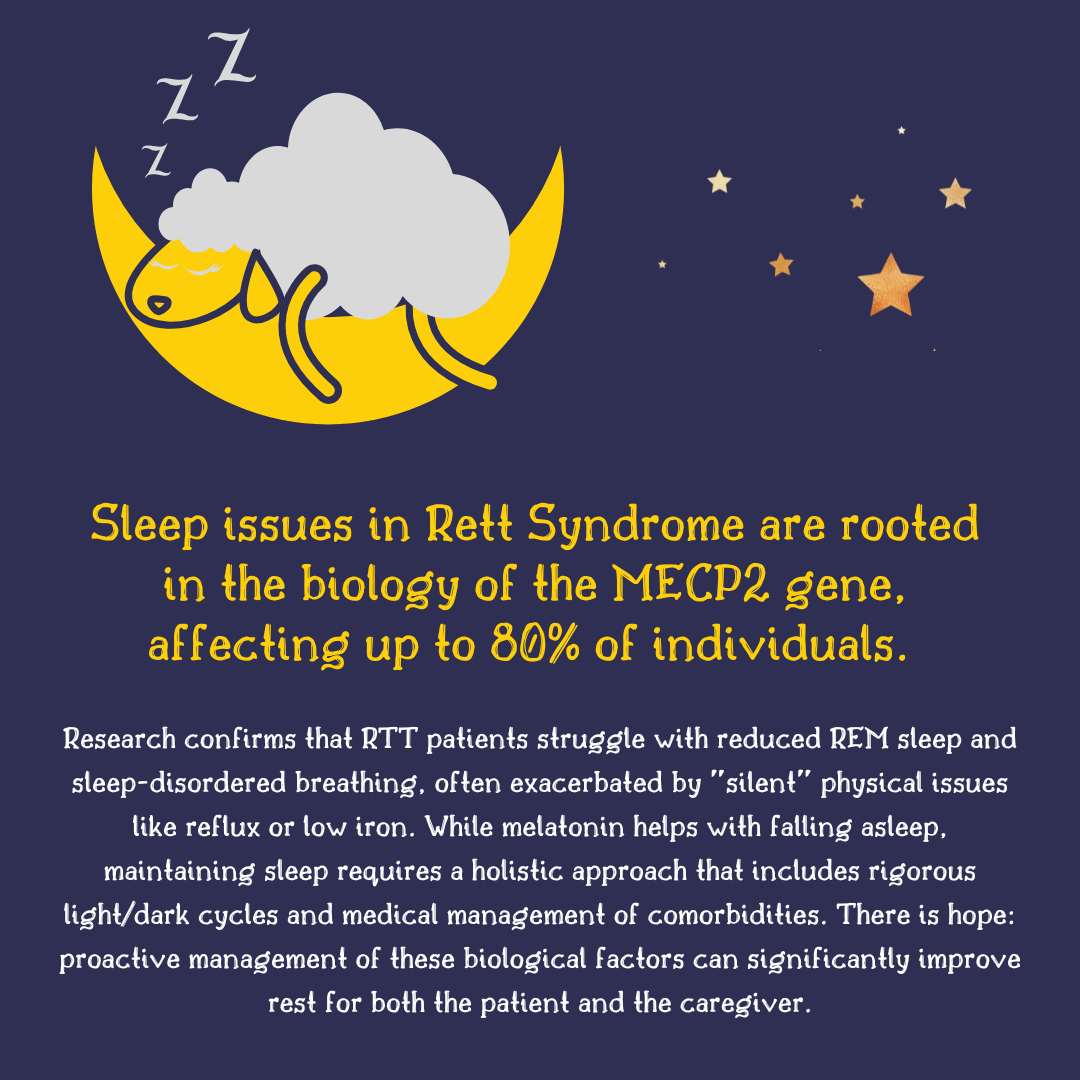
For families navigating Rett Syndrome (RTT), sleep deprivation isn't just an occasional annoyance; it is often a chronic, exhaustion-inducing reality. Research indicates that up to 80% of individuals with Rett Syndrome experience significant sleep disturbances, ranging from difficulty falling asleep to severe nighttime breathing irregularities.
But to solve the problem, we first need to understand the condition itself. Why does Rett Syndrome affect the brain's ability to rest? By understanding the biological reasons behind these wakeful nights, we can move away from frustration and toward targeted, effective management strategies.
What is Rett Syndrome?
Before diving into sleep, it is helpful to understand the "why" behind the diagnosis. Rett Syndrome is a rare genetic neurological disorder that primarily affects females. It is caused by a mutation in the MECP2 gene found on the X chromosome.
Think of the MECP2 gene as a "volume knob" for other genes. It helps regulate the production of proteins that are critical for brain development. When this gene doesn't function correctly, it leads to a period of regression—usually between 6 and 18 months of age—where a child may lose acquired skills like purposeful hand movements and speech.
However, RTT is not just about movement or speech. Because the MECP2 gene is active in many parts of the brain, it affects the autonomic nervous system—the automatic "control center" that manages things we don't think about, like digestion, heart rate, and, crucially, sleep cycles.
What Do Sleep Struggles Actually Look Like in RTT?
If you asked a parent of a child with RTT about their nights, they likely wouldn't just say, "My child wakes up." The sleep disturbances in RTT are distinct and often intense. They go far beyond standard childhood insomnia.
Common "nighttime phenotypes" (behaviors) include:
Nighttime Laughing or Screaming: Sudden, unexplained spells of laughter or crying in the middle of the night. These can be confusing for parents—is she happy? Is she in pain? (Note: These are sometimes related to seizure activity or just behavioral releases).
Bruxism (Teeth Grinding): Loud, rhythmic grinding of teeth that can disrupt the child's sleep and be distressing for caregivers to hear.
Fragmented Sleep: The "popcorn" effect. The child falls asleep, pops awake an hour later, falls back asleep, and pops awake again.
Early Waking: Waking up fully energized at 4:00 AM, ready to start the day as if the sun were up.
These aren't behavioral tantrums. They are signs that the brain's "off switch" is flickering.
Is the "Master Clock" Broken? Understanding the MECP2 Connection
The primary reason for these erratic behaviors lies in the suprachiasmatic nucleus (SCN). Think of the SCN as the brain’s "Master Clock." In a neurotypical brain, this clock tells the body when to release cortisol (to wake up) and when to release melatonin (to sleep).
In Rett Syndrome, this clock is often out of sync. Research published in Frontiers in Sleep (2024) highlights that individuals with RTT often have a fragmented sleep structure. Specifically, they may experience reduced REM sleep (the deep, dreaming phase of sleep) and increased "Wake After Sleep Onset" (WASO).
What this means for you: Your loved one isn't waking up because they are being "difficult." Their brain may literally believe it is daytime. This biological misalignment explains why standard "sleep training" methods often fail in RTT—you cannot train a clock that is biologically set to the wrong time zone.
Why Do Breathing Patterns Change at Night?
One of the most terrifying aspects of Rett Syndrome for caregivers is the change in breathing patterns. You might notice your child holding their breath, hyperventilating, or experiencing apnea (pauses in breathing) while asleep.
This happens because RTT affects the brainstem—the part of the brain that controls automatic functions. A 2022 study by Leoncini and colleagues found that breathing irregularities in RTT are not just a daytime issue. While "breath-holding" is common when awake, sleep-disordered breathing (SDB), including obstructive and central sleep apnea, is highly prevalent at night.
The "Double Whammy": These breathing interruptions do two things:
They physically wake the brain up to restart breathing (causing fragmentation).
They can lead to fluctuations in oxygen levels, which puts the body in a state of low-level "fight or flight" stress, making it nearly impossible to settle back down.
Does Melatonin Actually Work for Rett Syndrome?
When you visit a specialist, melatonin is often the first suggestion. But does the research back it up?
The consensus from recent literature is: Yes, but with realistic expectations.
Melatonin is effective at reducing "sleep latency"—the time it takes to fall asleep. However, it is less effective at keeping a child asleep throughout the night. Since the RTT brain often struggles to maintain a steady release of sleep hormones, a standard dose of melatonin might help at 8:00 PM, but by 1:00 AM, the effect has worn off.
The Safety Profile: Fortunately, melatonin is considered safe for long-term use in this population. However, it should not be the only tool in your kit. Relying solely on melatonin without addressing environmental factors or physical discomfort (like reflux or seizures) often leads to diminishing returns.
What Practical Steps Can You Take Tonight?
Knowing the biology is validating, but you need actionable steps. Based on the "bio-psycho-social" model of care, here are three strategies to trial:
1. The "Iron" Check Before adding heavy sedatives, check the basics. Sleep movement disorders (like Restless Legs Syndrome) are common in RTT and can be worsened by low iron levels. Have your clinician check ferritin levels (iron stores). Supplementing iron (under medical guidance) can sometimes dramatically reduce nighttime thrashing.
2. Optimize the "Cue" Environment Since the internal clock is weak, the external cues must be strong.
Morning: Blast the room with bright, blue-spectrum light (or natural sunlight) immediately upon waking. This anchors the SCN.
Evening: Total blackout conditions are non-negotiable. Even a small nightlight can confuse a sensitive circadian system.
3. Address the "Hidden" Wakers Pain is a silent sleep thief. In RTT, two major culprits often masquerade as insomnia:
Silent Reflux (GERD): Lying flat can cause acid to creep up, causing pain without vomiting. Elevating the head of the bed by 30 degrees can help.
Constipation: A full bowel presses on the bladder and causes discomfort that leads to night waking. Aggressive bowel management is often the best "sleep medicine."
Conclusion: Progress Over Perfection
Sleep disturbances in Rett Syndrome are biological, complex, and incredibly taxing on the whole family. But they are not insurmountable. By shifting your focus from "forcing sleep" to supporting the biological clock and managing physical discomfort, you can find a rhythm that works better for your loved one.
-
Bricker, K., & Vaughn, B. (2024). Rett syndrome: a review of clinical manifestations and therapeutic approaches. Frontiers in Sleep, 3, 1373489.
Leoncini, S., De Felice, C., Signorini, C., Zollo, G., Cortelazzo, A., & Hayek, J. (2022). Breathing abnormalities during sleep and wakefulness in Rett syndrome: clinical relevance and paradoxical relationship with circulating pro-oxidant markers. Frontiers in Neurology, 13, 833239.
Zhang, Z., Smits, G., & Suter, B. (2023). An investigation of the sleep macrostructure of girls with Rett syndrome. Annals of Clinical and Translational Neurology, 11(2), 290–301.