Sleep & Circadian Disruption Fuel Insulin Resistance
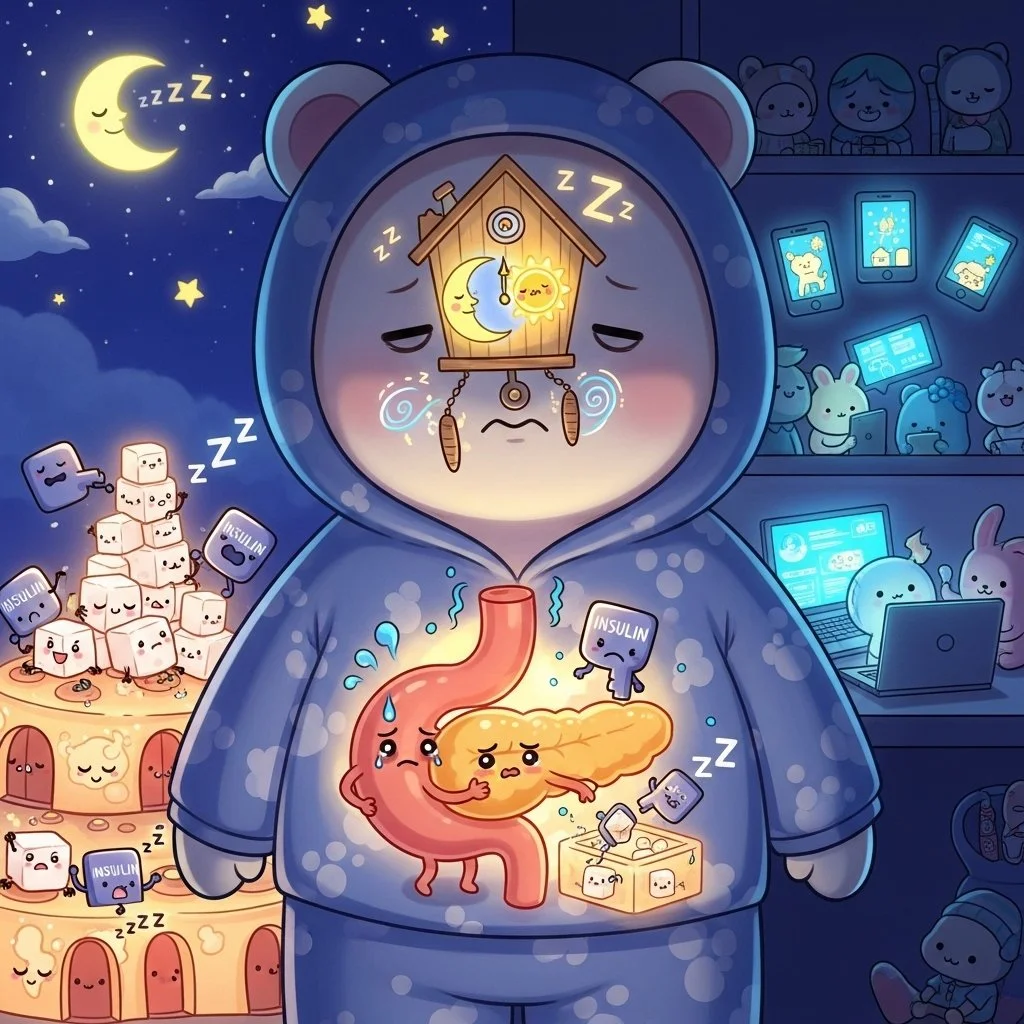
In our hyper-connected, screen-lit world, sleep is often the first thing we sacrifice. We think of it as a nice-to-have, a luxury we can trade for an extra hour of work or streaming. But what if skimping on shut-eye isn't just making you tired—what if it's silently sabotaging your long-term health?
Growing research is issuing a powerful wake-up call: poor or mis-timed sleep actively rewires your metabolism. It's not just about calories and exercise anymore. Your sleep schedule and your body's internal clock are central regulators of how you process energy, and disrupting them significantly raises your risk of conditions like Type 2 Diabetes, heart disease, and obesity.
Metabolic Misalignment
Why does sleep have such immense power over your metabolism? It all comes down to timing.
Your body operates on a precise, 24-hour internal clock—your circadian rhythm. Regulated by specific "clock genes," this rhythm controls essential metabolic processes, dictating when your body expects to secrete insulin, absorb glucose, and manage fuel in the liver.
When these clocks are thrown off—by insufficient sleep, irregular bedtimes, shift work, or frequent jet lag—it creates a metabolic disaster:
Stress Hormones Spike: Disruption increases nervous system activity and elevates cortisol, a stress hormone. High evening/nighttime cortisol is a powerful driver of insulin resistance, which is the state that precedes Type 2 Diabetes.
Appetite Goes Haywire: Sleep loss messes with your hunger hormones. It lowers leptin (the hormone that signals fullness) and raises ghrelin (the hormone that signals hunger). This shift makes you crave food, especially late at night, and promotes weight gain.
Poor Choices Compound: Let's face it: when you're exhausted, you're more likely to grab junk food, skip the gym, and eat erratically. These poor behavioral choices independently drive up diabetes risk.
Taken together, these physiological and behavioral changes create a perfect storm. Even in healthy people, controlled lab studies confirm that short or mis-timed sleep makes cells less responsive to insulin. Your body struggles to clear sugar from your blood, laying the foundation for chronic disease.
Reclaim Your Rhythm
The good news is that these disruptions are largely within your control. Reclaiming your metabolic health requires layered strategies that stabilize your internal clock.
1. Prioritize Consistent Sleep and Light
The single most high-impact strategy is stability.
Fixed Schedule: Aim for a fixed bedtime and wake time—even on weekends. Consistency keeps your central and peripheral clocks aligned. Most adults need 7 to 9 hours of quality sleep.
Manage Light: Bright morning light is your friend; it helps set your internal clock for the day. Conversely, you must avoid bright screens and overhead lights in the late evening, as blue light delays the release of the sleep hormone, melatonin.
2. Adopt Circadian-Aware Eating
It's not just what you eat, but when you eat it.
Prefer Earlier Meals: Your body is naturally less insulin-sensitive at night. Eating a large meal late in the evening worsens your glucose response. Try to concentrate your caloric intake earlier in the day.
Ditch Late-Night Snacks: Even a small snack right before bed can interfere with your body's overnight glucose regulation. Keep your active eating period aligned with your active day.
3. Move Your Body
Regular exercise—both aerobic and resistance—is a potent insulin-sensitizer.
Daily Movement Matters: Moving your body improves your cells' ability to use insulin, independent of weight loss.
Time it Right: When possible, try to schedule your workout during your normal active period, as this can also help re-entrain your circadian rhythm.
🩺 When to Seek Clinical Support
While lifestyle changes are the foundation, don't ignore potential underlying issues.
Check for Sleep Apnea: If you snore, wake up gasping, or have excessive daytime sleepiness, talk to your doctor about screening for Obstructive Sleep Apnea (OSA). OSA is a significant, independent driver of insulin resistance, and treatment (like CPAP) often dramatically improves metabolic health.
Shift Work Strategy: If you work night shifts, try to avoid rapidly rotating schedules. Use bright light during your shift to stay alert and, crucially, block morning light on your commute home to protect your necessary daytime sleep. Avoid heavy meals during the biological night.
-
Singh, T. (2022). Does Insufficient Sleep Increase the Risk of Developing Insulin Resistance? (PMC).
Lee, D. Y., Jung, I., Park, S. Y., et al. (2024). Attention to Innate Circadian Rhythm and the Impact of Its Disruption on Diabetes. Diabetes & Metabolism Journal, 48(1), 37–52. doi:10.4093/dmj.2023.0193.
Xie, F. (2024). Association between night shift work and the risk of type 2 diabetes: a meta-analysis. BMC Endocrine Disorders.
Jiao, Y., Butoyi, C., Zhang, Q., Yuan, G., & Jia, J. (2025). Sleep disorders impact hormonal regulation: unravelling the relationship among sleep disorders, hormones and metabolic diseases. Diabetology & Metabolic Syndrome, 17, 78. doi:10.1186/s13098-025-01871-w.
Pinheiro, M. C., Costa, H. E., Mariana, M., & Cairrao, E. (2025). Sleep Deprivation and Its Impact on Insulin Resistance. Endocrines, 6(4), 49. doi:10.3390/endocrines6040049.